Rodent Anesthesia Systems for Vivarium and Laboratory Research
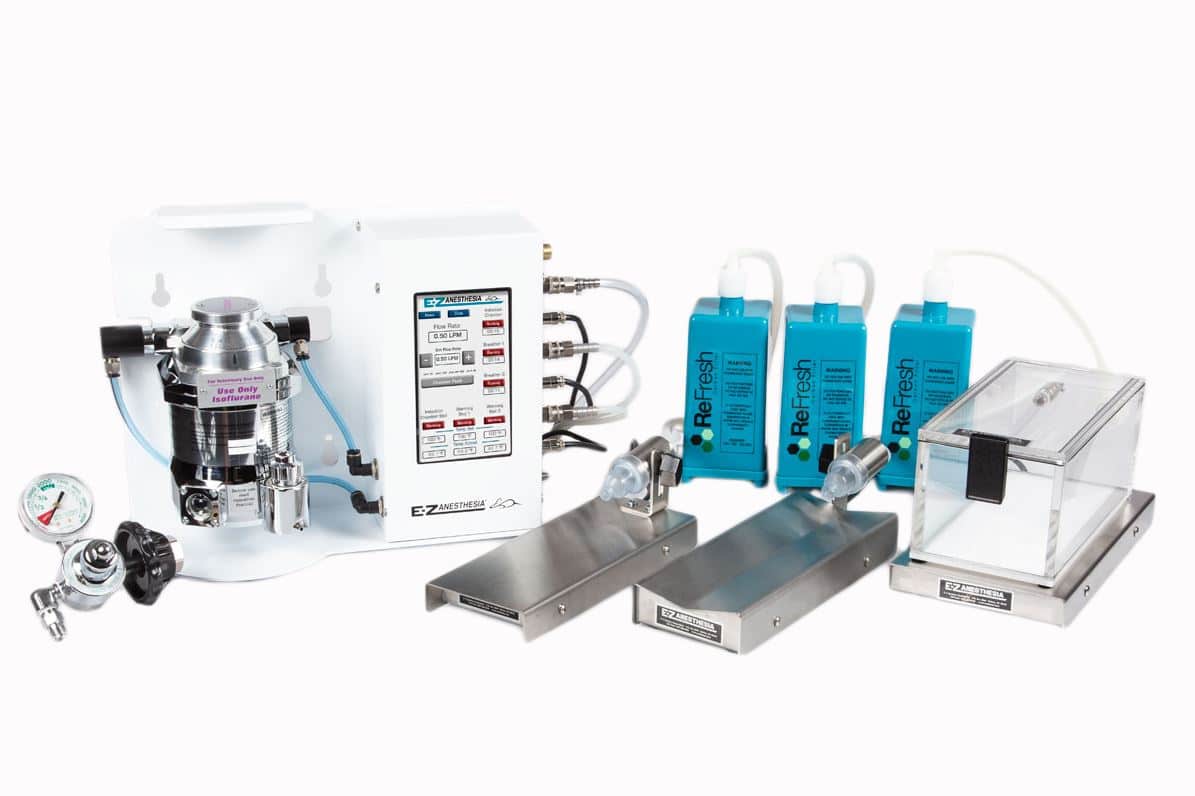
Rodent anesthesia systems deliver precision-vaporized inhalation anesthesia to mice, rats, and other small animals during survival surgery, terminal procedures, in vivo imaging, and stereotaxic work. Each system pairs a calibrated isoflurane vaporizer with regulated oxygen or medical air flow, an induction chamber for onset, and nose cone delivery for maintenance—producing the stable anesthetic depth that IACUC protocols, ARRIVE guidelines, and AAALAC-accredited programs require. ARES Scientific supplies E-Z Anesthesia and EZ Systems platforms across single-station benchtop units and multi-position manifolds, supporting workflows that range from individual procedure rooms to high-throughput core facilities. These systems integrate with broader vivarium equipment programs and serve research teams operating across the vivarium industry.
Configurations Available in This Category
Digital Precision Systems
Digital anesthesia systems such as the E-Z Anesthesia AD-5000 use electronically controlled vaporization to deliver tightly regulated isoflurane concentrations across induction and maintenance phases. Digital control reduces dial drift, improves run-to-run consistency between technicians, and produces a clearer audit trail for studies requiring documented anesthetic depth. These platforms suit reproducibility-sensitive work including pharmacology dosing studies, longitudinal imaging cohorts, and any protocol where anesthetic variability could confound endpoints.
Multi-Station Auto Flow Manifolds
Auto flow systems like the EZ-AF9000 and EZ-7000 Classic use a single induction chamber paired with up to four or five independent maintenance outputs, allowing concurrent procedures across multiple breathing circuits. This configuration matches the throughput needs of stereotaxic surgical suites, perfusion stations, and shared cage change and transfer station environments where several technicians work in parallel. Independent flowmeters at each station allow species-specific or weight-specific titration without disrupting adjacent procedures.
Single-Animal Portable Systems
Compact single-animal platforms such as the EZ-SA800 deliver professional-grade vaporization in a portable footprint suitable for satellite procedure rooms, training labs, and budget-constrained programs. Integrated carry handles and consolidated controls make these systems practical for teams that move between rooms or share equipment across small rodent caging facilities and core labs.
Technical Features and Safety Considerations
Vaporizer Accuracy and Agent Compatibility
Precision vaporizers maintain output within tight tolerances across the clinical range (typically 0.5–5% isoflurane) and require periodic calibration per manufacturer guidance, generally every 12 months or after defined service intervals. Agent-specific vaporizers prevent cross-contamination between isoflurane and other halogenated agents and should be matched to the institutional formulary before purchase.
Waste Anesthetic Gas Scavenging
Scavenging waste anesthetic gas (WAG or WAGD) protects personnel from chronic isoflurane exposure and is required or strongly recommended by most institutional EHS policies, ACGIH guidance, and OSHA recommended exposure limits. Passive scavenging routes effluent through activated charcoal canisters that adsorb halogenated agents and require periodic replacement based on weight gain. Active scavenging connects to facility vacuum or dedicated exhaust and suits higher-volume operations or rooms with limited air changes per hour. Both approaches integrate with broader clean air and containment infrastructure including procedure hoods for terminal work.
Flow Control and Animal Support
Stable low-flow delivery (typically 0.2–1.0 LPM for mice, 0.5–2.0 LPM for rats) requires accurate flowmeters and leak-tight tubing. Most systems integrate with heated platforms, rectal temperature probes, and pulse oximetry to maintain physiological stability during longer procedures—a particular concern for mice, which lose body heat rapidly under anesthesia. Compatibility with procedure lights and stereotaxic frames should be confirmed during planning.
Applications and Regulatory Context
Survival Surgery and Stereotaxic Procedures
Survival surgery in research vivaria requires consistent maintenance depth across procedures lasting from 30 minutes to several hours. Stereotaxic work in particular demands minimal anesthetic variability because depth fluctuations affect respiratory rate, blood pressure, and ultimately the precision of cranial coordinates. Multi-station manifolds support paired surgeries and allow recovery monitoring on adjacent stations.
In Vivo Imaging and Terminal Procedures
Imaging workflows—MRI, microCT, IVIS, ultrasound—require anesthesia delivery compatible with the imaging environment, including non-magnetic components for MRI suites and integration with imaging beds. Terminal procedures and perfusions often pair anesthesia delivery with downstream euthanasia systems or tissue collection workflows requiring rapid transition between anesthetic and post-mortem stages.
IACUC and AAALAC Compliance
Anesthesia equipment selection sits within the broader regulatory framework defined by the Guide for the Care and Use of Laboratory Animals, USDA Animal Welfare Act provisions, and AAALAC International accreditation standards. Documentation requirements typically include vaporizer calibration records, scavenging maintenance logs, and protocol-specific anesthetic regimens reviewed by the IACUC. Research programs operating under these frameworks benefit from equipment selection that supports clear maintenance trails and reproducible delivery.
Selection Guidance for Procurement and Facility Planning
Throughput and Station Count
Programs running fewer than 10 procedures per week typically operate well on single-station systems, while higher-volume cores generally benefit from 3- to 5-station manifolds. Plan for 20–30% headroom above current volume to accommodate study growth and avoid scheduling bottlenecks during high-activity periods.
Species and Procedure Mix
Most platforms support both mice and rats with appropriate induction chamber sizes and nose cone fittings, but verify accessory compatibility before specifying. Procedures requiring extended anesthesia (over 60 minutes) or precise depth control may justify digital systems despite higher initial cost. Programs with mixed species or evolving protocols benefit from modular platforms that accept additional outputs over time.
Facility Integration
Confirm room ventilation, vacuum availability for active scavenging, gas cylinder or piped oxygen access, and electrical specifications during the planning phase. Coordinate placement with adjacent vivarium workflow stations to minimize animal transport between induction and procedure areas. ARES Scientific representatives can support facility walkthroughs and configuration reviews for new builds and renovations.
Frequently Asked Questions About Rodent Anesthesia Systems
What is a rodent anesthesia system used for?
A rodent anesthesia system delivers controlled inhalation anesthesia—most commonly isoflurane in oxygen or medical air—to mice, rats, and other small animals during survival surgery, terminal procedures, stereotaxic work, in vivo imaging, perfusions, and other interventions requiring stable anesthetic depth and reproducible delivery.
What components does a typical mouse or rat anesthesia setup include?
A standard setup includes a precision vaporizer, oxygen or medical air source with regulated flow control, an induction chamber sized for the species, maintenance delivery via nose cone, and a scavenging solution—either an activated charcoal canister for passive scavenging or an active vacuum interface. Most facilities add heated platforms, temperature probes, and pulse oximetry for physiological support.
Is waste gas scavenging required for isoflurane use?
Scavenging is required or strongly recommended by most institutional EHS policies and aligns with ACGIH and OSHA guidance on occupational exposure to waste anesthetic gases. The choice between passive (charcoal canister) and active (vacuum-connected) scavenging depends on procedure volume, room ventilation, and institutional safety policy.
Should I choose a single-station or multi-station system?
Single-station systems suit lower procedure volumes, satellite labs, and specialized work. Multi-station manifolds with three to five independent outputs are preferred for high-throughput surgical cores, training programs, and any environment where multiple animals are maintained concurrently across paired procedures or recovery stations.
Can the same system support both mice and rats?
Yes—most platforms accommodate both species when paired with appropriately sized induction chambers, nose cones, and tubing. Confirm available accessories during purchase and document species-specific flow rates and chamber configurations in your IACUC protocols and SOPs.
How are anesthesia systems calibrated and maintained?
Maintenance includes routine leak checks, replacement of charcoal canisters and consumables based on weight gain or scheduled intervals, periodic vaporizer service and calibration (typically annual), and documentation of all service activity. Calibration follows manufacturer guidance and supports IACUC and AAALAC documentation requirements.
What anesthetic agents are compatible with these systems?
Most rodent anesthesia systems use agent-specific vaporizers calibrated for isoflurane, which is the dominant inhalation agent in research vivaria due to its safety profile, rapid onset and recovery, and low metabolic burden. Sevoflurane-compatible vaporizers are available for specialized applications. Agent substitution requires a vaporizer matched to the new agent.
About Anesthesia System Procurement Through ARES Scientific
ARES Scientific distributes E-Z Anesthesia and EZ Systems rodent anesthesia platforms alongside the broader animal and vivarium equipment portfolio, supporting research institutions, contract research organizations, pharmaceutical developers, and academic medical centers. Configuration support, facility planning input, and equipment integration with adjacent vivarium workflows are available through regional ARES Scientific representatives serving programs across the vivarium and laboratory sectors.