Cage Change and Transfer Stations for Research Vivariums
ARES Scientific supplies industry-leading cage change and transfer stations from Baker and the ARES Flow Line, engineered to deliver operator safety, allergen control, and workflow efficiency in research vivarium facilities. Whether processing dozens or hundreds of cages per day, our change and transfer stations are built for ergonomics, containment, and compliance with AAALAC, GLP, and institutional animal care standards.
Cage change operations are mission-critical in any vivarium—they directly impact animal welfare, technician health, and study integrity. Our equipment integrates vertical laminar airflow, stainless steel construction, HEPA filtration, integrated weighing surfaces, and modular design to minimize allergen exposure, cross-contamination, and repetitive strain injuries.
Baker Authorized Cage Change & Transfer Stations
ARES Scientific is an authorized Baker distributor offering the full range of
Baker SterilGARD® and AniGARD® animal transfer stations. Baker has engineered these systems to meet the strictest vivarium requirements—ISO Class 4 (Class 10) or better HEPA-filtered air cleanliness, adjustable work surfaces, and sealed transfer pathways that protect both animals and staff.
Baker SterilGARD® e3 with Adjustable Mobile Lift
The
SterilGARD e3 combines a Class II, Type A2 biological safety cabinet footprint with a continuously adjustable electric-hydraulic lift system (22" to 40.5" work surface height). This design accommodates technicians of varying heights, reduces back strain during prolonged cage processing, and allows seamless integration with existing rack systems. The adjustable work surface can be lowered for inventory inspection or raised for ergonomic standing work, making it ideal for high-volume facilities processing mixed cage types and sizes.
Baker AniGARD® e3 with HEPA Filtration
The
AniGARD e3 delivers ISO Class 4 (Class 10) HEPA-filtered air cleanliness across the entire work surface, suppressing cage dust, allergens, and dander before they reach the technician's breathing zone. Its slanted viewscreen and spacious work deck accommodate rodent, rabbit, and ferret cage configurations with minimal repositioning, reducing handling time and animal stress. The flat work surface allows cages to slide in and out quickly, supporting rapid cage turnover in barrier and conventional vivarium workflows.
ARES Flow Line: Proprietary Cage Change & Bedding Management Systems
ARES Scientific partnered with
Sychem to develop the ARES Flow Line—an integrated suite of vivarium workstations engineered specifically for North American research facilities. The ARES Flow Line includes specialized equipment for cage change, bedding handling, and allergen control, all built with stainless steel construction, advanced filtration, and modularity to match facility footprints and protocols.
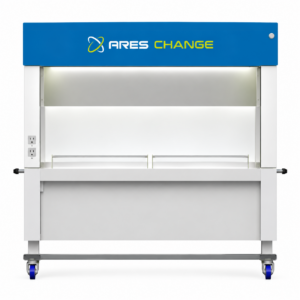
ARES Change Animal Transfer Station
The
ARES Change delivers ISO Class 3 air cleanliness via proprietary Active Airflow Technology with H14 HEPA filtration and high-velocity laminar downflow. Dual-access work areas allow two technicians to work simultaneously, increasing throughput in multi-shift vivarium operations. Integrated containment zones separate soiled cages from clean stock, reducing cross-contamination risk and operator exposure. The modular design accommodates custom shelf heights and cage configurations.
ARES Fill Automatic Animal Bedding Dispenser
Precision bedding dispensing (±4% accuracy) ensures reproducible study conditions and minimizes bedding waste. The
ARES Fill integrates seamlessly with cage change workflows, allowing technicians to prepare fresh cage setups at the same workstation where cages are being processed. Programmable dispensing volumes accommodate standard rodent cages, large animal enclosures, and IVC systems without manual adjustment between cage types.
ARES Waste Animal Bedding Disposal Station
The
ARES Waste provides sealed, filtered disposal of soiled cage bedding and waste directly at the change station. Multi-stage HEPA filtration captures allergens and particulates, protecting technicians from dust clouds and biohazard exposure. Universal cage compatibility, large work surfaces, and integrated waste chutes streamline the full cage-change cycle without separate transfers to distant disposal areas.
Key Features & Technology Comparison
Filtration & Air Cleanliness
Both Baker and ARES Flow stations use HEPA (H13/H14) filtration to achieve ISO Class 3–4 air cleanliness. Baker's vertical laminar downflow design protects the technician's breathing zone during cage insertion; ARES Flow's Active Airflow Technology provides high-velocity stratified air movement to suppress allergens across the entire work surface and dual-access areas. For barrier-room protocols, both systems can integrate ducted exhaust to isolated exhaust stacks, preventing cross-room contamination.
Stainless Steel & Sanitation
All change stations feature fully welded 304 or 316 stainless steel construction, rounded corners, and nozzle-free surfaces for fast cleaning and inspection. Both Baker and ARES Flow designs are wash-down compatible and compatible with
cage and rack washers, allowing full decontamination cycles without disassembly.
Ergonomics & Workflow Integration
Baker's adjustable lift system (SterilGARD e3) excels for variable-height teams and mixed cage types. ARES Flow's integrated bedding dispensing and disposal modules support single-workstation cage processing, reducing technician movement and fatigue. Both support push-button or foot-pedal controls for hands-free operation when technicians are handling animals.
Modularity & Custom Configuration
ARES Scientific can design custom shelf arrangements, drawer systems, and transfer bins to match your facility's cage types, IVC racks, and protocol requirements. Baker systems integrate well with standard laboratory cabinetry and existing ventilation infrastructure. Both support modular expansions as vivarium workflows evolve.
Applications & Regulatory Alignment
AAALAC & Institutional Compliance
Cage change and transfer stations are core infrastructure for AAALAC International accreditation. They demonstrate commitment to technician occupational health (allergen control) and animal welfare (minimized handling stress). ARES supplies equipment configurations aligned with the Guide for the Care and Use of Laboratory Animals and institutional IACUC protocols. As an
authorized Baker distributor, we ensure your facility has access to industry-standard Class II animal transfer stations that meet the highest compliance standards.
Vivarium Workflow Integration
Change stations sit at the intersection of housing, procedure, and sanitization workflows. Positioning them adjacent to
automated cage washers, bulk bedding storage, and procedure areas reduces cage-handling distance and cross-contamination risk. The ARES Flow Line, developed in partnership with
Sychem, integrates bedding dispensing and disposal directly into the change station, eliminating separate handling steps and streamlining the entire cage-change cycle. ARES Scientific provides layout guidance for facility redesign or optimization projects.
Barrier & Conventional Room Operations
Barrier rooms require sealed transfer bins and dedicated filtration to prevent pathogen migration. Conventional rooms prioritize cost-efficiency and throughput. ARES supplies equipment for both configurations, with filter cartridge options and ducting packages tailored to your room classification.
Frequently Asked Questions
What is the difference between a baker change station and an ARES Flow Line change station?
Baker stations (SterilGARD e3, AniGARD e3) are Class II biological safety cabinets with animal-specific refinements: adjustable work surfaces, welded stainless steel, integrated caster systems. They excel in facilities with complex IVC systems or mixed cage workflows. ARES Flow Line stations are purpose-built for vivarium cage processing, integrating bedding dispensing, waste disposal, and dual-access work areas into a unified module. Both achieve ISO Class 3-4 air cleanliness; choose based on facility layout, throughput, and integration preferences.
Does HEPA filtration in a change station reduce allergen exposure?
Yes. HEPA-filtered vertical or stratified laminar airflow suppresses cage dust, dander, and animal allergens before they reach the technician's breathing zone. Studies show that properly maintained HEPA change stations reduce occupational allergen exposure by 85–95% compared to uncontained cage processing. Filter replacement every 6–12 months maintains rated performance.
Can I use a change station for both rodent and rabbit cages?
Yes. Both Baker and ARES Flow stations have adjustable access openings (14"–16" high) and spacious work decks that accommodate
rodent cages,
rabbit enclosures, and
ferret systems. Height-adjustable work surfaces (Baker SterilGARD e3) or modular shelf arrangements (ARES Flow) allow quick transitions between cage types without repositioning heavy equipment.
Are change stations compatible with automated cage washers?
Yes. Both Baker and ARES Flow change stations feature fully welded stainless steel with rounded corners and nozzle-free surfaces, supporting full wash-down cleaning. Cages processed at a change station can move directly to automated cage washers (Baker, ARES Cool, or Steelco washers) without intermediate handling.
What maintenance do change station filters require?
HEPA filter cartridges should be inspected monthly and replaced every 6–12 months, depending on cage traffic volume and facility air quality. Pre-filters (dust collection stage) may require more frequent replacement in high-traffic vivariums. ARES provides filter kits and maintenance protocols specific to each model.
Can I integrate a change station into a barrier room protocol?
Yes. Both Baker and ARES Flow stations can be ducted to isolated exhaust stacks, preventing air recirculation into common areas. Transfer bins with quick-open lids support sealed cage movement between clean and dirty zones. ARES Scientific provides custom ducting packages and HEPA cartridges rated for barrier-room exhaust loads.
How much floor space do change stations require?
Baker SterilGARD e3 and AniGARD e3 occupy ~4' × 3' footprints (180–200 sq. ft. with work tables). ARES Flow systems range from 5' × 4' (single-station) to 8' × 6' (dual-station with integrated bedding handling). ARES provides 3D layout drawings and floor-space optimization recommendations during specification.
Why Choose ARES Scientific for Cage Change & Transfer Equipment
ARES Scientific is an authorized Baker distributor and exclusive ARES Flow Line partner, giving you access to the industry's most trusted animal transfer systems alongside an innovative proprietary alternative. Our expertise spans vivarium design, equipment specification, installation coordination, technician training, and lifecycle service support. We help you right-size your change station to facility footprint, throughput, protocol requirements, and budget, ensuring your investment delivers measurable reductions in allergen exposure, handling time, and operational disruption.
Featured Cage Change & Transfer Stations Products
Explore the complete range of
cage change and transfer stations available through ARES Scientific, including Baker SterilGARD e3, Baker AniGARD e3, ARES Change, ARES Fill, and ARES Waste.
Integrated Vivarium Solutions
Cage change is one component of a complete vivarium ecosystem. ARES Scientific also supplies
animal transport equipment for inter-room workflows—seamlessly connecting cage change operations with safe movement between housing and procedure areas. After cage processing, cages move to
automated cage wash systems for full decontamination cycles without intermediate handling.
To optimize cage-change workflows, integrate
bedding fill and disposal systems like the ARES Fill dispenser and ARES Waste disposal unit directly into your change station—eliminating separate bedding handling steps and reducing technician fatigue. Complement these with compatible
rodent caging,
rabbit caging, and
ferret caging systems. Contact us for facility-wide optimization consulting.