Introduction to Rodent Caging Systems for Research Vivariums
ARES Scientific supplies individually ventilated cage (IVC) rack systems, heated housing platforms, and high-density rodent caging solutions for research institutions, pharmaceutical laboratories, and academic vivarium facilities.
Following the acquisition of Animal Care Systems in January 2026, ARES Scientific now distributes the full ACS product catalog — including the OptiMice and OptiRat IVC rack families — alongside a broader selection of vivarium equipment and supplies for complete facility outfitting.Learn more about the ARES Scientific and Animal Care Systems partnership.
Selecting the right rodent housing system requires balancing animal welfare requirements, facility space constraints, ventilation infrastructure, and research protocol demands. IVC rack systems provide individual cage-level biocontainment and ventilation, making them the standard choice for immunocompromised mouse colonies, infectious disease models, and multi-investigator facilities where cross-contamination risk must be minimized.
Heated and environmentally controlled systems add precise thermal management for neonatal housing, metabolic studies, and species with specific thermoregulatory needs. All rodent caging systems carried by ARES Scientific are compatible with standard cage change and transfer station workflows and automated cage wash systems for streamlined vivarium operations.
IVC Rack Systems from Animal Care Systems
The Animal Care Systems IVC rack lineup available through ARES Scientific is built around passive convection‑assisted, low‑velocity, one‑pass airflow technology — eliminating motors and blowers from individual rack units.
This approach creates quieter, vibration‑free holding rooms that reduce animal stress and support more reproducible research outcomes. All ACS IVC rack systems are backed by a five‑year parts and labor warranty.
ARES OptiMice II IVC System
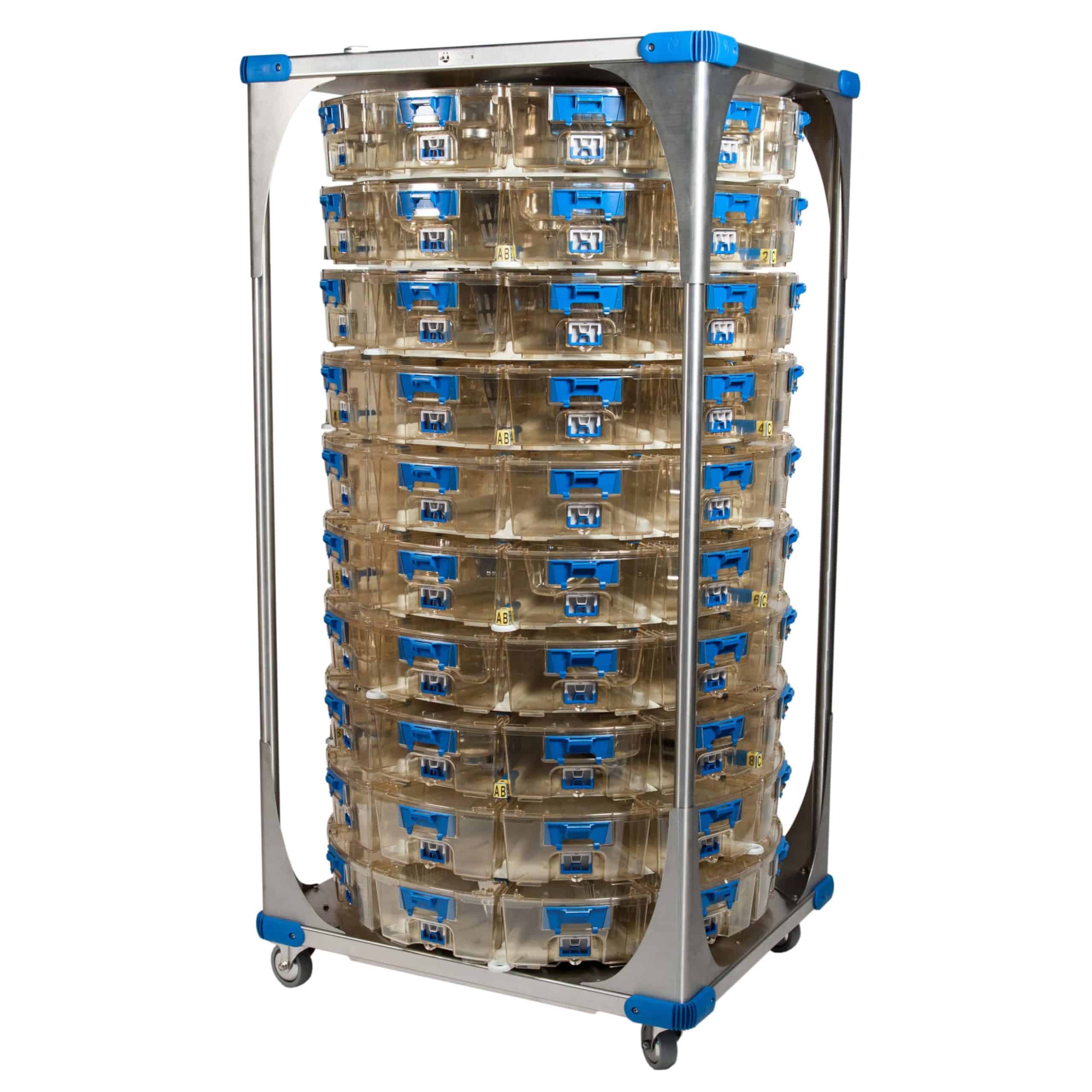
The ARES OptiMice II IVC System delivers the highest cage density on the market at 110 cages per square meter while maintaining backward compatibility with existing OptiMice cages.Read how high‑density IVC systems increase vivarium capacity without facility expansion.
This system utilizes convection‑assisted, low‑velocity, one‑pass airflow technology without motors or blowers, eliminating unwanted noise, vibrations, and odors. The reinforced polymer carousel and stainless steel construction withstand rigorous autoclave and dry‑heat sterilization cycles, while a single 4‑inch exhaust hose connection simplifies installation.
Animal Care Systems OptiMice Rack
The original Animal Care Systems OptiMice Rack supports facilities with existing cage inventories requiring backward‑compatible rack upgrades. Each assembly includes 100 cages and can be configured with water bottles or internal auto‑water systems. Airflow requirements per rack: 45 CFM minimum, 60 CFM recommended. Fits through standard 36‑inch (91 cm) doors with cages removed.
OptiRat GenII Rack
Rat, hamster, gerbil, and multi‑species housing is available through the OptiRat GenII Rack. Built on the same motor‑free, exhaust‑ventilated technology as all ACS caging systems, the rotating carousel provides easy cage access without moving racks. Rack dimensions: 39.7″ L × 39.0″ W × 76.5″ H. Capacity: 42 cage stations. Airflow: 55 CFM minimum, 82 CFM recommended. Five‑year parts and labor warranty.
OptiRat Plus Rack
The OptiRat Plus Rack offers a multi‑level design with mezzanine for rats and other large rodents. The wide interior allows intra‑cage enrichment and permits rats to stand upright. Water bottles are externally located to allow changing without opening cages. Rack dimensions with cages: 41.0″ L × 39.7″ W × 78.0″ H. Capacity: 30 cage stations.
Heated and Environmentally Controlled Caging Systems
Heated and environmentally controlled systems add precise thermal management for neonatal housing, metabolic studies, and species with specific thermoregulatory needs.
The SMART System Warming Rack is an IVC rack system that offers 10 heated mouse cage stations with heated comfort under a portion of the cage floor. Mice can self‑select their thermal comfort zone, providing a superior home‑cage advantage for neonatal development and metabolic research. The system is built on the same motor‑free technology as standard ACS racks.
Technology and Airflow Features of ACS Rodent Caging
All Animal Care Systems IVC racks operate on a unique motor‑free, exhaust‑ventilated technology that integrates directly with building HVAC exhaust systems.
Rather than relying on blowers within each rack, ACS systems use passive convection‑assisted airflow driven by the room’s negative pressure. This design eliminates electrical consumption for individual rack operation, reduces maintenance requirements, and removes sources of noise and vibration that can stress laboratory animals. In case of a power failure, ACS caging continues to ventilate passively, a unique safety feature.
Airflow Requirements and HEPA Filtration
ACS IVC racks are designed for one‑pass, low‑velocity airflow with total volume air changes. Typical air change rates exceed 50‑70 ACH per cage, maintaining optimal air quality and removing ammonia and other contaminants. When integrated with facility HEPA filtration systems, ACS racks provide ISO Class 5‑equivalent microenvironmental air quality. The pie‑shaped cage design promotes laminar airflow from front to rear, capturing and carrying airborne contaminants to the exhaust port.
Applications and Regulatory Compliance for Rodent Caging
Rodent caging systems must comply with multiple regulatory frameworks including the Guide for the Care and Use of Laboratory Animals (8th edition), AAALAC International standards, and PHS Policy on Humane Care and Use of Laboratory Animals.
ACS IVC systems are designed to meet or exceed space requirements for mice (minimum 15 in² per adult mouse) and rats. The OptiMice II’s 110‑cage density increases capacity by approximately 40% compared to traditional IVC racks, allowing facilities to maximize animal housing without increasing floor space.
AAALAC‑accredited facilities require documented housing density policies, with IACUC oversight of any overcrowding exceptions. ACS systems support compliance with detailed cage identification standards including unique cage ID, dam ID, genotype information, and breeding status. For facilities using NIH or other PHS‑supported activities, ACS caging provides documentation‑ready environmental monitoring capabilities.
Selection and Procurement Guidance for Rodent Caging
Selecting the right rodent housing system requires evaluating cage density requirements, facility ventilation infrastructure, species and strain needs, and compatibility with existing cage inventories.
Facilities with existing OptiMice cages can upgrade to the OptiMice II system while maintaining backward compatibility. For mixed‑species programs, OptiRat racks accommodate rats, hamsters, gerbils, and even invertebrates. Labs requiring specialized thermal management should consider the SMART System heated cage stations.
Space Planning and Vivarium Design
The OptiMice II houses 110 cages in just one square meter of floor space — approximately 40% more capacity than traditional 70‑80 cage racks. The rotating carousel design eliminates the need for dual‑sided aisles, reducing overall room footprint requirements. All ACS racks fit through standard 36‑inch (91 cm) doors with cages removed.
Compatibility with Other Vivarium Equipment
ACS caging systems are compatible with standard cage change stations, automated cage wash systems, and bottle filling stations. The motor‑free design eliminates electrical requirements, simplifying installation and reducing fire code considerations compared to blower‑based IVC racks.
Frequently Asked Questions About Rodent Caging
What cage density does the OptiMice II IVC system provide?
The ARES OptiMice II delivers industry‑leading density of 110 mouse cages per square meter of floor space — approximately 40% more capacity than traditional IVC racks.
How does motor‑free IVC technology work?
ACS racks use passive convection‑assisted, low‑velocity, one‑pass airflow driven by the room’s HVAC exhaust system rather than motors or blowers within the rack. This eliminates noise, vibration, and electrical consumption while providing automatic fail‑safe ventilation.
What species can be housed in ACS cages?
ACS racks accommodate mice (OptiMice lines), rats, hamsters, gerbils, deer mice, guinea pigs, and wild‑caught rodents. OptiRat models also support invertebrates when needed.
What are the airflow requirements for ACS racks?
OptiMice racks require 45 CFM minimum, 60 CFM recommended. OptiRat models require 55 CFM minimum, 82 CFM recommended. Systems connect to facility HVAC exhaust via a single 4‑inch hose.
Are ACS cages autoclavable?
Yes. The reinforced polymer carousel and stainless steel components withstand rigorous autoclave and dry‑heat sterilization cycles.
How does the rotating carousel improve workflow?
The carousel rotates on low‑friction bearings, allowing operators to access any cage from a single working position without moving the rack or forming large aisles between racks.
What is the warranty on ACS IVC rack systems?
All Animal Care Systems IVC rack systems distributed by ARES Scientific are backed by a five‑year parts and labor warranty.
Do ACS racks require electrical power?
No. The motor‑free technology requires no electrical connection for individual rack operation, simplifying installation and eliminating electricity costs.
Does ARES Scientific offer assisted living cages?
Contact ARES Scientific directly to discuss specialized housing needs including assisted living cages for research protocols requiring enhanced monitoring or support.
About Rodent Caging Procurement Through ARES Scientific
ARES Scientific serves as a full‑service distributor and manufacturer’s representative for Animal Care Systems rodent caging and complementary vivarium equipment.
With the January 2026 acquisition, ARES Scientific now offers direct access to the complete ACS product catalog including OptiMice and OptiRat IVC rack families, heated caging solutions, and specialized configurations. Our vivarium equipment specialists assist with space planning, cage density calculations, workflow integration with cage change stations, and compatibility with automated cage wash systems.
All ACS systems are backed by a five‑year parts and labor warranty with factory‑trained technical support. For facilities planning new vivarium construction or expanding existing animal facilities, ARES Scientific provides detailed capacity modeling and regulatory documentation support for AAALAC accreditation, IACUC protocols, and PHS Policy compliance.
Use our vivarium cage density and capacity calculator to estimate requirements, or browse the full vivarium equipment and supplies category for complete facility outfitting solutions.