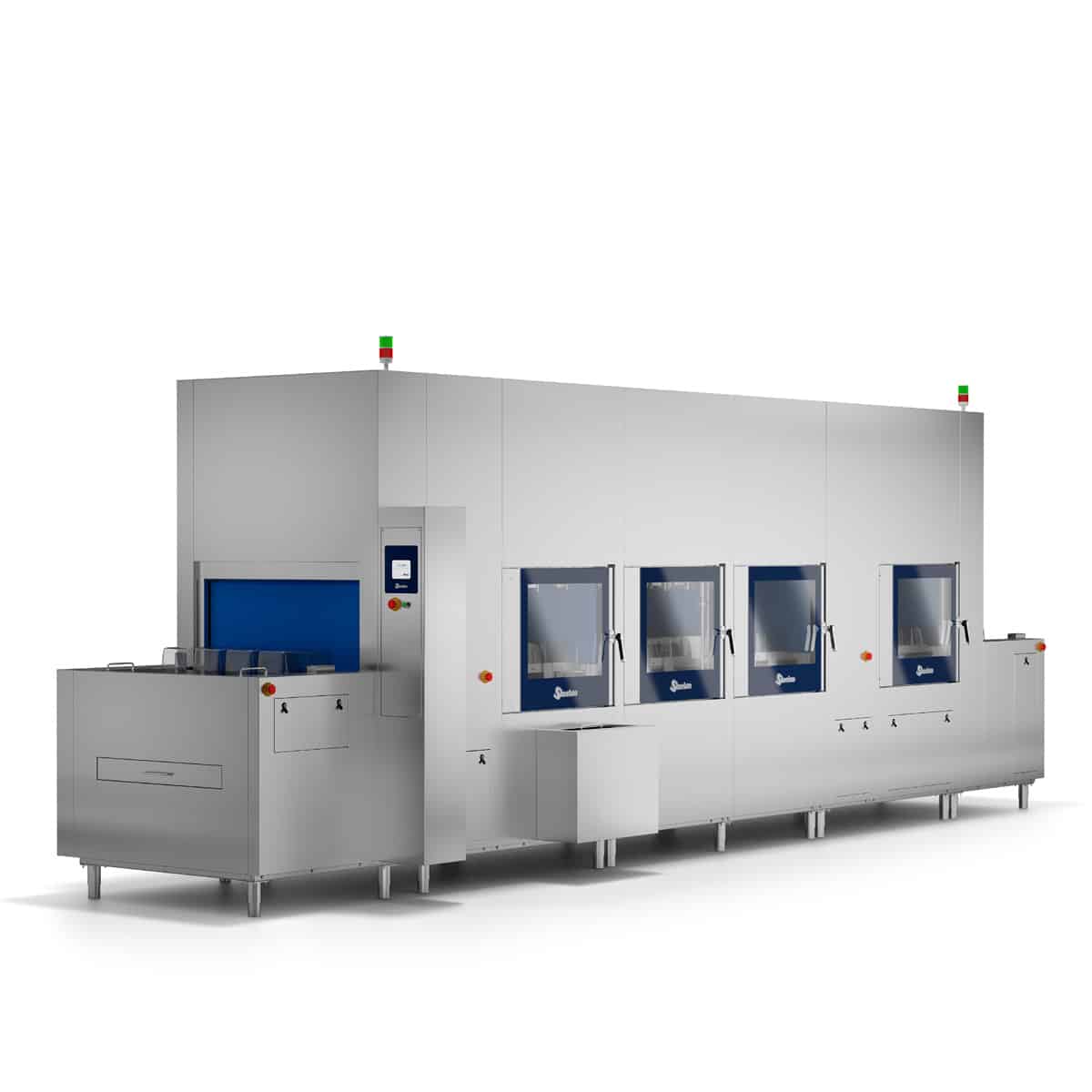
Tunnel Washers for High-Throughput Laboratory and Vivarium Operations
Tunnel washers are continuous-flow automated washing systems designed for high-volume cleaning operations in pharmaceutical manufacturing, large-scale research facilities, and institutional vivariums. These industrial-grade systems feature conveyor-driven transport mechanisms that move items through sequential washing, rinsing, and drying zones, enabling continuous loading and unloading without interrupting the cleaning process. By processing hundreds to thousands of items per hour, tunnel washers eliminate the bottlenecks associated with batch-style washing equipment and dramatically reduce labor requirements while ensuring consistent, validated cleaning results.
ARES Scientific offers advanced tunnel washer systems from leading manufacturers including Steelco, Miele, and other industry-trusted brands. Our tunnel washing solutions range from compact single-lane systems suitable for mid-sized facilities to large multi-zone installations designed for pharmaceutical production plants processing thousands of cage racks, vials, bottles, and laboratory glassware daily. Each system is engineered to meet stringent GMP requirements with full validation documentation, programmable cleaning cycles, and integrated quality control features that ensure reproducible results across all production shifts.
Common Applications and Use Cases
Tunnel washers serve critical functions in facilities requiring high-throughput automated cleaning:
- Large-Scale Vivarium Operations: Continuous processing of animal cages, water bottles, racks, and feeders in institutional research facilities supporting hundreds to thousands of animals, eliminating the bottleneck of batch washing systems
- Pharmaceutical Manufacturing: GMP-compliant cleaning of vials, ampoules, syringes, stoppers, and production equipment components used in sterile drug manufacturing, with full validation and batch documentation
- Biopharmaceutical Production: Validated washing of cell culture vessels, bioreactor components, chromatography columns, and other bioprocessing equipment requiring reproducible cleaning between batches
- Contract Research Organizations (CROs): High-volume processing of laboratory glassware, sample bottles, and analytical equipment supporting multiple concurrent studies with rapid turnaround requirements
- Central Sterile Supply Departments: Hospital and healthcare facility washers processing surgical instruments, trays, basins, and reusable medical devices before sterilization
- Food and Beverage Quality Control: Automated cleaning of sample containers, testing equipment, and production line components in facilities requiring HACCP compliance and allergen control
- Environmental Testing Laboratories: Continuous processing of sample bottles, extraction vessels, and analytical glassware used in water quality, soil analysis, and air monitoring programs
Types and Configurations of Tunnel Washers
Selecting the appropriate tunnel washer configuration depends on throughput requirements, item types, facility layout, and validation needs.
Single-Lane Tunnel Washers represent the most common configuration for mid to large-scale operations, featuring a linear conveyor system that transports items through pre-wash, wash, rinse, and drying zones in a continuous sequence. These systems typically process 200-800 items per hour depending on item size and cleaning requirements. Single-lane tunnels range from 15 to 40 feet in length and can be configured with variable zone quantities to accommodate different cleaning challenges. They integrate seamlessly with existing cage and bottle washing operations and can be expanded with additional zones as facility demands grow.
Multi-Lane Tunnel Systems provide maximum throughput for pharmaceutical production facilities and large institutional vivariums processing thousands of items daily. These systems feature parallel conveyor lanes that can operate independently or synchronously, allowing simultaneous processing of different item types or cleaning protocols. Multi-lane configurations excel in facilities with diverse washing requirements, enabling segregation of equipment used for different products or projects to prevent cross-contamination. Installation requires significant floor space (30+ linear feet) and substantial utility capacity, but the throughput gains justify the investment in high-volume operations.
Pass-Through Tunnel Washers incorporate barrier designs that enable loading on a "dirty" side and unloading on a "clean" side, maintaining strict separation between contaminated and clean zones. This configuration is essential in cGMP pharmaceutical facilities, BSL-3 vivariums, and cleanroom operations where contamination control and directional workflow are critical. Pass-through tunnels can incorporate airlocks, differential pressure zones, and environmental monitoring to meet stringent regulatory requirements for classified manufacturing spaces.
Combination Tunnel Washer-Dryers integrate washing and drying functions in extended tunnel configurations, featuring additional heated air zones that complete the drying process before items exit the clean side. These all-in-one systems eliminate the need for separate laboratory glassware dryers and reduce material handling, though they require longer overall footprints (40-60 feet) and more complex utility connections. Combined systems are ideal for facilities with limited labor resources where continuous fully-automated processing provides maximum operational efficiency.
Specialized Application Tunnels are engineered for specific item types or industries. Zebrafish and aquatics tunnel washers feature gentle water flow and specialized basket conveyors for delicate aquarium equipment. Pharmaceutical vial washers incorporate rotating mechanisms and precision spray nozzles for interior and exterior cleaning of glass and plastic containers. Each specialized configuration addresses unique cleaning challenges that general-purpose tunnels cannot effectively handle.
How to Choose the Right Tunnel Washer System
Selecting an optimal tunnel washer requires comprehensive evaluation of operational requirements, facility constraints, and long-term capacity needs:
- Throughput Capacity Planning: Calculate current daily washing volumes and project 3-5 year growth. Size the tunnel to handle peak demand plus 20-30% capacity buffer. Undersized systems create persistent bottlenecks; oversized units waste energy and space
- Item Mix and Basket Compatibility: Inventory all item types requiring washing including dimensions, materials, and cleaning difficulty. Ensure conveyor system accommodates your largest items and baskets. Consider systems with adjustable conveyor speeds and zone configurations for mixed loads
- Cleaning Validation Requirements: For GMP facilities, specify systems with integrated validation capabilities including temperature monitoring at multiple points, pressure transducers, flow meters, and automatic batch recording. Ensure compliance with FDA, EU Annex 1, and other applicable regulatory standards
- Water Quality and Treatment: Determine if final rinse requires purified water (WFI, RO, DI) and specify appropriate water treatment integration. Pharmaceutical applications typically require conductivity monitoring and validated water systems. Municipal water suffices for most vivarium operations
- Detergent and Chemical Systems: Evaluate automatic detergent dosing systems with multiple chemical inputs for alkaline cleaners, acidic rinses, and sanitizers. Closed-loop systems reduce chemical exposure and ensure consistent concentrations. Review our comprehensive detergent guide for selection criteria
- Energy Efficiency and Utility Requirements: Assess electrical capacity (often 100-400 amps), water consumption (100-500 gallons/hour), compressed air needs, and steam supply if required. Modern systems with heat recovery can reduce operating costs by 30-40%
- Facility Integration and Footprint: Measure available floor space including loading/unloading areas, service access, and utility connections. Account for wall and ceiling clearances. Coordinate with facility engineers on drain capacity, exhaust requirements, and structural loading
- Automation and Material Handling: Consider integration with automated loading/unloading systems, conveyor networks to washing areas, and tracking systems (RFID, barcoding). Full automation maximizes labor efficiency but requires significant capital investment
- Control Systems and Data Management: Specify PLC-based controls with touchscreen interfaces, recipe management, user authentication, and LIMS connectivity. FDA 21 CFR Part 11 compliance is mandatory for pharmaceutical applications. Remote monitoring and predictive maintenance features reduce downtime
- Service and Support Infrastructure: Evaluate manufacturer's service network, spare parts availability, and preventive maintenance programs. Complex tunnel systems require specialized technical support—proximity to factory-trained service technicians is valuable
Our tunnel washer specialists conduct on-site facility assessments to ensure optimal system sizing and configuration. We also offer complementary equipment including automated cage wash systems and sterilizers to create complete washing and sterilization workflows.
Key Features to Compare Across Tunnel Washer Models
When evaluating tunnel washers from different manufacturers, focus on these critical performance and operational characteristics:
- Zone Configuration Flexibility: Systems with modular zone designs allow customization of pre-wash, wash, multiple rinse, and drying stages to match specific soil loads and item types. Look for independently controlled zones with adjustable temperatures, pressures, and dwell times
- Spray System Design: Multi-angle spray nozzle arrays ensure complete coverage of complex geometries. Rotating spray arms improve cleaning of bottle interiors and cage bars. Stainless steel nozzles resist clogging and corrosion better than brass alternatives
- Conveyor System Robustness: Heavy-duty stainless steel chain or belt conveyors with variable speed drives (VFDs) provide smooth, reliable transport. Look for systems rated for continuous 24/7 operation with minimal maintenance requirements
- Temperature Control Precision: Pharmaceutical applications require tight temperature tolerances (±2°C) throughout all zones. Multiple RTD sensors with closed-loop control ensure consistent thermal disinfection or chemical reaction temperatures
- Water Recirculation and Filtration: Multi-stage filtration systems (coarse, fine, and polishing filters) enable water reuse in pre-wash and wash zones, reducing consumption by 50-70%. Automatic backflushing filters minimize manual maintenance
- Heat Recovery Systems: Counterflow heat exchangers that preheat incoming fresh water with outgoing waste water can reduce energy consumption by 30-40%. Combined with condensate recovery from drying zones, modern tunnels achieve exceptional efficiency
- Chemical Dosing Accuracy: Peristaltic or piston-driven dosing pumps with flow verification ensure precise detergent concentrations (±2%). Multi-channel systems enable separate alkaline wash, acid neutralization, and sanitizer rinses in sequence
- Data Logging and Traceability: Integrated recording of temperature, pressure, chemical concentration, and cycle parameters for every batch. Export capabilities to PDF, CSV, or direct LIMS integration support regulatory compliance and trending analysis
- Noise Reduction Features: Insulated cabinets, vibration isolation, and low-noise pumps reduce operational sound levels to 70-80 dBA. Important for systems located near occupied workspaces or animal housing areas
- Sanitary Design and Cleanability: Sloped surfaces, self-draining tanks, and spray-in-place capabilities facilitate daily cleaning and prevent bacterial growth. Smooth weld finishes and crevice-free construction meet sanitary design standards
- Safety and Ergonomics: Emergency stops, safety interlocks on access panels, automatic water shut-off systems, and burn-prevention controls protect operators. Loading/unloading heights should minimize lifting strain
Premium tunnel washers incorporate predictive maintenance features using vibration sensors, bearing temperature monitors, and pump performance tracking to alert maintenance teams before failures occur. These features significantly reduce unplanned downtime in mission-critical operations.
Maintenance and Best Practices for Tunnel Washers
Regular maintenance ensures consistent cleaning performance, minimizes downtime, and extends equipment service life:
- Daily Operational Checks: Inspect conveyor operation for smooth movement and proper speed. Verify all spray zones activate correctly. Check detergent reservoir levels and refill as needed. Remove debris from intake screens and drain strainers. Monitor cycle completion times for consistency
- Weekly Deep Cleaning: Clean all accessible spray nozzles to prevent mineral buildup and clogging. Inspect and clean main tank screens and filters. Wipe down exterior surfaces and control panels. Check door seals and gaskets for wear or damage. Test emergency stops and safety interlocks
- Monthly Preventive Maintenance: Inspect conveyor chain/belt tension and adjust if necessary. Lubricate conveyor bearings and drive mechanisms per manufacturer specifications. Clean or replace pre-filters and main filtration elements. Verify temperature sensor accuracy with calibrated reference thermometers. Check pump seals and coupling alignments
- Quarterly Comprehensive Service: Perform chemical dosing system calibration verification. Inspect spray manifolds and nozzles for damage or wear—replace as needed. Clean heat exchangers to maintain thermal efficiency. Test all alarms and shutdown systems. Review and update cleaning cycle parameters based on effectiveness data
- Annual Validation and Certification: Conduct full IQ/OQ/PQ requalification including temperature mapping, pressure verification, and cleaning efficacy studies with biological indicators or residue testing. Update all validation documentation and SOPs. Replace worn components proactively including pump diaphragms, valve seats, and spray nozzles
- Water Quality Monitoring: Test final rinse water conductivity daily (pharmaceutical applications). Monitor incoming water hardness monthly and adjust softener settings if needed. Perform quarterly microbial testing of rinse water for biofilm detection. Sanitize the system quarterly with validated chemical or thermal cycles
- Chemical System Maintenance: Descale spray manifolds and tanks semi-annually using appropriate acid cleaners. Verify detergent concentrations monthly with titration or other analytical methods. Inspect chemical feed lines for deposits or deterioration. Calibrate conductivity and pH meters per manufacturer schedules
- Comprehensive Record Keeping: Document all maintenance activities, repairs, calibrations, and validations in equipment logbooks or CMMS. Track mean time between failures (MTBF) for critical components. Maintain complete parts inventory for mission-critical consumables and wear items
- Operator Training and Competency: Provide thorough initial training on proper loading techniques, cycle selection, and troubleshooting. Annual refresher training ensures consistency across shifts. Certify operators on validation procedures and documentation requirements for regulated facilities
- Energy and Water Consumption Tracking: Monitor monthly utility usage to identify efficiency degradation indicating maintenance needs like scale buildup in heat exchangers or failing insulation. Modern tunnels with built-in monitoring simplify this tracking
For detailed guidance on maintaining washing equipment, review our laboratory washer maintenance guide and 15 pro tips to extend washer lifespan. These principles apply to all automated washing systems and can dramatically reduce total cost of ownership while ensuring consistent performance.
Frequently Asked Questions
What is the difference between tunnel washers and batch-style laboratory washers?
Tunnel washers are continuous-flow systems where items move through sequential cleaning zones on a conveyor, allowing simultaneous loading and unloading while the washing process continues uninterrupted. Batch-style laboratory glassware washers process complete loads in a single chamber through all cleaning stages before the door can be opened. Tunnel washers excel in high-throughput operations (500+ items/hour) where continuous processing eliminates idle time, while batch washers are more suitable for smaller facilities (50-200 items/hour) with limited space and varied washing protocols. Tunnel systems require larger capital investment and floor space but provide superior labor efficiency—one operator can manage continuous loading while the system processes items automatically. Batch washers offer greater flexibility for mixed loads and specialized cleaning cycles but require more labor for loading/unloading. Most facilities transition to tunnel washers when daily washing volumes consistently exceed 1,000-1,500 items.
How much space is required to install a tunnel washer system?
Space requirements vary significantly based on tunnel configuration and capacity. Compact single-lane systems require minimum 15-20 feet of linear length, 6-8 feet of width, and 8-10 feet of ceiling clearance. Mid-size tunnels typically need 25-35 feet of length, while large pharmaceutical production tunnels may require 40-60 feet or more. Width requirements increase to 10-15 feet for multi-lane configurations. Additionally, you must account for loading and unloading areas (typically 8-12 feet on each end), maintenance access clearances (minimum 3 feet on all sides), and utility connection zones. Pass-through installations require wall penetrations and sufficient space on both sides. Total floor area requirements typically range from 400 square feet for compact systems to 2,000+ square feet for large pharmaceutical installations. Ceiling height must accommodate the tunnel plus overhead utility routing and potential structural supports. Our application engineers conduct detailed site surveys and create CAD layouts to verify fit within your facility constraints before equipment ordering.
Can tunnel washers handle different types of items in the same cycle?
Yes, most tunnel washers can process mixed loads of different item types simultaneously, provided they have similar cleaning requirements (soil load, material compatibility, and temperature tolerance). Items are loaded into standardized baskets or racks on the conveyor, and the system processes everything through the same washing sequence. However, items requiring significantly different cleaning protocols (different temperatures, chemical concentrations, or dwell times) should be processed in separate cycles. Many facilities operate tunnels in dedicated modes—for example, processing only vivarium caging during one shift and laboratory glassware during another. Some advanced systems feature zone-specific parameter adjustments that can accommodate limited variation within a single continuous process. For facilities with highly diverse washing requirements, consider systems with programmable recipe management that allows quick changeovers between different cleaning protocols. Very different items like animal cage racks and pharmaceutical vials typically require separate dedicated tunnel washers to prevent cross-contamination and maintain validation integrity.
What are the water and energy consumption rates for tunnel washers?
Water consumption varies widely based on tunnel size, configuration, and efficiency features. Basic systems consume 200-500 gallons per hour during operation, while large pharmaceutical tunnels may use 500-1,000+ gallons per hour. Modern tunnels with multi-stage water recirculation and heat recovery systems reduce fresh water consumption by 50-70% compared to older single-pass designs. Electrical consumption typically ranges from 30-100 kW for standard systems to 150-300+ kW for large heated tunnels with integrated drying zones. Natural gas or steam consumption (if required for heating) adds 200,000-800,000 BTU/hour depending on system size. Over a 10-year lifecycle, energy and water costs often exceed the initial equipment purchase price, making efficiency features a critical selection criterion. When evaluating proposals, request detailed utility consumption specifications based on your anticipated throughput levels. Facilities processing 2,000+ items daily typically see payback on efficiency upgrades within 2-3 years through reduced operating costs. Our team can provide detailed operating cost projections based on your local utility rates and expected usage patterns.
Do tunnel washers require special water treatment systems?
Requirements depend on application and regulatory standards. Pharmaceutical manufacturing typically requires final rinse with Water for Injection (WFI), Purified Water (PW), or Reverse Osmosis (RO) water meeting USP specifications, necessitating integration with validated water treatment systems including storage, distribution, and monitoring. Research vivariums and general laboratory applications can usually operate with softened municipal water for washing zones and filtered tap water for rinsing. Water hardness above 150 ppm calcium carbonate typically requires softening to prevent scale buildup in heat exchangers and spray nozzles. Final rinse water should have low conductivity (<10 μS/cm for pharmaceutical applications) to prevent mineral residues on cleaned items. Some facilities install multi-stage water treatment including particle filtration, softening, deionization, and final sterile filtration. Budget $20,000-$100,000+ for comprehensive water treatment systems depending on facility requirements and flow rates. Regular water quality testing and treatment system maintenance are essential—poor water quality is the leading cause of tunnel washer performance issues and premature component failure. Consult with water treatment specialists during tunnel washer specification to ensure integrated system design.
How often do tunnel washers require validation in GMP facilities?
FDA and international regulatory agencies require initial validation (IQ/OQ/PQ) before placing tunnel washers into GMP production use. Annual revalidation or requalification is standard practice to demonstrate continued compliance and performance. Additional validation is mandatory after any significant modifications including control system updates, zone configuration changes, conveyor repairs, or relocation to a different facility. Many pharmaceutical facilities also perform quarterly or semi-annual partial requalification focusing on critical parameters like temperature, pressure, and cleaning efficacy. Validation protocols should include worst-case challenge testing with representative soil loads, temperature and pressure mapping throughout all zones, chemical concentration verification, water quality testing, and biological indicator or residue testing to demonstrate cleaning effectiveness. Maintain complete validation documentation packages including protocols, executed data, deviations, and final summary reports. Consider engaging specialized validation contractors familiar with washing equipment and pharmaceutical requirements—improper validation documentation is a common FDA 483 observation. Our technical team can provide validation support services including protocol development, execution assistance, and final report preparation. Related resources include our guides on cGMP washing systems and sterilization validation.
What types of detergents work best in tunnel washer systems?
Tunnel washers require specially formulated low-foam alkaline and acidic detergents designed for automated spray washing systems. High-foaming household or laboratory detergents will cause overflow and system malfunctions. Most facilities use a two-stage chemical protocol: alkaline detergent (pH 10-13) in wash zones to saponify fats and break down organic soils, followed by acidic rinse aid (pH 2-4) to neutralize alkalinity, prevent water spotting, and enhance drying. Pharmaceutical facilities often add a final sanitizing rinse using peracetic acid, hydrogen peroxide, or other validated antimicrobials. Select detergents compatible with your items' materials—stainless steel, polypropylene, and borosilicate glass tolerate most formulations, but polycarbonate and certain plastics require pH-neutral or mild alkaline cleaners. For hard water conditions, choose detergents with built-in sequestering agents to prevent scale formation. Concentrated formulations reduce storage requirements and shipping costs. Our comprehensive detergent guide provides detailed selection criteria including compatibility matrices, dosing recommendations, and cost comparisons. We stock compatible laboratory detergents from major manufacturers including Miele, Steelco, and specialty chemical suppliers. Proper detergent selection and dosing are critical for achieving validated cleaning results—consult with chemical suppliers and conduct validation studies before implementing new detergent formulations in GMP operations.
Can tunnel washers be integrated with building automation systems?
Yes, modern tunnel washers feature comprehensive connectivity options for integration with building management systems (BMS), supervisory control and data acquisition (SCADA) platforms, and laboratory information management systems (LIMS). Standard communication protocols include Ethernet TCP/IP, Modbus, OPC-UA, and BACnet enabling real-time monitoring of equipment status, cycle parameters, utility consumption, and alarm conditions. Advanced systems provide bidirectional communication allowing remote cycle initiation, parameter adjustment, and shutdown commands from central control rooms. Data export capabilities support automated generation of batch records, equipment utilization reports, and predictive maintenance alerts. For pharmaceutical facilities, 21 CFR Part 11 compliant data management includes electronic signatures, audit trails, and secure data storage. Integration benefits include centralized monitoring of multiple washers across facilities, automated response to utility disruptions or equipment faults, energy management and demand response capabilities, and streamlined documentation for regulatory compliance. Specify integration requirements during equipment procurement as retrofit installation of control system upgrades can be complex and expensive. Our automation specialists work with facility IT and engineering teams to ensure seamless integration with existing infrastructure and provide ongoing technical support for connected systems.
Related Washing and Sterilization Equipment
Tunnel washers are one component of comprehensive cleaning, sterilization, and material handling systems. Related equipment categories that complement tunnel washer installations include:
Request a Quote for Tunnel Washer Systems
ARES Scientific's washing system specialists provide comprehensive support from initial facility assessment through installation, validation, and ongoing service. Our team has extensive experience designing and implementing tunnel washer solutions for pharmaceutical manufacturers, research institutions, contract laboratories, and large vivariums across North America.
We offer complete project management services including capacity analysis and throughput modeling, equipment specification and vendor selection, utility requirement assessment and coordination with facility engineers, custom integration with existing material handling systems, installation supervision and commissioning support, IQ/OQ/PQ validation services and documentation, operator training and competency certification, and preventive maintenance programs with rapid-response service support.
Whether you're planning a new facility, upgrading aging batch washers, or expanding capacity to support facility growth, our consultative approach ensures optimal system design that meets your current needs while accommodating future expansion.
Connect with our tunnel washer specialists:
- Request a detailed quote and ROI analysis
- Schedule a virtual facility assessment and system sizing consultation
- Discuss validation requirements and regulatory compliance support
- Arrange equipment demonstrations at our showroom or your facility
Nationwide delivery, installation, and commissioning services available. Ask about our comprehensive service agreements including 24/7 emergency support, annual preventive maintenance, spare parts programs, and validation assistance to ensure your tunnel washer systems maintain peak performance and full regulatory compliance throughout their 15-20 year service life. Financing and leasing options available for qualified customers.