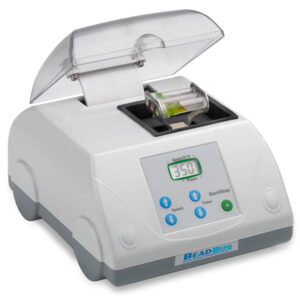
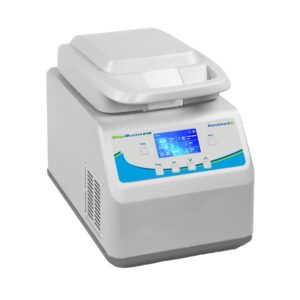
Benchtop Bead Homogenizers for Tissue, Cell & Microbial Sample Preparation
Efficient and reproducible sample disruption is essential for workflows in genomics, proteomics, microbiology, environmental science and bioprocessing. ARES Scientific offers a comprehensive selection of benchtop bead homogenizers—also known as bead mill homogenizers or bead beaters—engineered to deliver consistent lysis, minimal cross-contamination and high-throughput processing across a wide range of sample types. These instruments use high-velocity beads to mechanically disrupt cells, tissues, spores, seeds, and other tough matrices inside sealed tubes, eliminating aerosol generation and protecting sample integrity.
Our bead homogenizer selection ranges from compact microtube homogenizers capable of processing 1–3 samples at a time to high-capacity bead mills that support 12, 24 or even 96 tubes in a single run. With cycle times often under 60 seconds and compatibility with multiple bead types and materials, these systems provide rapid, reproducible lysis for tissue, microbial, plant and environmental samples.
Key considerations when selecting a bead homogenizer include bead size and composition, sample volume, throughput requirements, cooling strategy, and compatibility with downstream workflows such as nucleic acid extraction, protein analysis, metabolomics, or mass spectrometry. ARES Scientific helps you evaluate these factors to identify the most efficient, reliable and cost-effective solution for your sample preparation pipeline.
Key Selection Factors for Bead Homogenizers
- Sample type & matrix: Different matrices—including soft tissues, tough tissues, bone, seeds, spores and microbial pellets—require specific bead sizes, materials and speed settings.
- Throughput & format: Choose between single-tube units, multi-tube (4, 6, 12, 24) formats, or plate-compatible bead mills depending on your sample load and workflow.
- Cooling and heat management: Bead homogenization generates heat; cooling blocks, cryo-accessories or shorter cycles are essential for RNA, protein or heat-sensitive analytes.
- Bead size & material: Glass, ceramic, zirconium and steel beads each excel with specific sample types; bead size determines impact energy and homogenization efficiency.
- Contamination control: Enclosed tubes and sealed carriers reduce aerosol formation and cross-contamination—important for infectious, environmental and regulated workflows.
- Software & reproducibility: Look for programmable protocols, adjustable speed/time cycles, multi-run memory and digital tracking for regulated or high-throughput labs.
Frequently Asked Questions About Bead Homogenizers
What is a bead homogenizer, and how does it work?
A bead homogenizer uses thousands of high-speed bead collisions inside a sealed tube to break open cells, tissues or tough matrices. This mechanical lysis method provides rapid and efficient disruption for DNA, RNA, protein and metabolite extraction.
How do bead homogenizers compare to probe or rotor-stator homogenizers?
Probe homogenizers use shear from a rotating blade and can introduce aerosols or cross-contamination, while bead homogenizers keep samples fully enclosed. Bead mills also allow simultaneous processing of many samples, making them ideal for high-throughput workflows.
What sample formats and volumes are supported?
Most bead homogenizers support microtubes (0.5–2 mL), strip tubes, deep-well plates and larger tubes/jars depending on the instrument. Many systems support volumes from ~25 µL up to several milliliters.
Do I need cooling for bead homogenization?
Yes—high-speed bead impacts generate heat. Cooling blocks, cryogenic adapters or short cycle programming help protect heat-sensitive analytes such as RNA, enzymes and metabolites.
How do I choose the right bead type?
Glass beads are ideal for soft tissues and cells, ceramic and zirconium beads suit tougher tissues or microbes, and steel beads offer maximum impact energy for bone or hard plant material. Bead size determines the degree of mechanical force applied.
Are bead homogenizers used in GMP or regulated labs?
Yes. Many bead mills offer sealed sample carriers, programmable cycles, audit-ready data logging and compatibility with validated extraction kits—important for GMP, GLP and clinical research environments.