Negative pressure isolators are the required containment primary engineering control (C-PEC) for sterile hazardous drug compounding under USP <800>, providing a hard physical barrier between the compounder and cytotoxic, antineoplastic, and other NIOSH-listed hazardous agents during vial reconstitution, syringe filling, and IV admixture preparation. By maintaining a sustained negative pressure differential—typically −0.05 to −0.12 inches of water column relative to the surrounding room—these closed-system isolators ensure that any unintended breach draws ambient air inward rather than allowing contaminated air to migrate outward into the pharmacy environment. ARES Scientific distributes negative pressure isolator platforms from Baker and Flow Sciences, serving hospital pharmacies, oncology compounding programs, outpatient infusion centers, and 503B outsourcing facilities that must simultaneously satisfy USP <800> containment requirements and the ISO Class 5 sterile work zone conditions demanded by USP <797>. For programs requiring isolators for non-hazardous sterile compounding, our full range of compounding aseptic containment isolators includes both negative and positive pressure isolator options to match the full scope of a pharmacy cleanroom program.
Types of Negative Pressure Isolators for Hazardous Drug Compounding
Dedicated Negative Pressure CACIs
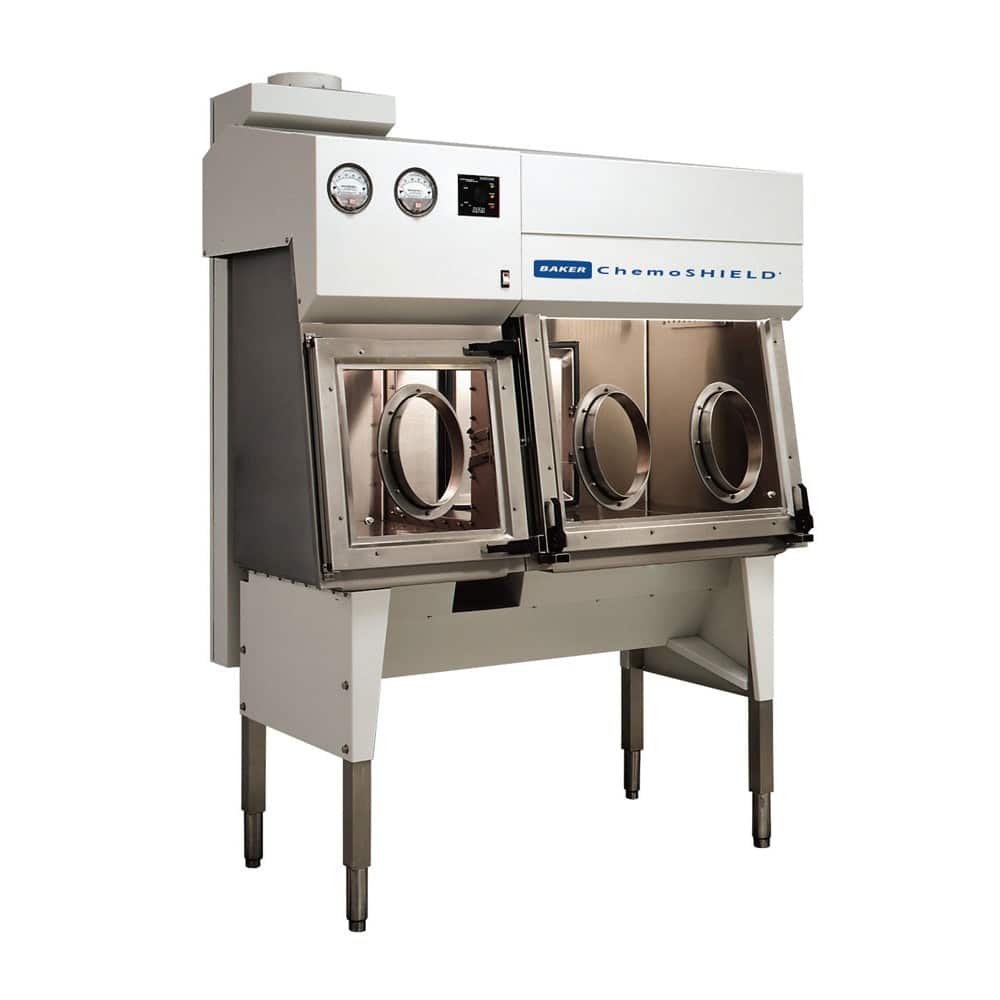
Purpose-built negative pressure CACIs represent the most common configuration for hazardous drug sterile compounding in hospital and oncology pharmacy settings. These systems are designed from the enclosure outward for containment: the chamber walls, glove ports, viewing windows, and pass-through seals form a continuous leak-tight barrier tested to AGS G001 pressure-decay standards, and the exhaust air stream passes through a dedicated HEPA filter before leaving the isolator. The Baker ChemoSHIELD exemplifies this category—it maintains a negative pressure work environment tested to AGS standards, with continuous-liner glove ports that keep the physical barrier intact even during extended compounding sessions, and HEPA-filtered supply air delivering an ISO Class 5 (Class 100) work zone that simultaneously satisfies the sterility requirements of USP <797>. Interior surfaces are 304 stainless steel throughout for compatibility with sporicidal cleaning agents including bleach, peracetic acid, and hydrogen peroxide vapor cycles. The pass-through interchange chamber allows vials, syringes, diluents, and waste containers to be transferred into and out of the work zone without opening the main chamber to room air, maintaining the negative pressure boundary throughout the compounding session. These isolators are appropriate for any facility compounding NIOSH-listed hazardous drugs in sterile form, including antineoplastics such as taxanes, platinum compounds, and anthracyclines, as well as biologic and hormonal agents on the NIOSH hazardous drug list. Facilities with comprehensive environmental monitoring programs can integrate pressure and particle count tracking for continuous compliance documentation alongside the isolator's built-in alarm systems.
Closed Restricted Access Barrier Systems (cRABS) for Chemo Containment
Closed restricted access barrier systems with negative pressure operation—such as the Flow Sciences ChemoSphere—provide an alternative containment architecture that shares the core isolation principles of a traditional CACI while offering modular installation flexibility and, in some configurations, reduced cleanroom infrastructure requirements. The ChemoSphere achieves ISO Class 4 (Class 10) air quality within the work zone, a more conservative margin than the ISO Class 5 minimum required by USP <800>, and satisfies USP <797>/<800> and NIOSH compliance requirements for chemo compounding. Stainless steel construction, continuous negative pressure operation, sealed glove ports, and an ergonomic modular design allow the ChemoSphere to be deployed in pharmacy environments where traditional cleanroom construction is not feasible or where the facility is transitioning to USP <800> compliance. The cRABS category is particularly relevant for pharma and bio-pharma manufacturing applications where modularity, validation documentation support, and ease of decontamination cycle integration are priorities alongside the standard containment performance requirements. Both cRABS and traditional CACI formats benefit from supplemental decontamination equipment for terminal sporicidal treatment of the isolator interior and the surrounding buffer room between compounding sessions.
Negative Pressure Isolators vs. Biological Safety Cabinets for Hazardous Drug Compounding
A common planning question for pharmacy programs implementing USP <800> is whether a negative pressure isolator or a biological safety cabinet is the more appropriate C-PEC for their hazardous drug program. Both equipment types can serve as C-PECs under USP <800>, but they differ in containment architecture and operational requirements in ways that significantly affect workflow, facility design, and personnel protection levels. A biological safety cabinet is an open-front design that relies on an air curtain at the sash opening to contain hazardous agents; the compounder works through the sash opening with no hard physical barrier separating them from the work zone. A negative pressure isolator uses a fully enclosed glovebox design with continuous-liner glove ports, eliminating the open front and providing a hard barrier between the operator and the drug preparation environment. For high-hazard, high-volume compounding programs—particularly those preparing NIOSH Table 1 antineoplastics—the closed glovebox design of a negative pressure isolator offers a higher level of containment assurance than an open-front BSC and simplifies the PPE and technique requirements associated with operator protection. Facilities comparing these options for their clean air and containment infrastructure should review the NIOSH exposure band for each drug being compounded alongside their Board of Pharmacy requirements to determine whether an open-front or closed-system C-PEC is most appropriate.
Negative Pressure Isolator Features and Technology
Pressure Control, Monitoring, and Alarm Systems
Sustained, verified negative pressure is the defining performance requirement of a hazardous drug containment isolator, and the systems that maintain and document that pressure are as important as the enclosure itself. Modern negative pressure isolators use electronic pressure transducers to continuously measure the differential between the work chamber and the surrounding room, with audible and visual alarms that activate when pressure drifts outside the validated setpoint range. The pressure setpoint—typically a negative differential of at least −0.05 in. w.c. but often −0.08 to −0.12 in. w.c. for higher-risk applications—must be established during initial qualification and documented in the facility's standard operating procedures. Some platforms provide data logging of pressure readings over time, enabling pharmacies to produce trend data as part of their USP <797>/<800> environmental monitoring records and to demonstrate continuous compliance during CETA certification visits or regulatory inspections. Glove integrity must also be monitored as a separate verification step: continuous-liner glove systems are inspected for breaches at defined intervals, and some programs use automated glove leak detection tools to verify integrity between sessions. Integration with the facility's temperature and humidity monitoring infrastructure provides a complete environmental record for the compounding suite that supports both day-to-day quality management and periodic compliance audits.
HEPA Filtration and Exhaust Configuration
Every negative pressure isolator used for hazardous drug compounding requires HEPA filtration on both the supply and exhaust air streams. Supply HEPA filters—typically rated at 99.99% efficiency at 0.3 µm—deliver ISO Class 5 unidirectional downward airflow to the work zone, sweeping particulates and aerosols generated during compounding away from the product and toward the exhaust plenum. Exhaust HEPA filters capture hazardous drug particulates before air leaves the isolator, preventing contamination of the pharmacy environment regardless of the downstream exhaust configuration. The exhaust configuration itself is a critical design decision: isolators used for volatile hazardous drugs or NIOSH Table 1 compounds with significant vapor generation should be configured for 100% hard-duct exhaust to the building exhaust system, preventing recirculation of vapor-phase agents that pass through HEPA particulate filtration. Facilities with lower-volatility drug lists may qualify for recirculating exhaust with HEPA-only filtration, but this determination requires a documented drug-by-drug risk assessment. Some isolator platforms support optional carbon adsorption modules upstream of the exhaust HEPA to address vapor-phase hazardous agents, providing an additional safety margin for facilities compounding volatile compounds without full exhaust infrastructure. Facilities considering exhaust configurations should evaluate compatibility with ducted exhaust systems already present in the pharmacy or adjacent laboratory spaces to understand the HVAC balance implications of adding isolator exhaust loads.
Glove Port Design, Pass-Through Chambers, and Interior Construction
The operator interface of a negative pressure isolator directly affects both containment performance and compounding productivity, and facilities should evaluate glove port design carefully as part of the equipment selection process. Continuous-liner glove systems—where the glove is bonded to a flexible sleeve that remains permanently attached to the isolator port—provide a higher containment assurance than removable glove designs by eliminating the glove-to-port interface as a potential leak point. Port height, horizontal spacing, and reach depth determine whether a compounder can access the full work surface without awkward postures that increase glove stress and fatigue during long preparation sessions; ergonomic port positioning is particularly important for high-volume oncology programs where compounding sessions may last several hours. Pass-through chambers and transfer sluices are designed so that materials can move into and out of the work zone without breaking the negative pressure boundary: a properly sized interchange chamber can accommodate standard IV bags, vial trays, syringe sets, and waste containers within a single transfer cycle, reducing workflow interruptions. Interior construction materials must withstand the full range of disinfectants and sporicidal agents used in the pharmacy's cleaning program; stainless steel 304 or 316 is standard for the work surface, walls, and ceiling, while seals and gaskets should be verified for chemical compatibility with the specific agents—bleach, peracetic acid, hydrogen peroxide vapor—in use. For programs that require validated decontamination protocols, compatibility with decontamination chamber equipment used for treating materials entering the sterile compounding area is an additional consideration.
Applications for Negative Pressure Isolators
Hospital and Health-System Oncology Pharmacy
Hospital pharmacies and centralized health-system compounding services represent the highest-volume use environment for negative pressure CACIs. These programs compound large daily batches of antineoplastic agents—taxanes, platinum-based compounds, anthracyclines, targeted biologics, and monoclonal antibody preparations—that carry significant occupational exposure risk and require a closed-system C-PEC to comply with USP <800>. Large health systems managing centralized compounding across multiple satellite sites benefit from standardizing on validated isolator platforms with documented qualification protocols, consistent certification schedules, and reproducible decontamination procedures. The enclosed glovebox design of a negative pressure isolator reduces the dependence on operator technique as the primary containment mechanism compared to an open-front cabinet, making it particularly valuable in high-throughput environments where multiple technicians may use the same isolator across shifts. USP <800> requires that these isolators be located within a negative pressure buffer room—itself part of the facility's secondary engineering control (SEC) design—and ARES Scientific's broader portfolio of clean air and containment equipment supports the complete buffer room and ante-room design alongside the isolator itself.
503B Outsourcing Facilities and GMP Hazardous Drug Production
FDA-registered 503B outsourcing facilities compounding hazardous sterile products at commercial scale operate under cGMP requirements per 21 CFR Part 211 in addition to USP <800> and <797> standards, placing more rigorous demands on isolator qualification documentation, environmental monitoring programs, and change control procedures than typical hospital compounding programs. Negative pressure isolators used in 503B settings must support full IQ/OQ/PQ validation, with manufacturer documentation verifying pressure differentials, airflow velocities, HEPA filter efficiencies, and glove port leak rates against written acceptance criteria. Environmental monitoring programs at 503B facilities typically include continuous pressure monitoring with data logging, routine viable and non-viable particle sampling in and around the isolator, and periodic HEPA integrity testing, all feeding into the quality systems documentation required for FDA inspection readiness. For facilities also operating validated washing and decontamination programs, integration with cGMP infrastructure—including cGMP washing systems and sterilization and decontamination solutions—creates a cohesive compliance infrastructure for hazardous drug manufacturing operations.
Outpatient Infusion and Specialty Compounding Pharmacies
Outpatient infusion pharmacies and independent compounding pharmacies serving oncology, pain management, and specialty drug markets often operate under space constraints and budget realities that make the flexibility and modularity of the isolator selection decision particularly consequential. For these facilities, the choice between a traditional negative pressure CACI and a cRABS platform may depend on whether full cleanroom infrastructure—including a dedicated negative pressure buffer room—is available or feasible, or whether a more flexible deployment is required. The Flow Sciences ChemoSphere cRABS, for example, is designed to allow compliant chemo compounding without requiring full cleanroom construction in qualifying pharmacy layouts, potentially reducing facility renovation costs while maintaining USP <800> compliance. Regardless of the isolator format selected, outpatient and specialty compounding pharmacies must verify that their chosen C-PEC meets the containment performance specification for each specific drug on their formulary, document the risk assessment that supports their exhaust configuration choice, and establish a certification and maintenance schedule aligned with CETA guidelines and their state Board of Pharmacy requirements. ARES Scientific supports pharmacy planners and compounding directors in evaluating negative pressure isolator options alongside complementary cleanroom laminar flow cabinets and biological safety cabinets to build a complete, compliant sterile compounding environment.
Selecting a Negative Pressure Isolator
Confirming Containment Class and Drug List Compatibility
The starting point for negative pressure isolator selection is a current, complete list of the hazardous drugs to be compounded in the system, cross-referenced against the NIOSH hazardous drug list and its exposure band classifications. NIOSH Table 1 antineoplastic agents represent the highest exposure concern and the strongest case for a fully enclosed negative pressure glovebox isolator over an open-front C-PEC. The volatility profile of each drug on the list determines whether the isolator requires 100% hard-duct exhaust, recirculating HEPA exhaust, or supplemental carbon adsorption—a determination that must be made before finalizing the exhaust configuration and facility HVAC design. Isolator selection should also account for future formulary changes: a system that can accommodate exhaust upgrades or carbon module additions provides more flexibility as drug lists evolve. Facilities planning new compounding suites should evaluate the isolator selection in parallel with pharma and bio-pharma manufacturing infrastructure decisions to ensure the complete system—isolator, buffer room, HVAC, and monitoring—functions as an integrated compliance solution.
Evaluating Workflow, Throughput, and Ergonomics
Negative pressure isolator selection should account for the compounding program's daily volume, the number and types of preparations being produced, and the physical demands placed on compounding staff over the course of a shift. Pass-through chamber size and design determine how efficiently materials can be staged and transferred without disrupting the negative pressure boundary; programs compounding large batches of multiple drug types in a single session benefit from larger interchange chambers that minimize transfer cycles. Glove port quantity, spacing, and height should be verified against the work surface dimensions and the specific compounding tasks to be performed: a two-glove-port isolator may be adequate for single-operator compounding of individual preparations, while a multi-port configuration supports two-operator workflows or simultaneous preparation of multiple products. Viewing window design, interior lighting intensity, and work surface height all contribute to session quality over extended compounding periods. Facilities should also verify that the isolator footprint and service access requirements are compatible with the negative pressure buffer room dimensions and the ante-room workflow described in their USP <800> facility design.
Certification, Documentation, and Long-Term Compliance
A negative pressure isolator is a regulated piece of equipment that requires ongoing certification and documentation to remain in compliant service, and the lifecycle costs of certification, maintenance, and consumables should factor into the selection decision from the outset. CETA certification at installation and at least annually thereafter is standard practice; certification includes pressure differential verification, airflow pattern testing, HEPA filter integrity testing using DOP or PAO aerosol challenge, glove port leak integrity testing, and alarm function verification. Filter change intervals vary by manufacturer and compounding volume, and the cost and procedure for filter replacement—including any containment protocols required during exhaust HEPA changeout—should be established before equipment purchase. Glove and continuous-liner sleeve replacement frequency is determined by compounding volume, chemical exposure, and the glove integrity inspection schedule established in the facility's SOPs. Continuous environmental monitoring between certification events documents ongoing ISO Class 5 performance and supports the trend analysis required by USP <797>/<800> quality programs, providing the audit-ready record that facilities need for Board of Pharmacy inspections, accreditation surveys, and internal quality reviews.
ARES Scientific distributes negative pressure isolators from Baker and Flow Sciences to hospital pharmacies, oncology compounding programs, 503B outsourcing facilities, and specialty compounding pharmacies across the United States, supporting USP <800> and USP <797> compliance as part of our broader compounding aseptic containment isolator and clean air and containment portfolio.