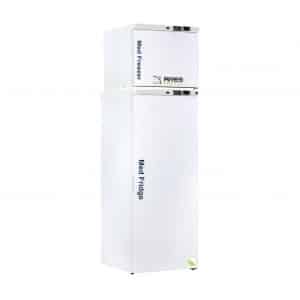
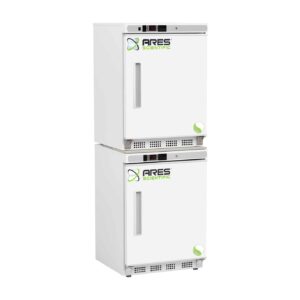
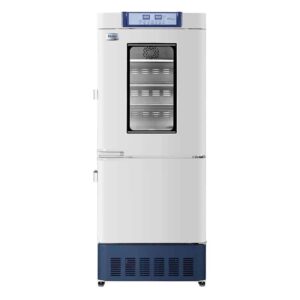
Refrigerator and freezer combo units give laboratories, pharmacies, clinical facilities, and research programs independent dual-zone cold storage within a single cabinet footprint. ARES Scientific stocks a range of laboratory cold storage equipment, including combination refrigerator/freezer units from the ARES Cool proprietary line and from Haier Biomedical — two manufacturers known for precision temperature control, robust construction, and compliance-ready performance. These integrated units consolidate refrigerated storage (typically 2°C to 8°C) and frozen storage (ranging from -20°C to -40°C depending on model) into one cabinet, reducing the equipment footprint in space-constrained environments without sacrificing temperature performance or sample integrity.
Facilities served by these units span hospital pharmacies, university research labs, clinical testing environments, blood banks, and pharmaceutical manufacturing sites. Common stored materials include vaccines, biological specimens, reagents, frozen plasma, compounded medications, and temperature-sensitive diagnostic kits. ARES Scientific helps procurement managers and laboratory planners identify the right combination refrigerator/freezer configuration by capacity, door style, freezer depth, and regulatory alignment — including CDC vaccine storage guidelines, USP pharmaceutical storage standards, and CAP accreditation requirements. Browse the full laboratory refrigerators and laboratory freezers categories for standalone cold storage alternatives.
Types of Laboratory Refrigerator and Freezer Combo Units
Compact and Undercounter Combo Units (7–10 cu. ft.)
Compact combination refrigerator/freezer units in the 7 to 10 cubic foot range are designed for satellite labs, nursing stations, pharmacy alcoves, and point-of-use cold storage at the workstation level. The ARES Cool RFC7 Series (7 cu. ft.) and RFC10 Series (10 cu. ft.) represent this tier, offering both solid door and glass door configurations with independent microprocessor-controlled temperature zones. The refrigerator compartment maintains 2°C to 8°C for vaccines and medications, while the freezer compartment reaches -20°C, -30°C, or -40°C depending on the selected variant. Units in this capacity range typically measure 23–25 inches wide, making them compatible with standard undercounter cabinetry in tight clinical spaces. Controlled Auto Defrost (CAD) technology — available on select RFC7 variants — manages defrost cycles at programmable intervals to prevent temperature spikes during defrost events, a critical feature for facilities storing temperature-sensitive biologics or vaccines. See undercounter refrigerators for additional compact cold storage options in this footprint class.
Mid-Capacity Combo Units (12 cu. ft.)
The 12 cubic foot tier represents the most widely specified combination refrigerator/freezer format for clinical pharmacies, hospital floor stations, and research labs managing moderate storage volumes. The ARES Cool RFC12 Series provides dual-zone storage in a full-height freestanding cabinet with multiple door style options: solid door, glass door, and solid door with Advanced Controlled Auto Defrost (Advanced CAD). The Advanced CAD system runs automatic defrost cycles every 6 hours at precision-controlled intervals, minimizing temperature excursions during defrost and supporting continuous cold chain integrity. RFC12 units maintain the refrigerator zone at 2°C to 8°C and the freezer zone at -20°C or deeper depending on configuration. These units suit pharmacy directors managing vaccine inventories under CDC two-unit vaccine storage guidelines, where a single combo unit serves as the designated primary vaccine storage solution. The ARES Cool RFC12 line connects directly to the broader ARES Cool cold storage brand portfolio.
Dual-Voltage and International-Specification Combo Units
The Haier Combined Refrigerator and Freezer (6.5 cu. ft. refrigerator / 3.4 cu. ft. freezer, 220/240V) addresses facilities requiring international voltage compatibility — including international research campuses, export projects, and facilities operating on non-standard electrical infrastructure. This unit features independently controlled compartments, a shelf-style evaporator for fast cooling recovery, a stainless steel interior, and a five-function alarm system with 48-hour battery backup to maintain alarm functionality during power interruptions. The independently controlled zones allow the refrigerator and freezer compartments to operate at distinct setpoints without thermal cross-talk, a design characteristic that matters when one compartment stores specimens at 4°C while the other holds frozen material at -20°C. For the full Haier Biomedical cold storage range distributed through ARES Scientific, visit the Haier partnership page.
Key Features of Medical-Grade Combination Refrigerator/Freezer Units
Medical-grade combination refrigerator/freezer units distinguish themselves from consumer-grade equipment through a specific set of engineering and compliance-focused features that directly affect temperature reliability, alarm response, and documentation capability. The following are the core features to evaluate when specifying a combo unit for laboratory, pharmacy, or clinical use.
- Independent dual-zone temperature control — Physically separated refrigeration circuits or thermally isolated compartments with independent evaporators prevent temperature cross-talk between zones. Each compartment maintains its setpoint independently: the refrigerator zone holds 2°C to 8°C per CDC and USP pharmaceutical storage requirements, while the freezer zone holds -20°C or deeper for frozen biologics, plasma, and specialty compounds.
- Microprocessor-based control with calibrated sensors — NTC or PT100 thermistor sensors provide continuous temperature monitoring and digital display readouts for both zones simultaneously, with setpoint adjustment accessible through a front-panel interface. This enables staff to verify zone temperatures at a glance without opening either compartment.
- Alarm systems — Door-open alarms, high/low temperature deviation alarms, and power failure alarms are standard on medical-grade models. The Haier 220/240V unit includes a five-function alarm system with 48-hour battery backup, ensuring alarm functionality persists through power interruption events.
- Controlled Auto Defrost (CAD) — CAD technology, featured on select ARES Cool RFC series models, schedules defrost cycles at fixed 6-hour intervals using a precision-controlled heating element that terminates the cycle as soon as frost is cleared. This limits temperature rise during defrost to well below the threshold that would compromise CDC-compliant vaccine storage or USP biological storage requirements — a meaningful improvement over conventional timed defrost systems. Advanced CAD variants add additional sensor inputs and cycle optimization to further reduce defrost temperature excursions.
- Door configuration options — Solid doors provide superior insulation performance — typically achieving R-values 15–25% higher than equivalent glass door models — which translates to lower compressor run time and greater temperature stability. Glass doors allow staff to perform visual inventory checks without opening the door, reducing cold air loss during high-traffic periods. Both configurations use magnetic door gaskets for an airtight perimeter seal and self-closing hinges to prevent accidental door-ajar situations.
- Hinge orientation flexibility — Most ARES Cool RFC series units offer both left-hinge and right-hinge door configurations, allowing installation flexibility in clinical rooms, pharmacy alcoves, and laboratory corridors where wall adjacency determines hinge orientation.
- Data logging and export — Units supporting temperature logging via USB port, RS-232, or integrated data logger extend documentation capabilities for GMP facilities and accreditation programs without requiring separate external monitoring equipment. For facilities needing continuous external monitoring regardless of unit type, temperature and humidity monitoring systems provide an independent data record.
- Construction materials — Foamed-in-place polyurethane insulation panels with stainless steel or powder-coated steel interiors and exteriors are standard across the ARES Cool RFC line and the Haier combination units. Stainless steel interiors resist corrosion from condensation and chemical spills, simplify cleaning, and support surface disinfection protocols required in pharmacy and clinical environments.
Applications for Combination Refrigerator/Freezer Units
Pharmacy and Clinical Medication Storage
Hospital pharmacies, outpatient infusion centers, and retail pharmacy compounding suites rely on combination refrigerator/freezer units to store vaccines, insulin, frozen IV preparations, and temperature-sensitive compounded medications within a single compliant cabinet. CDC guidelines for vaccine storage specify that refrigerator compartments maintain 2°C to 8°C and freezer compartments maintain -15°C or colder for frozen vaccines such as MMRV and varicella — performance requirements that ARES Cool RFC series combo units are engineered to meet. Pharmacy directors managing VFC vaccine inventories must document continuous temperature compliance; models with integrated data loggers or USB data export support this requirement without separate external monitoring equipment. USP general storage requirements and USP sterile compounding standards both specify temperature ranges that these units are designed to maintain consistently. The pharmacy and nursing industry page covers the broader cold storage, clean air, and workflow equipment landscape for pharmacy environments.
Research Laboratories and Biorepositories
University research labs, government research facilities, and biorepositories use combination refrigerator/freezer units to co-locate reagents, buffers, enzyme stocks, and frozen aliquots at the bench or workstation level. A single combo unit positioned adjacent to a biological safety cabinet or PCR workstation allows researchers to access both refrigerated and frozen materials without walking to a separate cold room or standalone freezer — reducing open-door time and minimizing thermal stress on temperature-sensitive reagents. For programs managing cell culture reagents, RNA extraction kits, restriction enzymes, and competent cell stocks, the -20°C to -40°C freezer compartment range available in ARES Cool RFC10 models accommodates a broad spectrum of frozen storage requirements. Labs managing larger inventories of frozen material may also evaluate ULT freezers for long-term biorepository storage alongside combo units for active working stocks. Research program managers comparing equipment options will also find relevant guidance on the laboratory equipment industry page.
Blood Banks and Clinical Specimen Storage
Blood bank operations and clinical microbiology laboratories use combination refrigerator/freezer units for storing whole blood components, fresh frozen plasma (FFP), cryoprecipitate, diagnostic reagent kits, and reference specimens that require distinct storage temperatures across refrigerated and frozen zones. AABB accreditation standards for blood banking require that blood components be stored within validated temperature ranges with continuous monitoring and documented alarm response. While dedicated blood bank refrigerators and plasma freezers serve as primary storage in large-volume operations, combination units fill the role of satellite or working-stock storage at the processing bench, collection station, or transfusion medicine service point. ARES Scientific's broader blood bank cold storage category covers the full range of dedicated blood component storage equipment for primary bank operations.
Pharmaceutical Manufacturing and cGMP Cold Storage
Pharmaceutical manufacturing facilities operating under FDA 21 CFR Part 211 and ICH Q1A(R2) stability guidelines require validated cold storage equipment with documented IQ/OQ/PQ protocols, calibrated temperature sensors, and continuous data logging. Combination refrigerator/freezer units in cGMP manufacturing environments serve as in-process material storage for active pharmaceutical ingredients (APIs), reference standards, working cell banks, and temperature-sensitive intermediates that need both refrigerated and frozen zones within the production suite or QC laboratory. Equipment qualification requires demonstrating temperature uniformity (typically ±2°C across the usable volume), mapping studies at maximum load, door-open recovery time data, and alarm setpoint validation. Pharma and biopharma cold storage requirements are covered in greater depth on the pharma and biopharma manufacturing industry page.
Selecting the Right Combination Refrigerator/Freezer Unit
The following decision factors cover the primary specification variables for combination refrigerator/freezer units across laboratory, pharmacy, clinical, and manufacturing environments.
- Capacity and compartment ratio — ARES Cool RFC series units range from 7 to 12 cubic feet total capacity. Most models allocate approximately 60–70% of total volume to the refrigerator compartment and 30–40% to the freezer compartment. Facilities with disproportionately high frozen storage volume should consider pairing a combo unit with a dedicated undercounter freezer rather than upsizing to a larger combo unit with excess refrigerator capacity.
- Freezer temperature depth — ARES Cool RFC10 models are available at -20°C, -30°C, and -40°C variants. Standard -20°C performance suits vaccine storage and most routine reagent stocks. The -30°C variant provides a wider safety margin for biologics requiring storage well below the -15°C minimum for frozen vaccines. The -40°C variant addresses deep-freeze applications that don't require full ULT infrastructure — including certain plasma products and biopharmaceutical intermediates. For applications requiring -60°C to -86°C, the ULT freezer category is the appropriate next tier.
- Defrost system — Facilities storing CDC-program vaccines or biologics under USP guidelines should specify CAD or Advanced CAD models rather than conventional timed-defrost units. CAD technology limits temperature excursions during defrost cycles and provides a technical compliance advantage for VFC program storage and state health department oversight.
- Door style — Choose glass doors for high-traffic environments where visual inventory checks reduce door-open frequency. Choose solid doors where light sensitivity, superior insulation performance, or secure access is a priority. Both styles are available across the ARES Cool RFC7, RFC10, and RFC12 series.
- Regulatory alignment — Confirm that the selected unit meets the specific temperature performance, alarm, and documentation requirements for your regulatory context: CDC VFC program guidelines, USP or , CAP laboratory accreditation, AABB blood bank accreditation, or FDA GMP validation requirements. CDC and state VFC program guidance specifically distinguishes between purpose-built pharmaceutical-grade units and household-grade units — the ARES Cool RFC series is designed as purpose-built pharmaceutical-grade cold storage.
- Voltage and electrical requirements — Standard ARES Cool RFC units operate on 115V/60Hz North American electrical infrastructure. The Haier combination unit is specified for 220/240V applications requiring international voltage compatibility.
- Footprint and installation constraints — Measure available floor space, ceiling clearance for top-mounted condenser ventilation, and wall adjacency before specifying hinge orientation. Most ARES Cool RFC units offer left-hinge and right-hinge configurations to accommodate installation constraints in pharmacy alcoves and laboratory corridors.
ARES Scientific distributes refrigerator and freezer combo units as part of a comprehensive cold storage portfolio that spans controlled room temperature cabinets, laboratory refrigerators, laboratory freezers, ULT freezers, and liquid nitrogen storage systems. For facilities evaluating combination units alongside separate refrigeration and freezer equipment, ARES Scientific provides specification guidance to help match storage equipment to regulatory requirements, capacity needs, and available facility infrastructure. Reach our equipment specialists at 720-283-0177 ext. 2.