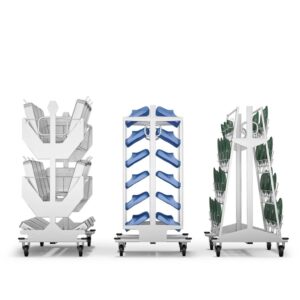
Trolley Washer Disinfectors for Healthcare and Laboratory Sterilization
Trolley washer disinfectors are specialized automated cleaning and thermal disinfection systems designed to process medical equipment, surgical instruments, transport carts, anesthesia equipment, and laboratory apparatus that cannot be steam sterilized. These large-capacity cabinet washers combine mechanical cleaning action with validated thermal disinfection cycles (typically 90-93°C for 10 minutes) to achieve A0 values that meet international standards for medical device reprocessing. By automating the cleaning and disinfection process, trolley washers eliminate manual handling of contaminated items, reduce staff exposure to infectious materials, and ensure reproducible results that satisfy regulatory requirements in hospitals, ambulatory surgery centers, and research facilities.
ARES Scientific offers a complete range of trolley washer disinfectors from leading manufacturers including Steelco, Miele, and other trusted medical equipment brands. Our systems accommodate everything from small instrument trays to full-size transport carts, anesthesia machines, and patient care equipment. Each washer is engineered to meet HTM 2030, CDC guidelines, and AAMI standards for thermal disinfection, with comprehensive validation documentation and connectivity options for integration with central sterile supply department (CSSD) tracking systems. Whether you need a single-chamber unit for a small surgical center or a multi-chamber pass-through system for a major hospital, we provide expert guidance to ensure optimal equipment selection and regulatory compliance.
Common Applications and Use Cases
Trolley washer disinfectors serve critical reprocessing functions across healthcare and research environments:
- Central Sterile Supply Departments (CSSD): High-volume automated cleaning and thermal disinfection of surgical instrument trays, procedure sets, basins, bowls, and reusable medical devices before terminal sterilization in autoclaves
- Operating Room Support: Processing anesthesia equipment including laryngoscope handles, breathing circuits, masks, and reusable airways that cannot withstand steam sterilization temperatures
- Ambulatory Surgery Centers: Efficient turnover of procedure-specific instrument sets, enabling multiple cases daily with validated cleaning and disinfection between patients
- Endoscopy and GI Departments: Reprocessing endoscope transport containers, biopsy forceps, accessory channels cleaning brushes, and procedure room equipment following manufacturer and FDA reprocessing guidelines
- Hospital Transport Equipment: Thermal disinfection of patient transport carts, stretchers, IV poles, meal trays, and isolation room equipment to prevent healthcare-associated infections
- Anesthesia Equipment Management: Validated cleaning and disinfection of reusable anesthesia circuit components, reducing disposable costs while maintaining patient safety standards
- Research Vivariums: Processing animal transport carts, procedure equipment, and veterinary surgical instruments used in laboratory animal care facilities
- Pathology and Mortuary Services: Disinfection of autopsy carts, dissection instruments, and mortuary equipment following infectious disease protocols
Types of Trolley Washer Disinfectors
Selecting the appropriate washer disinfector configuration depends on facility layout, throughput requirements, infection control protocols, and equipment types being processed.
Single-Door Front-Loading Trolley Washers are the most common configuration for smaller facilities and decentralized processing locations. These systems feature chamber capacities ranging from 200-500 liters and can accommodate multiple instrument trays or a single full-size transport cart. Front-loading models install in standard equipment rooms without requiring pass-through wall configurations, making them ideal for ambulatory surgery centers, outpatient clinics, and research laboratories with moderate daily reprocessing volumes. Modern single-door units include programmable cycles, automatic detergent dosing, and data logging capabilities that meet validation requirements while maintaining compact footprints suitable for space-constrained facilities.
Double-Door Pass-Through Trolley Washers provide barrier separation between contaminated (dirty) and clean processing zones, essential for maintaining proper workflow in central sterile supply departments and operating room support areas. These systems feature independently sealed doors on opposite sides of the chamber—loading occurs from the contaminated side while unloading happens in the clean zone after the complete washing and thermal disinfection cycle. Pass-through configurations prevent cross-contamination by enforcing unidirectional flow and are mandatory in many healthcare facility designs following HTM 2030 and CDC guidelines. Chamber sizes typically range from 300-800 liters, accommodating multiple carts simultaneously for high-volume operations. Installation requires wall penetration and adequate space on both sides, with consideration for drainage, utilities, and personnel flow patterns.
Multi-Chamber Trolley Washer Systems incorporate two or more independent washing chambers sharing common water treatment, heating, and control infrastructure. These advanced systems maximize throughput in busy healthcare facilities by allowing continuous operation—while one chamber completes a cycle, others are being loaded or unloaded. Multi-chamber configurations are particularly effective in large hospitals processing 50+ loads daily, as they eliminate bottlenecks during peak surgical schedules and provide redundancy if one chamber requires maintenance. Investment costs are higher than single-chamber units, but labor efficiency gains and reduced equipment downtime typically justify the expense in facilities processing more than 30 loads daily.
Specialized Instrument Washers are optimized for specific medical device types. Anesthesia equipment washers feature specialized spray arms and baskets designed for breathing circuits, masks, and tubing. Endoscopy accessory washers include connection ports for automated cleaning of biopsy forceps and other channeled devices. These specialized systems ensure thorough cleaning of complex geometries and internal lumens that general-purpose trolley washers may not adequately address. Many facilities combine general-purpose trolley washers for trays and carts with specialized units for unique device categories, creating comprehensive reprocessing capabilities.
Combination Washer-Disinfectors with Drying integrate thermal disinfection and hot air drying in extended cycle programs, producing items ready for immediate use or packaging for sterilization without separate drying equipment. These all-in-one systems reduce material handling and processing time but require longer cycle durations (90-120 minutes versus 45-60 minutes for wash/disinfect only). Facilities with limited space and moderate throughput demands often prefer combination units despite the extended cycle times.
How to Choose the Right Trolley Washer Disinfector
Selecting an optimal trolley washer requires careful evaluation of clinical workflows, regulatory requirements, and facility infrastructure:
- Throughput Capacity Assessment: Calculate daily and peak hourly reprocessing volumes including instrument trays, equipment, and transport carts. Size the washer to handle peak demand plus 20-30% capacity buffer. Facilities processing 20+ loads daily typically require double-door pass-through or multi-chamber systems
- Chamber Dimensions and Loading Configuration: Verify internal chamber dimensions accommodate your largest items—full-size transport carts (36" x 24"), anesthesia machines, or multiple stacked trays. Consider chamber height for tall items and adjustable rack systems for mixed loads. Measure door openings to ensure equipment fits through access points
- Thermal Disinfection Validation: Specify systems achieving validated A0 values ≥3000 (90°C for 10 minutes or equivalent time-temperature relationships) meeting ISO 15883 standards. Ensure multiple independent temperature sensors throughout the chamber document thermal distribution. Look for systems with biological indicator test capabilities
- Water Quality Requirements: Final rinse should use purified water meeting pharmacopeia standards for injectable water quality. Specify integration with existing water treatment systems or include dedicated reverse osmosis (RO) or deionization (DI) systems. Conductivity monitoring verifies water quality continuously
- Chemical Dosing Systems: Automatic detergent and neutralizer dosing ensures consistent cleaning chemistry. Multi-channel systems enable enzymatic pre-wash, alkaline cleaning, acid neutralization, and thermal disinfection sequences. Verify chemical compatibility with your instrument manufacturers' recommendations. Review our detergent selection guide for chemical considerations
- Process Control and Documentation: Modern systems include PLC-based controls with touchscreen interfaces, password-protected recipe management, and comprehensive data logging. FDA 21 CFR Part 11 compliant systems provide electronic batch records, audit trails, and LIMS connectivity. Essential for Joint Commission and regulatory compliance
- Pass-Through Configuration Requirements: If facility design mandates separation of contaminated and clean zones, specify double-door pass-through models with independent door interlocks preventing simultaneous opening. Coordinate with architects on wall penetration, structural supports, and utility routing
- Utility Infrastructure: Verify adequate electrical capacity (typically 20-60 amps), water supply pressure and flow rates, drainage capacity, and steam supply if required for enhanced thermal disinfection. Many systems require dedicated 208V or 480V three-phase power
- Ergonomic and Safety Features: Loading/unloading height should minimize staff bending and lifting. Automatic cart ejection systems reduce manual handling. Safety features must include door interlocks during high-temperature phases, automatic water shut-off, and emergency stop functions
- Maintenance and Service Support: Evaluate manufacturer service networks, spare parts availability, and preventive maintenance requirements. Complex systems require specialized technicians—proximity to factory-trained service providers reduces downtime. Consider service contract options during procurement
Our medical equipment specialists conduct on-site workflow assessments to ensure optimal washer configuration and integration with existing sterile processing operations. We also provide related equipment including laboratory glassware washers and steam sterilizers for complete reprocessing solutions.
Key Features to Compare Across Trolley Washer Models
When evaluating trolley washer disinfectors from different manufacturers, focus on these critical performance and operational characteristics:
- Spray Arm Design and Coverage: Multi-level rotating spray arms with precisely engineered nozzle patterns ensure complete coverage of complex geometries. Upper, middle, and lower spray zones should provide overlapping coverage eliminating shadow areas. Removable spray arms facilitate inspection and cleaning
- Thermal Distribution Uniformity: Multiple temperature sensors (minimum 6-9 locations) throughout the chamber verify uniform heat distribution during thermal disinfection phases. Systems achieving ±2°C temperature variation meet stringent validation requirements. Demand heat distribution mapping data during equipment evaluation
- Cycle Flexibility and Programming: Multiple pre-programmed cycles accommodate different soil loads and item types. User-defined programs enable customization for specific instrument sets or equipment. Look for cycle libraries with 20+ program storage capacity and export/import capabilities
- Water Recirculation and Filtration: Self-cleaning filters and multi-stage filtration systems enable water reuse during wash phases, reducing consumption by 40-60%. Automatic filter backflushing minimizes maintenance. Stainless steel mesh filters outperform polymer alternatives in longevity
- Energy Efficiency Features: Heat recovery systems capturing thermal energy from drain water to preheat incoming fresh water reduce operating costs by 25-35%. Insulated chamber construction and ECM motors further improve efficiency. Calculate 10-year energy costs when comparing models
- Chemical Dispensing Accuracy: Precision dosing systems (±2-5% accuracy) ensure consistent detergent concentrations critical for validated cleaning. Conductivity or colorimetric verification confirms proper chemical delivery. Level sensors prevent running cycles without adequate chemical supply
- Data Management Capabilities: Comprehensive cycle data logging including time-temperature profiles, pressure readings, and chemical concentrations. Ethernet connectivity enables LIMS integration, remote monitoring, and automated batch record generation. Essential for regulatory compliance and quality trending
- Door Seal Design and Longevity: Silicone door gaskets with proven 5+ year service life reduce maintenance frequency. Self-adjusting seal mechanisms maintain pressure integrity despite wear. Double-seal designs provide backup protection against leakage
- Drying Performance: If drying capability is included, verify ability to dry internal surfaces and channels. HEPA-filtered drying air prevents recontamination. Adjustable drying temperatures accommodate heat-sensitive items. Residual moisture levels should be <2% by weight
- Alarm and Diagnostic Systems: Visual and audible alarms for cycle completion, system faults, temperature deviations, and door seal failures. Remote alarm connectivity to pagers or hospital alert systems enables rapid response. Detailed fault logging aids troubleshooting
- Validation and Qualification Support: Manufacturers should provide comprehensive IQ/OQ/PQ protocols, validation reports, and technical documentation supporting regulatory submissions. Temperature mapping studies, repeatability data, and cleaning efficacy studies should be readily available
Premium systems incorporate predictive maintenance features using sensor data analytics to forecast component failures before they occur, significantly reducing unplanned downtime in mission-critical healthcare operations.
Maintenance and Best Practices for Trolley Washer Disinfectors
Regular maintenance ensures consistent disinfection efficacy, equipment reliability, and regulatory compliance:
- Daily Operational Protocols: Inspect door seals for debris or damage before first cycle. Verify water supply pressure and temperatures meet specifications. Check chemical reservoir levels and refill as needed. Remove debris from chamber drains and spray arm nozzles. Run empty test cycle if washer was idle overnight to verify proper function
- Weekly Cleaning and Inspection: Deep clean chamber interior, door seals, and spray arms using manufacturer-approved cleaning agents. Remove and clean filtration screens. Inspect spray arm rotation for smooth operation—restricted movement indicates bearing wear or debris buildup. Wipe control panel and exterior surfaces. Document cleaning activities in maintenance logs
- Monthly Preventive Maintenance: Verify temperature sensor accuracy using calibrated reference thermometers at multiple chamber locations. Test all safety interlocks and emergency stops. Inspect water inlet filters and replace if flow restriction detected. Check chemical dosing pump calibration. Lubricate door hinges and latch mechanisms per manufacturer specifications
- Quarterly Comprehensive Service: Perform water quality testing including conductivity and microbial contamination of final rinse water. Inspect heating elements for scale buildup—descale if necessary using validated procedures. Replace consumable items including door seals (if showing wear), spray arm nozzles, and filtration elements. Verify data logging accuracy and backup systems
- Annual Validation and Requalification: Conduct complete revalidation including temperature mapping with calibrated data loggers at 9+ chamber positions throughout thermal disinfection cycle. Perform biological indicator challenges using Enterococcus faecalis or other validated organisms. Update validation documentation and review SOPs for accuracy. Recertify operator competency with written and practical assessments
- Chemical System Maintenance: Flush chemical dosing lines quarterly to prevent precipitate buildup. Calibrate conductivity sensors and verify dosing accuracy with titration tests. Inspect tubing for deterioration—replace annually or as needed. Maintain MSDS/SDS documentation for all chemicals and ensure staff training on safe handling
- Water Treatment System Maintenance: If equipped with integrated RO or DI systems, monitor conductivity continuously and replace cartridges when conductivity exceeds specifications. Sanitize water storage tanks quarterly. Test for biofilm formation and implement control measures if detected. Coordinate with environmental monitoring programs
- Detailed Record Keeping: Maintain comprehensive documentation including daily cycle logs with time-temperature records, chemical lot numbers and concentrations, maintenance activities with technician signatures, calibration certificates for temperature sensors and instruments, validation reports and requalification data, and deviation investigations with corrective actions. Electronic record systems with automated data capture reduce documentation burden
- Operator Training and Competency: Provide initial comprehensive training covering proper loading techniques, cycle selection, troubleshooting, and emergency procedures. Annual competency assessment ensures consistent practices across shifts. Document all training activities with signed attestations. Refresh training when procedures change or after extended absences
- Performance Monitoring and Trending: Track cycle completion rates, rejection/rerun frequencies, and energy/water consumption. Establish alert thresholds for abnormal trends indicating maintenance needs. Modern systems with connectivity enable automated performance dashboards supporting data-driven maintenance decisions
For detailed maintenance protocols applicable to all washing equipment, review our laboratory washer maintenance guide and 15 pro tips to extend equipment lifespan. These principles apply equally to medical washer disinfectors and significantly extend equipment service life.
Frequently Asked Questions
What is the difference between a trolley washer disinfector and a standard laboratory washer?
Trolley washer disinfectors are specifically designed and validated for medical device reprocessing, incorporating validated thermal disinfection cycles (typically 90-93°C for 10 minutes achieving A0 values ≥3000) that meet international standards for killing vegetative bacteria, fungi, and enveloped viruses. They include features specifically required for healthcare applications: multiple independent temperature sensors for validation, purified water final rinse systems, automatic documentation meeting FDA and ISO 15883 requirements, and compatibility with medical-grade alkaline and enzymatic detergents. Standard laboratory glassware washers focus on removing chemical residues and particulates but lack validated thermal disinfection capabilities and medical device cleaning validation documentation required by regulatory agencies and accreditation bodies like The Joint Commission. Medical device reprocessing regulations mandate use of validated washer disinfectors—laboratory washers cannot legally substitute for this application. Chamber construction also differs, with medical washers featuring specialized loading racks for surgical instruments, spray patterns optimized for lumened devices, and pass-through barrier designs for contaminated/clean zone separation.
How long does a typical trolley washer disinfector cycle take?
Standard washing and thermal disinfection cycles typically range from 45-75 minutes depending on soil load, selected program, and whether drying is included. A typical cycle sequence includes: pre-wash (5-8 minutes) with cold water to remove gross soil and prevent protein coagulation, enzymatic wash (8-12 minutes) at 40-50°C to break down organic matter, main wash (10-15 minutes) at 55-65°C with alkaline detergent, neutralization rinse (3-5 minutes) with acidic rinse aid, thermal disinfection (10-15 minutes) at 90-93°C maintaining temperature for validated time, and final rinse (5-10 minutes) with purified water. If hot air drying is included, add 20-30 minutes to total cycle time. Express cycles for lightly soiled items may complete in 35-40 minutes, while heavily soiled instruments or those requiring extended thermal disinfection for specific organisms (e.g., C. difficile spores, Mycobacterium tuberculosis) may require 90+ minute cycles. Facilities should calculate throughput needs based on realistic cycle times—assume 50-60 minutes for planning unless validated data supports shorter durations. Running multiple incomplete or abbreviated cycles to increase throughput compromises disinfection efficacy and violates validation protocols.
Do trolley washer disinfectors eliminate the need for autoclaving?
No, trolley washer disinfectors do not eliminate the need for terminal sterilization in autoclaves for instruments used in sterile procedures. Thermal disinfection achieves high-level disinfection killing vegetative bacteria, fungi, most viruses, and some bacterial spores, but does not achieve the sterility assurance level (10^-6 probability of viable microorganisms) required for surgical instruments and devices entering sterile body sites. Medical device reprocessing standards including CDC guidelines and AAMI standards require steam sterilization for critical items (those contacting sterile tissue or the vascular system). Trolley washer disinfectors serve as the essential pre-sterilization cleaning and thermal disinfection step—automated washing removes organic and inorganic soil that would interfere with steam penetration during autoclaving. The validated thermal disinfection cycle also reduces bioburden before sterilization. Semi-critical items (contacting mucous membranes but not penetrating tissue) such as anesthesia equipment, respiratory therapy devices, and some endoscopes require only high-level disinfection and may be used directly after washer disinfector processing following appropriate rinse and drying. The washer-sterilizer sequence is complementary: trolley washers clean and thermally disinfect, while autoclaves provide terminal sterilization. Both processes are essential components of comprehensive instrument reprocessing.
What water quality is required for trolley washer disinfectors?
Water quality requirements vary by wash phase, with the most stringent specifications applying to final rinse water. Pre-wash and wash phases can use municipal water softened to <150 ppm calcium carbonate hardness—unsoftened hard water causes scale buildup in heating elements, spray nozzles, and chamber surfaces. Final rinse water must meet pharmacopeia standards for purified water: conductivity <5 μS/cm (preferably <2 μS/cm), bacterial contamination <100 CFU/ml, endotoxin levels 10 microns. Most facilities use reverse osmosis (RO) or deionization (DI) systems producing water meeting these specifications. Some washer models integrate water treatment systems including softening, RO, and final deionization with continuous conductivity monitoring. For facilities without integrated systems, external water treatment with dedicated delivery to the washer is required. Water quality affects reprocessed instrument appearance and function—mineral deposits from inadequate final rinse water cause spotting, corrosion, and valve malfunction in complex instruments. Regular water quality testing (conductivity daily, microbial quarterly) and water treatment system maintenance (filter/membrane replacement per specifications) are mandatory. Document all water quality data for validation and regulatory compliance. Poor water quality is the most common cause of inadequate disinfection validation and instrument damage in healthcare facilities.
Can trolley washer disinfectors process instruments with lumens and channels?
Standard trolley washer disinfectors effectively clean external surfaces and open geometries but have limited capability for long narrow lumens (12 inches length) found in laparoscopic instruments, arthroscopes, and complex surgical devices. For these challenging items, specify washer models with specialized lumen cleaning accessories: irrigation ports connecting directly to device channels forcing cleaning solutions and rinse water through lumens under pressure, dedicated spray manifolds directing jets into cannulated instruments, or ultrasonic transducer integration for enhanced cleaning of occluded channels. Some facilities use combination approaches: pre-cleaning lumened devices with manual brushing or ultrasonic cleaners, followed by trolley washer disinfection with lumen irrigation accessories for validated thermal disinfection. Extremely complex devices like flexible endoscopes require dedicated automated endoscope reprocessors (AERs) with specialized channel connections and chemical disinfection capabilities that trolley washers cannot provide. During equipment specification, provide detailed listings of all instrument types requiring processing—manufacturers can recommend appropriate configuration and accessories. Validation protocols must specifically demonstrate adequate cleaning and disinfection of lumened devices using your facility's most challenging instruments. Inadequate lumen processing is a common deficiency cited during Joint Commission and regulatory inspections.
What regulations and standards govern trolley washer disinfector validation?
Multiple regulatory and standards organizations provide requirements for washer disinfector validation and operation. ISO 15883 (Parts 1-2) establishes international standards for washer disinfector design, performance testing, and validation protocols including thermal disinfection parameters, water quality specifications, and documentation requirements. In the United States, FDA classifies washer disinfectors as Class II medical devices requiring 510(k) premarket notification and compliance with Quality System Regulations. CDC Guidelines for Disinfection and Sterilization in Healthcare Facilities specify appropriate disinfection levels for different medical device categories. AAMI standards including ST79 (steam sterilization) and ANSI/AAMI ST58 (chemical indicators) provide complementary guidance on comprehensive instrument reprocessing. In the UK and Europe, HTM 2030 (Health Technical Memorandum) establishes detailed requirements for washer disinfector validation, operation, and maintenance. The Joint Commission and other healthcare accreditation bodies enforce these standards through regular facility inspections examining equipment validation documentation, cycle records, water quality data, and operator competency. Facilities must maintain comprehensive validation packages including Installation Qualification (IQ), Operational Qualification (OQ), and Performance Qualification (PQ) protocols executed by qualified personnel. Annual revalidation or requalification demonstrates continued compliance. Our validation support services include protocol development, execution assistance, and final documentation preparation meeting all applicable regulatory requirements. Related information on validated equipment is available in our cGMP equipment section.
How do I troubleshoot common trolley washer disinfector problems?
Common issues and initial troubleshooting steps include: **Inadequate Cleaning Results** - verify proper chemical concentrations through conductivity testing or titration, ensure correct cycle selection for soil load, inspect spray arms for clogging or restricted rotation, check water temperature meets specifications throughout wash phases, and review loading techniques to ensure items don't shield each other from spray contact. **Failed Thermal Disinfection Validation** - verify all temperature sensors functioning correctly with calibrated references, ensure adequate thermal disinfection time at target temperature, check for air pockets preventing heat transfer, confirm proper water flow rates through chamber, and validate steam supply if steam-boost thermal disinfection used. **Water Spotting and Residues** - test final rinse water conductivity (<2 μS/cm required), verify neutralizer/rinse aid dosing functioning properly, check drying temperature and duration adequacy, ensure proper water softener operation in wash phases, and inspect for scale buildup in spray nozzles. **Extended Cycle Times** - verify water supply pressure meets specifications (typically 40-80 psi), check heating element function and adequate power supply, ensure drain lines not restricted, confirm proper water fill rates, and inspect for control system faults. **Door Seal Leaks** - inspect gasket for debris or damage, verify door latch engagement and adjustment, check that chamber not overfilled, ensure drain functioning preventing pressure buildup, and confirm proper maintenance of seal surfaces. **Chemical Dosing Failures** - verify adequate chemical supply in reservoirs, inspect dosing pump function and tubing integrity, check conductivity sensors accurately measuring chemical concentrations, ensure proper pump calibration, and confirm no precipitate buildup in dosing lines. For persistent issues, contact factory-trained service technicians as complex diagnostic procedures and specialized tools may be required. Maintain detailed records of all problems and corrective actions for trending analysis and regulatory documentation.
Related Medical and Laboratory Washing Equipment
Trolley washer disinfectors are one component of comprehensive healthcare and laboratory reprocessing systems. Related equipment categories that complement trolley washer installations include:
Request a Quote for Trolley Washer Disinfectors
ARES Scientific's medical equipment specialists provide comprehensive support from initial needs assessment through installation, validation, and ongoing service for trolley washer disinfector systems. Our team has extensive experience supporting central sterile supply departments, ambulatory surgery centers, hospital operating rooms, and research facilities with validated reprocessing equipment that meets all regulatory requirements.
We offer complete project management services including workflow analysis and throughput modeling, equipment specification aligned with regulatory standards, utility assessment and coordination with facility engineers, custom configuration for specific instrument types and equipment, installation supervision and commissioning support, comprehensive IQ/OQ/PQ validation services and documentation packages, operator training with competency certification, and preventive maintenance programs with rapid-response service support.
Whether you're establishing a new surgical center, upgrading aging CSSD equipment, expanding processing capacity, or replacing non-compliant systems following regulatory citations, our consultative approach ensures optimal equipment selection and seamless integration with existing workflows.
Connect with our medical equipment specialists:
- Request a detailed quote and validation support information
- Schedule an on-site workflow assessment and system sizing consultation
- Discuss regulatory compliance requirements and documentation support
- Arrange equipment demonstrations at our facility or on-site evaluation
- Receive comparative analysis of multiple manufacturer options with TCO calculations
Nationwide delivery, installation, and commissioning services available. Ask about our comprehensive service agreements including 24/7 emergency support, annual revalidation services, calibration and preventive maintenance programs, spare parts inventory management, and ongoing regulatory compliance support to ensure your trolley washer disinfectors maintain peak performance throughout their 12-15 year service life. Financing and leasing options available for qualified healthcare organizations.