TOMI SteraMist® Environment System
Quote
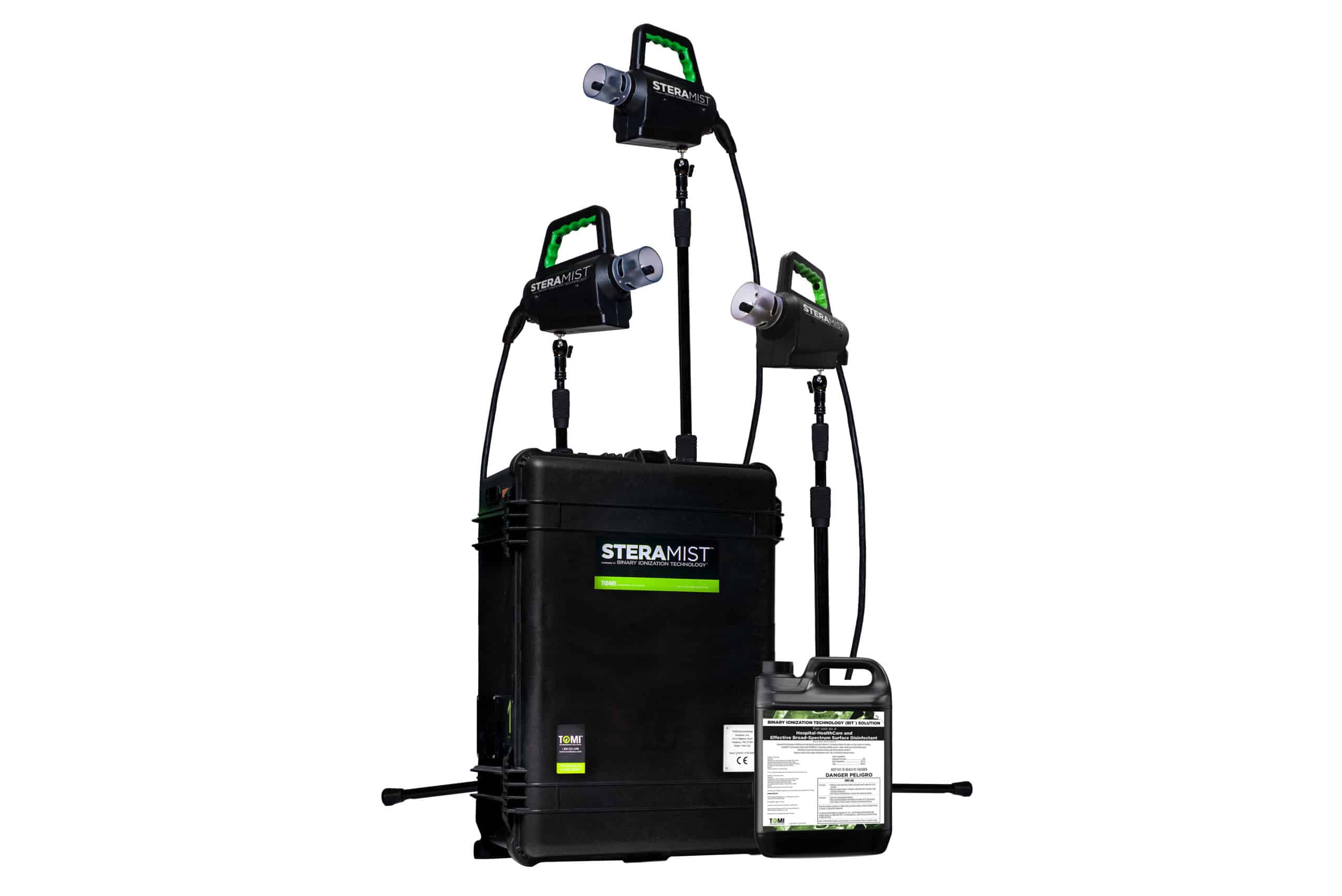
The TOMI SteraMist Environment System is a transportable environment decontamination system engineered for whole-room disinfection, terminal room decontamination, and facility-scale iHP fogging workflows using TOMI’s patented Binary Ionization Technology (BIT™) to deliver broad-spectrum, validated 6-log reduction (99.9999%) pathogen inactivation across the full three-dimensional volume of treated spaces. The system’s three integrated spray port applicators disperse a less-than-8% hydrogen peroxide solution as 0.05–3 micron ionized hydroxyl radical particles that behave like a gas, penetrating beneath furniture, behind equipment, inside HVAC supply zones, and into surface recesses that conventional liquid disinfectants and manual wipe-down protocols cannot effectively reach — making it the preferred whole-room disinfection machine for outbreak response, terminal room decontamination in healthcare settings, biosafety laboratory room decontamination, pharmaceutical room decontamination, and vivarium facility disinfection programs that demand documented, repeatable results with minimal room downtime. For a 3,663.7 ft³ (104 m³) room, the SteraMist Environment System completes the iHP application phase in under 45 minutes, with a complete cycle including contact time and aeration finished in just over 75 minutes — a significant throughput advantage over VHP room decontamination systems that require extended aeration phases before personnel re-entry.
Designed for standardized deployment across diverse facility types and room geometries, the SteraMist Environment System supports automated cycle programming through an intuitive HMI with remote-controlled operation capability, enabling treatment teams to initiate, monitor, and document room decontamination cycles without manual exposure to the iHP fogging environment and without being present in the space during active treatment. Downloadable cycle datasets provide audit-ready documentation for cGMP manufacturing facilities, regulated pharmaceutical production suites, cleanrooms, and hospital infection control programs that require traceable cycle records for regulatory inspection and internal quality assurance protocols. The system’s equipment-compatible iHP chemistry — non-corrosive, no-wipe, no-rinse, and free of the residue associated with chlorine dioxide, formaldehyde, and quaternary ammonium surface treatments — supports deployment in laboratory spaces containing sensitive instrumentation, electronics, cell culture incubators, and other non-washdown assets that would be damaged by liquid disinfectant fogging or high-concentration chemical vapor systems. Facilities deploying the SteraMist Environment System as part of a comprehensive decontamination strategy can also integrate the SteraMist SteraBox for point-of-transfer material decontamination at controlled environment entry points to create a complete contamination control program spanning both room-level and material-transfer workflows.
ARES Scientific is an authorized distributor for TOMI Environmental Solutions, ensuring you receive a genuine SteraMist Environment System with full manufacturer support, application guidance for cycle development and SOP standardization, and access to the complete TOMI iHP product portfolio. The system’s convertible design extends its value beyond whole-room fogging by transforming into handheld surface units for targeted touchpoint disinfection between full room cycles, effectively delivering both a room fogging decontamination system and a surface decontamination system in a single portable platform — maximizing return on investment across diverse facility disinfection workflows in pharmaceutical manufacturing, research laboratories, hospital and clinical environments, vivarium operations, and any regulated setting requiring fast, validated, and material-compatible whole-room disinfection between room uses or following contamination events.
Description
TOMI SteraMist Environment System – Product Highlights
- Whole-room iHP fogging delivers validated 6-log reduction (99.9999%) efficacy against bacteria, bacterial spores, viruses, and fungi using Binary Ionization Technology (BIT™) that disperses 0.05–3 micron ionized hydroxyl radical particles throughout the entire three-dimensional volume of treated spaces, reaching surfaces and recesses that liquid disinfectants, manual wipe-downs, and UV disinfection systems cannot effectively decontaminate in this environment decontamination system.
- Rapid room cycle completes iHP application in under 45 minutes for a 3,663.7 ft³ (104 m³) room, with a total cycle including contact time and aeration finished in just over 75 minutes — enabling faster room turnover for outbreak response, terminal room decontamination between patient admissions, and high-frequency disinfection cycles in pharmaceutical manufacturing suites and research laboratory environments that require minimal operational downtime.
- Automated cycles with remote-controlled operation and downloadable datasets allow treatment teams to initiate, monitor, and document room decontamination cycles without manual presence in the treated space during active iHP fogging, providing audit-ready cycle records that support regulatory inspection compliance for cGMP manufacturing facilities, hospital infection control programs, and cleanroom qualification and requalification documentation requirements.
- Three-applicator configuration ensures consistent room coverage across diverse room geometries, obstacle-filled laboratory spaces, and large treatment volumes, with a standardized dose rate of 0.5 ml per ft³ and a flow rate of 25 ml per minute per applicator delivering repeatable, uniform iHP distribution throughout the treated environment for predictable, validated decontamination cycle performance across all room types.
- Equipment-friendly non-corrosive iHP chemistry is safe for use in spaces containing sensitive laboratory instruments, electronics, cell culture equipment, analytical instruments, and other non-washdown assets that would be damaged by liquid chemical fogging agents, high-concentration VHP systems, or chlorine dioxide room decontamination treatments, enabling whole-room disinfection without requiring equipment removal or extensive pre-treatment protection procedures.
- Dual-use platform converts to handheld surface units for targeted touchpoint disinfection and spot treatment between full room fogging cycles, extending the system’s utility beyond scheduled whole-room decontamination to include rapid response surface disinfection of high-contact areas, equipment surfaces, and critical touch points, effectively delivering both a room fogging system and a surface decontamination system in a single portable platform.
- Transportable design supports multi-room and multi-facility deployment with a compact footprint of 31.28 × 24.21 × 17.48 in and a unit weight of approximately 95 lb, enabling a single system to service multiple laboratory rooms, manufacturing suites, hospital wards, or vivarium zones across a facility without the fixed infrastructure investment required by permanently installed room decontamination systems or dedicated chemical vapor generation equipment.
- Configurable cycle programming via intuitive HMI supports facilities building GMP-aligned, validated room decontamination SOPs with repeatable cycle parameters, custom treatment protocols tailored to specific room volumes and contamination risk levels, and standardized procedures that can be replicated across multiple rooms or facilities within a single decontamination program.
- Broad-spectrum pathogen inactivation supports diverse contamination scenarios including routine terminal room disinfection, post-spill biological decontamination, pre-qualification cleanroom fogging, outbreak response in healthcare and research settings, and scheduled periodic disinfection cycles for pharmaceutical manufacturing suites, BSL-2 and BSL-3 laboratory spaces, and barrier vivarium facilities requiring documented microbial control programs.
- ARES Scientific is an authorized distributor for TOMI Environmental Solutions, ensuring you receive genuine SteraMist Environment System products with full manufacturer warranty, SOP development support, and access to the complete TOMI decontamination portfolio including surface units and material transfer chambers for comprehensive facility contamination control programs.
Frequently Asked Questions – TOMI SteraMist Environment System
What is the TOMI SteraMist Environment System, and how does it work?
The TOMI SteraMist Environment System is a transportable whole-room iHP fogging decontamination platform that uses TOMI’s patented Binary Ionization Technology (BIT™) to convert a less-than-8% hydrogen peroxide solution into 0.05–3 micron ionized hydroxyl radical particles that disperse through the treated space like a gas, achieving 6-log reduction (99.9999%) efficacy against bacteria, bacterial spores, viruses, and fungi by penetrating surfaces, recesses, and areas that liquid disinfectants and manual wipe-down protocols cannot effectively reach. The system operates three applicators simultaneously to ensure consistent room coverage at a standardized dose rate of 0.5 ml per ft³, with automated cycles controlled remotely via an intuitive HMI that generates downloadable cycle data for regulatory documentation and SOP validation. It is categorized within ARES Scientific’s portfolio of environment decontamination systems for whole-facility disinfection applications.
How long does a full room decontamination cycle take with the SteraMist Environment System?
For a reference room volume of 3,663.7 ft³ (104 m³), the SteraMist Environment System completes the iHP fogging application phase in under 45 minutes, with the complete cycle — including contact time and aeration — finished in just over 75 minutes, enabling rapid room turnover for terminal room decontamination between patient care episodes, post-production pharmaceutical suite cleaning, and outbreak response scenarios where minimizing room downtime is operationally critical. This total cycle time is significantly shorter than many vaporized hydrogen peroxide (VHP) room decontamination systems, which require extended aeration phases to reduce residual peroxide concentrations to safe re-entry levels before personnel can return to the treated space. Actual cycle times will vary based on room volume, geometry, HVAC configuration, and treatment protocol requirements specific to the facility’s validated SOP.
How does the SteraMist Environment System compare to VHP room decontamination?
Both SteraMist iHP and vaporized hydrogen peroxide (VHP) systems use hydrogen peroxide as the active decontamination agent, but they differ in concentration, particle physics, cycle speed, and equipment requirements in ways that make iHP a more practical choice for many laboratory and healthcare settings. The SteraMist system uses less than 8% hydrogen peroxide — far below VHP concentrations — and generates an ultra-fine 0.05–3 micron ionized fog that disperses rapidly throughout the room without requiring the sealed, pressurized environments or dedicated exhaust infrastructure that most VHP generator systems demand; aeration after a SteraMist cycle is also faster since lower peroxide concentrations decompose to safe levels more quickly. The non-corrosive residue-free iHP chemistry is additionally more compatible with sensitive laboratory equipment, reducing the need for equipment removal and protection steps that add significant time and labor to VHP room decontamination workflows. Facilities that also need material-level transfer decontamination can pair the Environment System with the SteraMist SteraBox pass-through decontamination chamber for a complete contamination control strategy.
What types of facilities and rooms is the SteraMist Environment System designed for?
The SteraMist Environment System is designed for any facility requiring validated whole-room disinfection with minimal equipment preparation, room modification, or extended downtime, including hospital patient rooms and isolation units for terminal room decontamination between admissions, pharmaceutical manufacturing suites and cleanrooms requiring periodic or pre-qualification room fogging, BSL-2 and BSL-3 biosafety laboratory spaces, vivarium animal housing rooms and procedure areas, blood bank and clinical laboratory spaces, morgue and pathology suites, and cannabis processing and testing facilities. Its transportable design and standardized 110/120V electrical requirement make it deployable across virtually any room type within a facility without specialized installation, and its configurable cycle programming supports facility-specific SOP development across diverse contamination control program requirements. Explore the full decontamination portfolio at ARES Scientific for complementary surface and material transfer decontamination solutions.
Is the SteraMist Environment System safe to use in rooms with sensitive laboratory equipment?
Yes — the SteraMist Environment System’s iHP chemistry is specifically designed to be non-corrosive, residue-free, and compatible with a wide range of materials including electronics, laboratory instruments, cell culture equipment, analytical instruments, plastics, and other sensitive assets that would be damaged by liquid chemical fogging agents, chlorine dioxide, formaldehyde, or high-concentration VHP systems. Unlike many room decontamination technologies that require extensive pre-treatment equipment protection, removal of sensitive instruments, or covering of exposed surfaces, the SteraMist iHP fogging process allows treatment of occupied equipment spaces in most standard laboratory and healthcare room configurations, reducing the labor and preparation time required before and after each decontamination cycle. Users should consult TOMI’s material compatibility guidance and establish validated protocols confirming compatibility for specific equipment configurations in their facility.
What is the difference between the SteraMist Environment System and the SteraMist SteraBox?
The SteraMist Environment System is designed for whole-room, facility-scale iHP fogging decontamination of entire spaces — treating all surfaces, air volumes, and equipment within a room simultaneously — while the SteraMist SteraBox is a stainless-steel decontamination chamber designed for item-level or material-level decontamination of supplies, equipment, and materials that must be treated before transfer into controlled environments such as cleanrooms, pharmaceutical suites, and vivarium barrier facilities. The two systems use the same BIT™ iHP technology and achieve the same 6-log reduction efficacy, but address different points in a facility’s contamination control workflow: the Environment System handles room-level terminal and periodic disinfection, while the SteraBox handles point-of-entry material transfer decontamination. Many facilities deploy both systems together to create a comprehensive contamination control program that addresses decontamination needs at every level of the facility operation.
Technical Specifications – TOMI SteraMist Environment System
| Model: | SteraMist Environment System |
| Manufacturer: | TOMI Environmental Solutions, Inc. |
| Decontamination Technology: | Binary Ionization Technology (BIT™) — ionized hydrogen peroxide (iHP™) |
| Active Agent: | Less than 8% hydrogen peroxide solution converted to hydroxyl radicals (reactive oxygen species) |
| Number of iHP Spray Ports: | 3 applicators |
| Particle Size: | 0.05–3 microns |
| Flow Rate: | 25 ml per minute per applicator |
| Dose Application Rate: | 0.5 ml per ft³ |
| Example Room Volume: | 3,663.7 ft³ (104 m³) |
| Application Time (example room): | Under 45 minutes |
| Total Cycle Time (example room): | Just over 75 minutes (application + contact + aeration) |
| Electrical: | 110/120V AC, 5A |
| Unit Dimensions (W × D × H): | 31.28 × 24.21 × 17.48 in (79.5 × 61.5 × 44.4 cm) |
| Unit Weight: | Approximately 95 lb / 43.09 kg (excludes applicators and stands) |
| Packaged Box Dimensions (L × W × H): | 35.5 × 27 × 22 in |
| Packaged Box Weight: | 106.7 lb |
| Operation Modes: | Automated room fogging; convertible to handheld surface unit mode |
| Data Output: | Downloadable cycle datasets for documentation and audit trail |
| Post-Treatment Requirements: | No wipe, no rinse required |
| Residue: | Non-corrosive; no surface residue |
| Efficacy: | 6-log reduction (99.9999%) against bacteria, spores, viruses, and fungi |
| Warranty: | 1 year parts and labor (voided if seal broken); extended warranty available |
Warranty (parts & labor) One (1) year (voided if seal is broken). Extended Warranty Available.
Related products

Benchmark Incu-Shaker™ 10L Mini with non-slip rubber mat
$3,089.71• TOUCH Screen control over time, speed, and temperature
• Horizontally circular 19mm orbit for aeration & mixing
• Instantly exchange flask clamps with MAGic Clamp™ accessories (PATENTED)
• Program STEP feature for linking consecutive ...