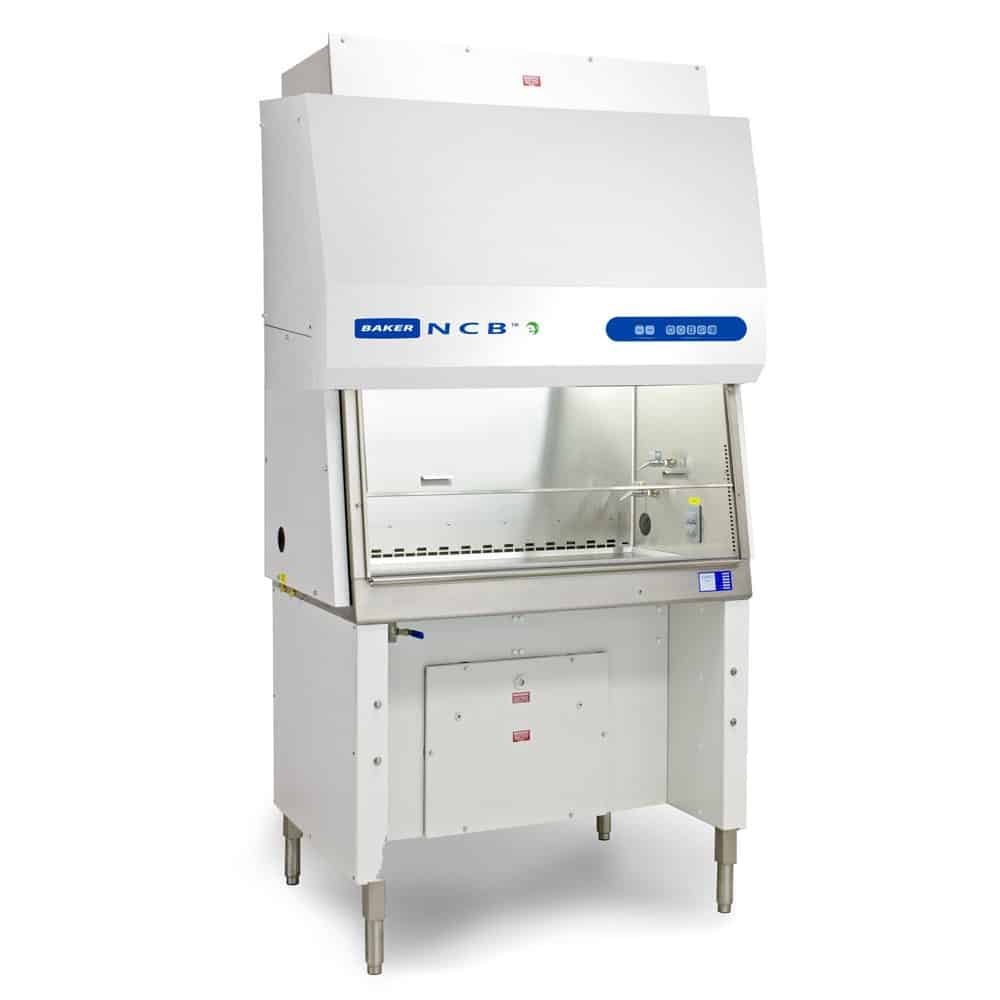
Class II Type B1 Biological Safety Cabinets: Zoned Exhaust for Limited Chemical Use
Class II Type B1 biological safety cabinets represent a specialized intermediate design between recirculating Type A2 and total-exhaust Type B2 cabinets, featuring unique zoned airflow patterns enabling safe handling of minute quantities of volatile chemicals alongside biological materials. The defining characteristic of B1 cabinets lies in their "smoke split"—an invisible airflow boundary dividing the work zone where approximately 30% of air recirculates through supply HEPA filters while 70% exhausts directly through dedicated hard-ducted connections. This split-flow design allows chemical work when performed behind the smoke split location where single-pass airflow prevents recirculation of chemical vapors, while maintaining product sterility and energy efficiency advantages of partial recirculation for biological procedures performed in front of the split.
Research institutions, diagnostic laboratories, and pharmaceutical development facilities occasionally specify Type B1 biosafety cabinets for workflows requiring occasional low-level chemical adjuncts—radioactive isotope labeling, chemical fixation of biological specimens, or small-volume solvent extractions—where full total-exhaust B2 infrastructure cannot be justified. However, the operational complexity inherent in B1 designs has limited their adoption compared to simpler alternatives. The invisible and variable smoke split position creates significant training challenges since operators must understand precisely where airflow transitions from recirculating to exhausting patterns, with chemical work strictly confined to the dedicated exhaust zone to prevent vapor recirculation. Many facilities evaluate whether canopy-exhausted A2 cabinets might provide adequate protection for minute chemical quantities with simpler operation, or whether workflows justify investing in B2 total-exhaust systems eliminating recirculation entirely.
Understanding the B1 Smoke Split and Zoned Airflow Design
The fundamental operational challenge of Type B1 cabinets stems from their divided airflow pattern creating distinct zones with different chemical handling capabilities within a single work envelope. Room air drawn through the front opening at minimum 100 feet per minute velocity mixes with recirculated cabinet air, creating total downflow across the work surface. At an approximately mid-point location along the work surface depth—the "smoke split"—this downflow divides with air in front flowing toward the front grille for recirculation while air behind flows toward the rear grille for direct exhaust. The front approximately 30% of airflow passes through the front grille, travels beneath the work surface to rear plenum spaces, ascends to the supply HEPA filter, and returns as laminar downflow protecting product sterility. The rear approximately 70% of airflow passes through the rear grille, enters a dedicated negative-pressure exhaust plenum isolated from recirculating pathways, ascends to the exhaust HEPA filter, and exits through hard-ducted connections to external exhaust blowers and building HVAC systems.
This zoned design theoretically enables safe chemical use when work occurs exclusively behind the smoke split where single-pass exhaust prevents vapor accumulation, while biological procedures not involving chemicals can utilize the recirculating front zone maintaining energy efficiency. However, the smoke split location is not marked on the work surface and varies depending on airflow balance, filter loading conditions, equipment placement disrupting airflow patterns, and operator arm movements creating turbulence. Smoke visualization during annual certification demonstrates the approximate split location under test conditions, but this boundary shifts during actual operation as conditions change. Purple-shaded "uncertainty zones" in B1 cabinet diagrams illustrate substantial areas where airflow patterns remain ambiguous—air in these transition regions may recirculate or exhaust depending on subtle factors difficult for operators to predict during routine use.
B1 Airflow Configuration and Infrastructure Requirements
Type B1 cabinets require dedicated hard-ducted exhaust connections similar to B2 units but exhausting only 70% of cabinet airflow rather than 100%, resulting in lower exhaust volume requirements and reduced make-up air demands compared to total-exhaust alternatives. External exhaust blowers typically mounted on building roofs maintain 400-800 CFM exhaust volumes creating negative pressure in rear plenum spaces, with actual requirements varying by cabinet size and manufacturer design. Ductwork sizing must accommodate exhaust volumes without excessive static pressure drops that would compromise cabinet containment performance, typically requiring 8-10 inch diameter rigid ducting with minimal bends and appropriate vibration isolation at blower connections. Make-up air systems must supply conditioned replacement air preventing excessive laboratory negative pressure, though requirements approximate 70% of equivalent-size B2 cabinets since 30% of B1 airflow recirculates rather than exhausting.
Installation costs for B1 cabinets typically range $15,000-$35,000 beyond cabinet purchase price when accounting for ductwork fabrication and installation, external blower procurement and mounting, electrical connections for blower and interlock systems, make-up air infrastructure modifications, and structural work potentially required for roof penetrations or mechanical space access. These infrastructure demands approximate 60-70% of B2 installation costs—substantial investment that prompts careful evaluation whether B1 operational characteristics truly match application requirements better than simpler alternatives. Annual operating costs including energy consumption for exhaust blower operation and make-up air conditioning typically range $1,500-$4,000 per cabinet depending on climate and utility rates, falling between A2 recirculating units ($200-$600 annually) and B2 total-exhaust systems ($3,000-$8,000 annually).
Appropriate Applications and Chemical Use Limitations
Type B1 biosafety cabinets serve specialized niches where workflows genuinely require occasional minute chemical quantities alongside predominantly biological procedures, facility infrastructure can accommodate hard-ducted exhaust but not full B2 demands, and operational complexity can be managed through comprehensive training and procedural controls. Research protocols involving trace radionuclide labeling of biological molecules—tritium, carbon-14, phosphorus-32, sulfur-35 in microcurie quantities—may justify B1 cabinets providing direct exhaust for radioactive decay product removal when work occurs behind the smoke split. Tissue fixation procedures using small volumes of formaldehyde, glutaraldehyde, or other chemical fixatives benefit from dedicated exhaust preventing vapor accumulation, particularly in high-throughput histology or pathology laboratories processing numerous specimens daily. Biological sample preparation requiring limited organic solvent extractions—phenol-chloroform DNA extraction, lipid extraction protocols, or metabolite isolation procedures—can utilize B1 cabinets when solvent volumes remain minimal and work positioning behind the smoke split can be consistently maintained.
However, laboratories must critically evaluate whether B1 complexity genuinely provides advantages over simpler alternatives for their specific workflows. Protocols involving only occasional minute chemical quantities—monthly radiolabeling experiments, infrequent fixation procedures, or rare solvent use—may be better served by properly canopy-exhausted A2 cabinets where exhaust connections remove chemical vapors without operational complications of invisible airflow zones. When chemical use occurs frequently or involves more than trace quantities, B2 total-exhaust cabinets eliminate uncertainty about airflow patterns by exhausting the entire work zone, providing superior chemical protection without requiring operators to maintain spatial awareness of invisible smoke split boundaries. Modern Type C1 cabinets offering switchable recirculating/exhausting modes may deliver B1 intended flexibility with clearer operational states and defined chemical-safe zones, though availability remains limited compared to established A2/B1/B2 designs.
Critical Training Requirements and Operational Procedures
Safe operation of Type B1 biosafety cabinets demands comprehensive operator training exceeding requirements for A2 or B2 units due to unique airflow zone characteristics and chemical handling restrictions. Personnel must understand the smoke split concept, recognize that this boundary remains invisible during operation, appreciate factors causing split location variability, and consistently position chemical work in the dedicated exhaust zone behind the approximate mid-depth location. Annual certification smoke testing should be witnessed by all cabinet users providing visual demonstration of airflow patterns under test conditions, though operators must recognize that observed smoke split location represents only one specific condition and actual boundaries shift during routine use. Written standard operating procedures must clearly define which materials and procedures can be performed in which cabinet zones, specify maximum allowable chemical quantities even when working behind the smoke split, and establish protocols for verifying proper exhaust blower operation before beginning chemical work.
Facilities should implement physical marking systems helping operators visualize approximate smoke split locations—removable tape lines on work surfaces, strategically positioned equipment creating visual reference points, or procedural requirements that chemical work occur only in the rear one-third of work depth providing safety margin beyond theoretical split location. Regular competency assessments ensure operators maintain awareness of proper techniques, understand chemical placement restrictions, and recognize alarm conditions indicating exhaust system failures. Despite best training efforts, the invisible and variable nature of B1 airflow zones creates inherent safety concerns that have contributed to declining B1 cabinet specifications in favor of alternatives with more intuitive operational characteristics. Modern biosafety programs increasingly question whether B1 complexity can be justified when simpler cabinet types might achieve equivalent protection with reduced training burden and lower risk of operator error.
Comparison with Type A2 and B2 Alternatives
Selecting between Type B1, A2, and B2 cabinets requires systematic evaluation of chemical use patterns, facility infrastructure capabilities, budget constraints, and operational complexity tolerance. Type A2 cabinets with canopy connections to building exhaust systems can safely handle minute quantities of volatile chemicals per NSF/ANSI 49 guidelines when exhaust volumes remove evaporated vapors from recirculated air streams, potentially providing adequate protection for occasional low-level chemical use without B1 operational complications. The key distinction lies in whether chemical quantities remain truly "minute"—generally interpreted as amounts where vapor concentrations in recirculated air remain below occupational exposure limits and do not interfere with subsequent biological work. For workflows where chemical use genuinely approaches or exceeds minute quantity thresholds, B1 cabinets theoretically provide superior protection through dedicated single-pass exhaust for the rear work zone, though this advantage must be weighed against training complexity and potential for operational errors if work inadvertently occurs in recirculating zones.
Type B2 total-exhaust cabinets eliminate all recirculation through 100% single-pass airflow, providing absolute certainty that chemical vapors exhaust from the facility rather than potentially recirculating regardless of work positioning within the cabinet envelope. This operational simplicity comes at substantial infrastructure cost—B2 units require approximately 150% of B1 exhaust volume, proportionally larger make-up air capacity, and correspondingly higher installation and operating expenses. However, for facilities with workflows involving regular chemical use, significant chemical quantities, or highly toxic compounds where even trace recirculation creates unacceptable risk, B2 investment may be justified by eliminating uncertainty inherent in B1 split-flow designs. The decision framework should consider total lifecycle costs including not only equipment and infrastructure but also training program development, ongoing competency verification, and potential consequences of operational errors—factors that may favor simpler cabinet types even when initial purchase prices appear comparable.
When B1 Cabinets Represent Optimal Solutions
Despite operational complexities, specific scenarios exist where Type B1 biosafety cabinets genuinely provide optimal balance of capabilities, infrastructure demands, and costs. High-throughput laboratories processing hundreds of biological specimens daily with standardized fixation protocols may benefit from B1 cabinets allowing rapid fixative application in the rear exhaust zone followed by biological processing in the recirculating front zone within a single cabinet, avoiding transfers between chemical fume hoods and biosafety cabinets that disrupt workflow and potentially compromise sample sterility. Radioisotope research facilities with established training programs and experienced personnel comfortable with complex equipment may successfully operate B1 cabinets for protocols requiring occasional radiolabeling where trace quantities justify exhaust capability but frequency and volumes do not warrant B2 infrastructure investment. Retrofit situations where existing facility infrastructure includes partial exhaust capacity insufficient for B2 requirements but adequate for B1 70% exhaust volumes may find B1 cabinets enabling chemical-compatible biocontainment without extensive facility modifications.
However, these scenarios represent specialized cases rather than typical laboratory needs. General microbiology, cell culture, diagnostic testing, or research programs without specific chemical handling requirements should specify A2 cabinets avoiding unnecessary complexity and infrastructure investment. Programs with regular significant chemical use should invest in B2 total-exhaust systems providing unambiguous chemical safety rather than accepting B1 operational limitations. The declining market share of B1 cabinets in contemporary laboratory equipment purchases reflects growing recognition that most applications are better served by simpler Type A2 or more comprehensive Type B2 alternatives, with B1 occupying an increasingly narrow middle ground as operational complexity outweighs potential advantages for many users.
Certification, Maintenance, and Exhaust System Monitoring
Type B1 biosafety cabinets require comprehensive annual certification by qualified technicians trained in procedures specific to hard-ducted exhaust configurations and split-flow airflow patterns. Certification protocols verify minimum 100 feet per minute inflow velocity at the work opening with cabinet recirculation blower operating, proper negative pressure in exhaust plenum spaces, HEPA filter integrity for both supply and exhaust filters, smoke pattern visualization demonstrating proper airflow split and containment at the work surface, and alarm function testing confirming audible and visual notification if exhaust airflow drops below acceptable thresholds. The critical importance of functioning exhaust systems for B1 containment performance necessitates interlock systems preventing cabinet operation if external blower failures compromise dedicated exhaust capability—without proper exhaust pull, contaminated air might flow into recirculating pathways or escape from the cabinet entirely rather than following intended split-flow patterns.
Ongoing exhaust system maintenance represents a significant B1 ownership consideration beyond cabinet-specific servicing. External roof-mounted blowers require quarterly inspections verifying proper operation, annual belt replacement on belt-driven models, bearing lubrication per manufacturer schedules, and vibration monitoring detecting developing mechanical issues before failures occur. Ductwork joints should be inspected annually for separation or deterioration that could compromise negative pressure maintenance, with particular attention to connections near blower inlets where vibration transmission creates stress on fittings. Exhaust monitoring systems providing continuous verification of proper airflow should be calibrated annually ensuring alarm thresholds trigger at appropriate flow reductions, with documented testing confirming that alarms both activate properly and that cabinet interlocks prevent operation when exhaust conditions fall outside acceptable ranges.
B1 Filter Replacement and Service Access Considerations
Filter replacement procedures for Type B1 cabinets involve additional complexity compared to recirculating A2 units due to contaminated exhaust plenum spaces and hard-ducted connections that must be properly sealed during service activities. Supply HEPA filters typically accessed from the front or top of the cabinet require standard decontamination procedures before removal—formaldehyde or vaporized hydrogen peroxide treatment eliminating residual biological contamination protecting service personnel from exposure during filter handling. Exhaust HEPA filters located in dedicated negative-pressure plenums connected to building ductwork present additional challenges since these spaces remain contaminated from direct exposure to work zone air and require both cabinet decontamination and temporary exhaust duct sealing preventing contaminated air release during filter change procedures. Some B1 designs incorporate bag-in/bag-out filter housings enabling filter replacement without direct contact with contaminated surfaces, though these systems add cost and complexity to cabinet construction.
Service technicians performing B1 filter replacements must be specifically trained in procedures maintaining containment during service activities, understanding exhaust system isolation requirements, and verifying proper re-establishment of airflow patterns after filter installation. Post-replacement leak testing becomes particularly critical for B1 cabinets since any leakage in exhaust filter seals could allow contaminated air to bypass filtration and enter ductwork, potentially distributing biological hazards throughout building HVAC systems. Facilities should budget for specialized service requirements when planning B1 cabinet ownership—filter replacement costs typically range $1,200-$2,500 including materials, specialized labor, pre-replacement decontamination, post-replacement certification, and documentation, occurring every 3-5 years depending on usage intensity and laboratory air quality.
Regulatory Compliance and Documentation Requirements
Type B1 biosafety cabinets must meet NSF/ANSI Standard 49 performance specifications defining airflow velocities, filter efficiency requirements, containment verification protocols, and construction standards ensuring proper negative pressure plenum design and appropriate materials selection. Facilities operating under cGMP regulations for pharmaceutical development or manufacturing must maintain comprehensive documentation of B1 cabinet installation qualification, operational qualification, and performance qualification demonstrating that cabinets consistently meet specified performance criteria. Institutional biosafety committees reviewing research protocols involving B1 cabinets typically require detailed descriptions of chemicals to be used, positioning within cabinet zones, maximum quantities per procedure, and operator training programs ensuring proper technique adherence. Some institutions may restrict B1 cabinet use to specific applications or require additional approvals beyond standard biosafety cabinet protocols due to operational complexity and potential for improper use.
Documentation requirements for B1 cabinets exceed those for simpler A2 units, including records of exhaust blower maintenance, duct system inspections, interlock function testing, operator training completion, and competency assessments verifying proper understanding of smoke split concepts and chemical handling restrictions. Facilities should establish standard operating procedures specific to each B1 cabinet installation addressing which materials and procedures are permitted, work positioning requirements relative to the smoke split, pre-use verification checklists confirming exhaust system operation, and emergency procedures if exhaust failures occur during operations. Annual regulatory inspections or internal audits should verify that B1 cabinets operate within certified parameters, operators demonstrate proper technique, and documentation systems capture required information supporting compliance with institutional biosafety programs and applicable regulatory standards.
Cost-Benefit Analysis and Alternative Technology Evaluation
Comprehensive cost-benefit analysis for Type B1 biosafety cabinet procurement should account for total lifecycle expenses spanning 15-20 year service life rather than focusing solely on initial purchase price. Cabinet acquisition costs typically range $25,000-$55,000 depending on size and feature specifications, falling between A2 recirculating units ($8,000-$25,000) and B2 total-exhaust systems ($45,000-$120,000) but closer to B2 pricing than A2. Installation infrastructure including ductwork, external blowers, electrical connections, and facility modifications adds $15,000-$35,000 for typical B1 installations. Annual operating costs for exhaust blower energy, make-up air conditioning, certification services, and routine maintenance total $2,000-$5,000. Filter replacements every 3-5 years cost $1,200-$2,500 per event. Training program development and ongoing operator competency verification add difficult-to-quantify expenses that may substantially exceed similar programs for A2 or B2 cabinets due to unique B1 operational requirements.
When total lifecycle costs aggregate to $80,000-$150,000+ over 15-20 years, facilities should carefully evaluate whether B1 capabilities genuinely provide value justifying this investment versus alternatives. Comparable-size A2 cabinets with canopy exhaust connections might deliver adequate minute chemical handling capability at total lifecycle costs of $25,000-$45,000—less than half B1 expenses—while eliminating operational complexity and training burden. B2 total-exhaust cabinets costing $150,000-$300,000 over similar timeframes provide unambiguous chemical safety and operational simplicity that may prove worthwhile for facilities with regular chemical use, particularly when considering potential costs of operational errors or training program failures with more complex B1 systems. Alternative containment strategies including ducted chemical fume hoods for chemical work and separate A2 biosafety cabinets for biological procedures might provide equivalent protection at comparable total cost while avoiding compromises inherent in combination designs.
Emerging Technologies and Future Cabinet Development
The limited and declining adoption of Type B1 biosafety cabinets in contemporary laboratory design reflects both operational complexity challenges and emergence of alternative technologies potentially addressing similar application needs with improved safety characteristics. Type C1 cabinets incorporating switchable operating modes allowing selection between recirculating A2-equivalent operation and hard-ducted B2-equivalent total exhaust provide flexibility previously unavailable, enabling facilities to adapt cabinet configuration to specific procedure requirements rather than relying on invisible airflow zones. These designs typically feature clearly defined chemical-safe work areas when operating in exhaust mode rather than variable smoke split locations, potentially reducing training requirements and operational errors. However, Type C1 cabinets remain relatively uncommon in the market with limited manufacturer offerings and higher costs than traditional designs, restricting adoption primarily to specialized facilities with specific requirements justifying premium pricing.
Computational fluid dynamics modeling and advanced airflow monitoring technologies may enable future B1 cabinet designs with real-time smoke split position indication, providing operators with visual or audible feedback confirming proper work positioning relative to recirculating and exhausting zones. Such systems could address primary safety concerns around invisible airflow boundaries while preserving energy efficiency advantages of partial recirculation. However, fundamental questions remain whether market demand justifies continued B1 development investment when simpler A2 and more comprehensive B2 alternatives serve most laboratory needs effectively. Facilities planning new laboratory construction or renovation should carefully evaluate whether including B1 cabinet specifications in equipment programs genuinely reflects anticipated research needs or represents outdated thinking about biosafety cabinet requirements that might be better addressed through clearer choices between recirculating A2 and total-exhaust B2 technologies.
Why Consider ARES Scientific for Type B1 Biosafety Cabinet Needs
ARES Scientific provides expert guidance helping research institutions, diagnostic laboratories, and pharmaceutical development facilities evaluate whether Type B1 biosafety cabinets genuinely represent optimal solutions for specific application requirements or whether alternative technologies might deliver superior value. Our technical specialists bring extensive experience assessing complex containment needs, understanding the unique operational characteristics and limitations of B1 split-flow designs, and helping customers make informed decisions balancing capabilities, infrastructure demands, costs, and operational complexity. We recognize that B1 cabinets serve specialized niches rather than representing appropriate solutions for most laboratory applications, and we prioritize matching equipment specifications to actual workflow requirements rather than defaulting to middle-ground compromises that may not serve any purpose optimally.
Our comprehensive project support extends beyond equipment sales to encompass critical installation planning, exhaust system design verification, operator training program development, and ongoing service resources ensuring B1 cabinets deliver intended performance throughout their service life. We help facilities assess whether existing HVAC infrastructure can accommodate B1 exhaust requirements without extensive modifications, coordinate with mechanical contractors ensuring proper ductwork and blower installation, verify interlock system function preventing unsafe operation during exhaust failures, and develop customized training materials addressing specific chemical handling protocols and work positioning requirements for particular research applications. For facilities determining that B1 complexity cannot be justified, we provide equivalent guidance on properly specified A2 or B2 alternatives delivering appropriate containment with operational characteristics better aligned to user needs and capabilities.
Contact ARES Scientific to discuss your biosafety cabinet requirements and evaluate whether Type B1, A2, B2, or alternative containment technologies best address your biological and chemical protection needs. Our containment specialists will assess your specific workflows, chemical usage patterns, facility infrastructure capabilities, and operator training resources, providing honest recommendations on optimal cabinet type selection. Request a quote by calling (720) 283-0177 or email info@aresscientific.com to connect with your local territory representative for personalized consultation on Type B1 biosafety cabinet specification, installation planning, and comprehensive lifecycle support.