Professional Autopsy Tables for Forensic, Clinical, and Research Pathology
Autopsy tables are specialized examination surfaces engineered for postmortem procedures in medical examiner offices, hospital pathology departments, veterinary diagnostic laboratories, and academic medical centers. These purpose-built tables provide stable, hygienic platforms for forensic autopsies, clinical autopsies, anatomical dissection, and necropsy procedures. Unlike standard surgical or laboratory tables, autopsy tables feature integrated drainage systems, fluid containment, specimen irrigation capabilities, and construction materials that withstand repeated exposure to biological materials, disinfectants, and cleaning agents.
ARES Scientific offers a comprehensive range of pathology and mortuary equipment including autopsy tables designed for diverse facility types and procedural requirements. Our portfolio includes pedestal-style autopsy tables, elevating autopsy tables with hydraulic height adjustment, pediatric autopsy tables for smaller specimens, ventilated dissection tables with integrated fume extraction, and pass-through autopsy tables for high-throughput facilities. Each configuration addresses specific workflow needs, from single-examiner community hospitals to high-volume metropolitan medical examiner offices conducting hundreds of autopsies annually.
Common Applications and Use Cases
Autopsy tables serve critical functions across forensic, clinical, veterinary, and educational settings:
- Forensic autopsy examinations: Complete postmortem examinations for medicolegal death investigation in medical examiner and coroner systems, including homicide, accident, and suspicious death cases
- Clinical autopsy procedures: Hospital-based autopsies for quality assurance, diagnostic correlation, medical education, and family-requested examinations to determine cause of death
- Pediatric and neonatal autopsies: Specialized examinations of infants and children requiring smaller table dimensions and appropriate positioning capabilities
- Mass fatality operations: Temporary or permanent facilities managing multiple simultaneous examinations during disasters, pandemics, or mass casualty events
- Anatomical dissection and education: Medical school gross anatomy laboratories, donated body programs, and continuing medical education courses using human cadavers
- Veterinary diagnostic necropsy: Animal disease investigation, diagnostic pathology services, and food safety examinations in veterinary diagnostic laboratories
- Research animal necropsy: Biomedical research facilities conducting terminal procedures and tissue collection from laboratory animals including rodents, rabbits, swine, and non-human primates
- Large animal pathology: Equine, bovine, and exotic animal examinations requiring reinforced tables with greater weight capacity and larger dimensions
- Tissue and organ procurement: Organ donation recovery procedures and tissue banking operations requiring specialized positioning and access
- Training and competency assessment: Pathology resident training, continuing education for forensic pathologists, and death investigator certification programs
Types of Autopsy Tables and Configurations
Selecting the appropriate autopsy table type depends on facility volume, procedure complexity, available space, budget, and specific workflow requirements. Understanding the distinctions between table configurations helps optimize both functionality and operational efficiency.
Pedestal-Style Autopsy Tables
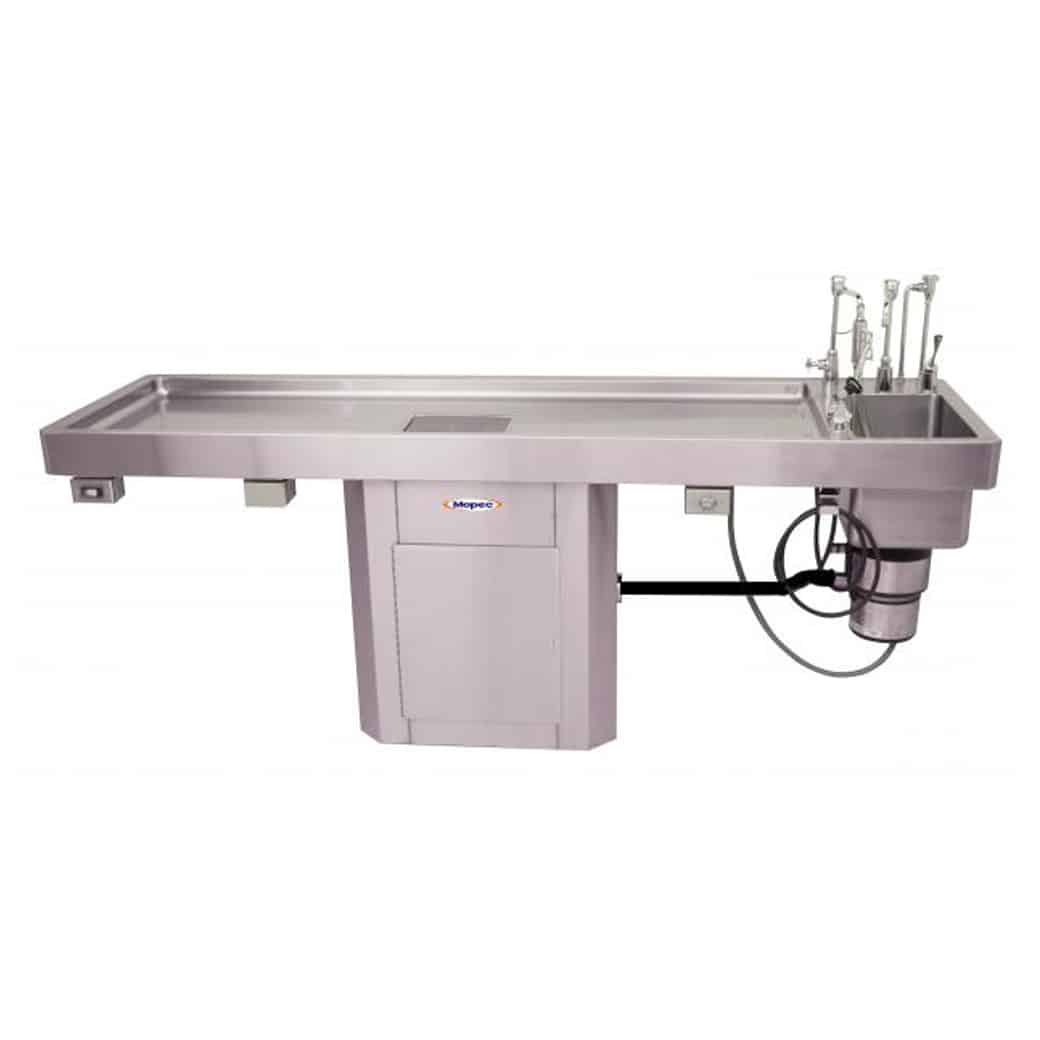
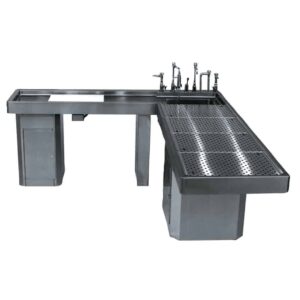
Pedestal autopsy tables feature a central support column with a fixed-height work surface, representing the most common and economical configuration for general autopsy use. The Mopec CE series exemplifies this design, offering stable platforms with integrated drainage channels, removable perforated trays, and optional wing extensions for instrument staging. Pedestal tables work well in facilities with standard ceiling heights and consistent procedural requirements, though they lack the height adjustability that benefits ergonomic positioning for examiners of different statures or procedures requiring varied working heights.
Elevating and Height-Adjustable Autopsy Tables
Elevating autopsy tables incorporate hydraulic, electric, or pneumatic lift systems that allow height adjustment during procedures. The Mopec CE600-CE700 series with elevating option provides motorized height adjustment, reducing examiner fatigue during lengthy procedures and accommodating examiners of different heights without requiring stools or platforms. Height-adjustable tables benefit facilities with multiple pathologists, teaching programs where observers need varied viewing angles, or procedures requiring both detailed examination (lower positions) and gross dissection (higher positions). These tables command premium pricing but offer significant ergonomic advantages in high-volume settings.
Pediatric Autopsy Tables
Pediatric autopsy tables feature reduced dimensions appropriate for infants, children, and small adults, typically 48-60 inches long compared to 72-84 inches for adult tables. The Mopec CE400-CE900 pediatric pedestal-style tables are available in multiple lengths to accommodate different size ranges. Pediatric tables optimize workspace in facilities handling mixed adult and pediatric caseloads, allowing adult tables to remain available while pediatric examinations proceed on appropriately sized surfaces. Many children's hospitals and facilities with significant pediatric volumes maintain dedicated pediatric autopsy tables.
Ventilated Dissection Tables with Downdraft
Ventilated autopsy tables incorporate integrated downdraft ventilation systems that capture aerosols, odors, and airborne particles at the work surface before they enter the breathing zone. The Mopec HC series ventilated dissection tables feature built-in HEPA filtration and recirculation systems that eliminate the need for facility-level fume extraction. These tables are particularly valuable for facilities handling decomposed remains, infectious disease cases, or situations where aerosol generation is a concern, though they require regular filter maintenance and represent higher initial investment than non-ventilated alternatives.
Pass-Through and Dual-Sided Autopsy Tables
Pass-through autopsy tables allow body positioning from either side of the table, facilitating collaborative examinations, teaching demonstrations, and high-throughput workflows where multiple examiners work simultaneously. These tables typically mount in facility walls between autopsy suite and clean corridor, though freestanding versions exist for open suite designs. Pass-through configurations benefit metropolitan medical examiner offices managing dozens of cases daily and academic medical centers conducting teaching autopsies where multiple residents and students require access.
C-Arm Compatible and Imaging-Integrated Tables
Some autopsy tables feature radiolucent surfaces or specialized construction allowing positioning of C-arm fluoroscopy, portable x-ray equipment, or CT imaging systems for postmortem radiological examination. The Mopec C-arm compatible autopsy carts provide mobile alternatives to fixed tables when imaging integration is required. These specialized tables support facilities incorporating digital imaging systems into autopsy protocols, particularly valuable for detecting foreign bodies, fractures, or projectiles before invasive examination begins.
Rotating and Tilting Autopsy Tables
Advanced autopsy tables incorporate rotation mechanisms that allow repositioning the body without manual lifting, reducing examiner strain and expediting procedures requiring access to posterior body surfaces. The Mopec HM100 two-body rotating dissection table accommodates simultaneous examination of multiple bodies while providing 360-degree rotation capability. These specialized tables serve high-volume facilities, mass fatality operations, and teaching institutions where efficiency and ergonomics justify the additional investment.
How to Choose the Right Autopsy Table
Selecting the optimal autopsy table configuration requires careful evaluation of multiple facility-specific and operational factors:
- Annual case volume and throughput requirements: High-volume facilities (200+ cases annually) benefit from hydraulic elevating tables, pass-through designs, or multiple standard tables; low-volume facilities can optimize budgets with fixed-height pedestal tables
- Case mix and demographic served: Facilities handling significant pediatric volumes should consider dedicated pediatric tables; mixed adult/pediatric facilities may opt for adjustable-height adult tables that accommodate both populations
- Examiner ergonomics and physical considerations: Elevating tables reduce fatigue for examiners conducting 3-4 hour procedures; facilities with examiners of significantly different heights benefit from height adjustment capabilities
- Available autopsy suite space and ceiling height: Measure actual clear dimensions including overhead obstructions; account for autopsy cart positioning, personnel circulation space, and equipment access around tables
- Plumbing infrastructure and drainage capacity: Existing floor drain locations may dictate table placement; verify drain size (minimum 3-inch diameter) and slope adequacy for table drainage systems
- Teaching and training requirements: Academic programs benefit from pass-through tables, rotating tables for 360-degree viewing, or multiple tables allowing simultaneous instruction of resident groups
- Ventilation and odor control needs: Facilities without dedicated autopsy suite HVAC may require ventilated tables with integrated downdraft; facilities handling decomposed remains regularly should prioritize ventilation capabilities
- Infection control and decontamination protocols: Consider ease of cleaning, surface materials, crevice-free construction, and compatibility with facility disinfection procedures and frequencies
- Imaging integration requirements: Facilities using postmortem CT, radiography, or C-arm fluoroscopy need tables compatible with imaging equipment positioning or radiolucent surfaces
- Budget and total cost of ownership: Balance initial equipment costs against maintenance requirements, expected lifespan (15-20 years typical), and replacement cycles; consider operational costs for elevating mechanisms and ventilation systems
- Regulatory compliance and accreditation: Ensure selected tables meet applicable NAME (National Association of Medical Examiners) facility standards, CAP accreditation requirements, or state/local health department specifications
- Future facility expansion or relocation: Modular designs or multiple smaller tables provide flexibility if facility needs change; consider whether pass-through mounting limits future reconfiguration
Key Features to Compare
When evaluating autopsy tables, focus on features that directly impact workflow efficiency, examiner safety, specimen integrity, and long-term durability:
- Work surface dimensions and weight capacity: Adult tables typically 30-36 inches wide × 72-84 inches long; verify weight capacity (standard 350-500 lbs, bariatric 800-1000 lbs) matches your population demographics
- Stainless steel gauge and construction quality: 14-gauge or heavier stainless steel provides superior durability; seamless welded construction eliminates crevices where biological material and bacteria can harbor
- Drainage system design and efficiency: Perforated top surfaces with underlying collection channels facilitate fluid runoff; integrated drain connections should be 1.5-inch minimum diameter to prevent clogging
- Removable tray and grid systems: Perforated trays that lift out simplify cleaning and allow access to drainage channels; stainless steel grids should be heavy-gauge to resist bending under body weight
- Integrated sink and spray systems: Some tables incorporate built-in autopsy sinks or spray heads at the head or foot for specimen rinsing and cavity irrigation without requiring separate sink access
- Instrument and accessory mounting: Wing extensions, hanging rails, magnetic tool strips, and organ hanging systems keep frequently used instruments accessible and organized during procedures
- Height adjustment range and mechanism: Hydraulic or electric elevating tables should provide 30-40 inches of height range; evaluate adjustment speed, control location, and foot pedal vs. hand control options
- Pedestal base design and stability: Wide pedestal bases (24-30 inch diameter) provide greater stability than narrow bases; leveling feet should be easily accessible and adjustable
- Downdraft ventilation specifications: Ventilated tables should provide minimum 100 feet per minute face velocity; verify HEPA filtration efficiency and filter replacement frequency/cost
- Surface finish and cleanability: Brushed or satin stainless finishes resist staining better than polished surfaces; coved corners and radius edges eliminate hard-to-clean joints
- Compatibility with body positioning accessories: Verify table accepts standard head blocks, organ cutting boards, rib spreaders, and other positioning aids your facility uses
- Warranty coverage and service availability: Evaluate manufacturer warranty terms (typically 2-5 years); confirm availability of replacement parts and qualified service technicians in your region
Autopsy Table Maintenance and Best Practices
Proper maintenance extends table lifespan, ensures examiner safety, maintains infection control standards, and prevents costly repairs. Implement these protocols to optimize autopsy table performance:
- Post-procedure cleaning: Remove all biological material; rinse table surfaces thoroughly with water; clean with hospital-grade disinfectant appropriate for stainless steel; allow adequate contact time per manufacturer specifications
- Daily end-of-shift protocols: Remove and clean perforated trays; inspect drainage channels for debris; flush drain connections with water; wipe down pedestals, controls, and surrounding floor areas
- Weekly deep cleaning: Disassemble removable components; clean underneath grids and trays; inspect and clean drain traps; check spray heads for mineral deposits; verify all mounting hardware is secure
- Monthly maintenance checks: Inspect stainless steel surfaces for corrosion, pitting, or damage; examine welded joints and seams; test elevating mechanisms for smooth operation; lubricate moving parts per manufacturer recommendations
- Filter maintenance for ventilated tables: Replace pre-filters monthly or per manufacturer schedule; replace HEPA filters annually or when airflow monitoring indicates reduced performance; document all filter changes
- Hydraulic system servicing: Check hydraulic fluid levels quarterly; inspect for leaks around cylinders and connections; bleed air from system if height adjustment becomes jerky or uneven
- Drain system management: Avoid chemical drain cleaners that corrode stainless steel; use enzymatic cleaners designed for biological material; schedule annual professional drain cleaning and camera inspection
- Staff training and protocols: Train all users on proper cleaning procedures, appropriate disinfectants, and maintenance requirements; post cleaning protocols visibly in autopsy suite
- Documentation and compliance: Maintain cleaning logs demonstrating daily disinfection; document preventive maintenance activities; retain records for facility accreditation and regulatory inspections
- Damage prevention: Avoid using abrasive scrubbers or steel wool that scratch surfaces; don't use table surfaces as cutting boards; prohibit standing on tables or placing excessive weight on wing extensions
Designing Complete Autopsy Suites and Facility Integration
Autopsy tables function as centerpieces of comprehensive facility systems. Thoughtful integration with complementary equipment creates efficient, compliant workflows while optimizing limited space and budget resources.
Most facilities pair autopsy tables with autopsy and embalming sinks for hand washing, instrument cleaning, and specimen preparation. Mobile autopsy carts provide flexible body transport and positioning, while hydraulic cadaver carriers reduce manual lifting strain when transferring bodies between refrigeration systems and examination tables.
High-volume facilities benefit from organized cadaver storage rack systems that maximize refrigeration capacity while facilitating efficient body retrieval. Facilities handling tissue processing pair autopsy tables with dedicated pathology grossing stations that provide ventilated workspaces for specimen examination and sampling.
Modern pathology facilities increasingly incorporate digital imaging systems for documentation and evidence preservation. Medical examiners and coroners exploring facility modernization often reference insights on the evolution of pathology from microscopes to digital platforms when planning comprehensive suite upgrades. For guidance on optimizing adjacent work areas, review best practices in enhancing anatomical pathology with modern grossing stations.
Veterinary diagnostic laboratories and large animal research facilities should also consult resources on essential features for large animal necropsy tables when planning necropsy suite configurations that accommodate diverse specimen sizes.
Frequently Asked Questions
What is the difference between an autopsy table and a dissection table?
Autopsy tables and dissection tables serve similar functions but are optimized for different settings and procedural requirements. Autopsy tables are designed specifically for complete postmortem examinations in forensic and clinical pathology, emphasizing features like integrated drainage systems, fluid containment, specimen irrigation capabilities, and construction that withstands daily exposure to blood, body fluids, and aggressive disinfectants. They typically feature perforated top surfaces with underlying drainage channels, removable grids, and configurations supporting full-body examinations. Dissection tables, while also made from stainless steel, may have simpler drainage systems and are often used in educational settings like medical school anatomy laboratories where teaching and learning take precedence over high-throughput examination workflows. Many dissection tables incorporate ventilation features to manage odors during extended anatomical dissection sessions. The terms are sometimes used interchangeably, but facilities conducting medicolegal autopsies typically specify "autopsy tables" while educational institutions may use "dissection tables" or "cadaver tables." Functionality overlaps significantly, and many tables serve both purposes depending on facility needs.
Do autopsy tables require special plumbing or floor drains?
Yes, autopsy tables require adequate drainage infrastructure to handle blood, body fluids, irrigation water, and cleaning solutions. Most tables include integrated drainage connections (typically 1.5 to 2-inch diameter) that must connect to facility floor drains or plumbing systems. Floor drains should be minimum 3-inch diameter with adequate slope (1/4 inch per foot minimum) to prevent backups and pooling. Many jurisdictions require P-traps or specialized biological material traps in drainage lines to prevent sewer gas infiltration and capture debris before it enters main facility plumbing. Water supply requirements vary by table configuration—tables with integrated sinks or spray systems need both hot and cold water connections, typically 1/2 to 3/4-inch supply lines with adequate pressure for simultaneous operation of multiple spray heads. Facilities planning new autopsy suites or table replacements should provide equipment specifications to plumbing contractors early in design phases, as drain locations often dictate table placement. Some facilities must upgrade existing drainage infrastructure when installing modern autopsy tables with greater water volume requirements than older equipment. Local health departments and plumbing codes govern specific requirements, which vary by jurisdiction. ARES Scientific provides detailed plumbing specifications and dimensional drawings to support facility planning and contractor coordination.
Can autopsy tables accommodate bariatric patients?
Standard autopsy tables typically have weight capacities of 350-500 pounds, which may be insufficient for bariatric patients (individuals over 300-400 pounds). Facilities serving populations with significant obesity rates or located in jurisdictions with increasing bariatric autopsy requirements should specify reinforced tables with 800-1000 pound weight capacities. Bariatric autopsy tables feature heavier-gauge stainless steel construction, reinforced pedestal bases, and wider work surfaces (typically 36-42 inches compared to standard 30-32 inches) to accommodate larger body dimensions. Some facilities invest in one or two bariatric-rated tables while maintaining standard tables for typical cases, allowing appropriate equipment selection based on decedent size. Another consideration is width of doorways, corridors, and refrigeration units—even with bariatric autopsy tables, facilities must ensure body transport equipment and refrigeration systems also accommodate larger individuals. Metropolitan medical examiners and coroners in areas with high obesity rates increasingly specify bariatric-rated equipment as standard rather than specialty items. Consult ARES Scientific about weight capacity requirements during equipment selection to ensure tables meet your population demographics.
How much space is required around an autopsy table?
Adequate clearance around autopsy tables ensures efficient workflows, compliance with safety regulations, and accommodation of equipment and personnel. General guidelines recommend minimum 42-48 inches of clear space on the primary working side of the table to allow unrestricted examiner movement, positioning of instrument carts, and use of mobile equipment like portable x-ray systems. For tables positioned against walls, maintain 24-36 inches clearance on non-working sides for cleaning access and maintenance. Pass-through tables require adequate clearance on both sides since examiners may work from either direction. Main traffic aisles in autopsy suites should be minimum 48-60 inches wide to accommodate cadaver carriers, gurneys, and personnel movement. Facilities with multiple tables should space them 6-8 feet apart to prevent workflow interference between concurrent examinations. Overhead clearance must account for ceiling-mounted equipment, lighting, and any ventilation ductwork—standard 9-10 foot ceiling heights usually provide adequate clearance. Facilities planning new construction or renovations should provide autopsy table specifications and layout preferences to architects early in design processes. Cramped autopsy suites compromise efficiency, create safety hazards, and complicate compliance with infection control protocols. ARES Scientific can review facility layouts and provide space planning recommendations to optimize table placement.
What maintenance is required for hydraulic elevating autopsy tables?
Hydraulic elevating autopsy tables require routine maintenance to ensure reliable operation and prevent failures during procedures. Check hydraulic fluid levels quarterly—most systems use standard hydraulic fluid available from industrial suppliers, though some manufacturers specify proprietary fluids. Inspect hydraulic cylinders, hoses, and connections monthly for leaks, damage, or deterioration; even small leaks can allow air into the system, causing jerky or uneven operation. If table height adjustment becomes slow, uneven, or requires multiple pump cycles to achieve full range, the system may need bleeding to remove trapped air—this procedure varies by manufacturer but generally involves opening bleed valves while operating the pump to purge air pockets. Lubricate pivot points and mechanical linkages annually with appropriate lubricants per manufacturer recommendations. Test emergency descent mechanisms (if equipped) quarterly to verify they function properly if hydraulic systems fail. Many facilities schedule annual preventive maintenance by qualified technicians who inspect the complete hydraulic system, verify operation across full height range, and replace worn components before failures occur. Maintain documentation of all hydraulic system maintenance as part of equipment service records. While hydraulic systems are generally reliable, facilities uncomfortable with hydraulic maintenance may prefer electric elevating tables with fewer maintenance requirements. ARES Scientific can connect facilities with qualified service providers for hydraulic system maintenance and repair.
Are there infection control standards specific to autopsy tables?
While no single regulation exclusively governs autopsy table design, multiple standards and guidelines establish requirements affecting table selection and use. OSHA's Bloodborne Pathogens Standard (29 CFR 1910.1030) requires appropriate work surfaces that can be decontaminated in areas with potential exposure to blood and other potentially infectious materials—stainless steel autopsy tables meet these requirements when properly cleaned and disinfected. CDC guidelines for safe handling of human remains emphasize appropriate decontamination procedures and surface materials that resist corrosion from repeated disinfectant exposure. The National Association of Medical Examiners (NAME) publishes inspection and accreditation checklists for medical examiner and coroner offices that include facility and equipment standards. Many state health departments have specific regulations governing autopsy facility design, surfaces, and sanitation protocols. While these standards rarely mandate specific table models, they collectively establish functional requirements: non-porous surfaces, adequate drainage, cleanability, and resistance to biological materials and disinfectants. Facilities pursuing NAME accreditation or operating under state licensure should review applicable standards during equipment selection. Stainless steel autopsy tables with seamless construction, coved corners, and proper drainage systems meet or exceed typical regulatory requirements when incorporated into appropriate facility cleaning and infection control protocols. ARES Scientific equipment documentation supports facility compliance efforts and accreditation processes.
Can veterinary facilities use human autopsy tables for animal necropsy?
Yes, many veterinary diagnostic laboratories, veterinary schools, and research facilities use human autopsy tables for animal necropsy procedures, though species size and procedural requirements should inform equipment selection. Small animal necropsy (companion animals, laboratory animals, wildlife) works well with standard human autopsy tables—the dimensions, drainage, and work surface features are entirely appropriate. Large animal necropsy (equine, bovine, swine, exotic species) requires tables with reinforced construction, larger work surfaces, and higher weight capacities than standard human tables. Some veterinary facilities invest in specialized veterinary necropsy tables designed specifically for animal pathology, featuring dimensions and configurations optimized for common domestic species. Facilities handling both small and large animal necropsy may maintain multiple table sizes to efficiently accommodate diverse caseloads. Veterinary teaching hospitals and diagnostic laboratories should review resources on essential features for large animal necropsy tables when planning equipment purchases. The primary considerations are work surface dimensions adequate for typical specimens, weight capacity matching the heaviest animals examined, and drainage systems appropriate for the volumes of fluid encountered. ARES Scientific assists veterinary facilities with table selection, ensuring equipment matches both current caseloads and anticipated future needs.
Related Pathology and Mortuary Equipment
Autopsy tables work in conjunction with complementary pathology and mortuary equipment to create complete, efficient facility solutions. Explore these related categories:
Request a Quote for Autopsy Tables
ARES Scientific provides expert guidance on selecting autopsy tables that meet your facility's procedural requirements, space constraints, and budget parameters. Our team understands the unique needs of medical examiner offices, hospital pathology departments, veterinary diagnostic laboratories, and academic medical centers.
Whether you're establishing a new facility, renovating existing autopsy suites, or replacing aging equipment, we help you evaluate configuration options and select optimal solutions. Our autopsy table portfolio includes equipment from trusted manufacturers with proven performance in demanding forensic and clinical pathology applications.
Contact ARES Scientific to discuss your autopsy table requirements:
Our pathology equipment specialists provide product recommendations, dimensional drawings, installation requirements, and budget estimates to support facility planning. We collaborate with architects, facility planners, medical examiners, and procurement teams to ensure equipment selections meet functional requirements, regulatory standards, and project timelines.
Explore our related resources on pathology facility planning and equipment selection: