
Understanding CO2 Incubator Jacket Technology
The jacket system surrounding a CO2 incubator’s chamber is one of the most critical, yet often overlooked, components affecting temperature stability, uniformity, and recovery time. When selecting a CO2 incubator for cell culture applications, understanding the differences between water-jacketed, air-jacketed, and gel-jacketed designs can significantly impact your research outcomes and operational efficiency.
The jacket serves as a thermal buffer between the internal chamber environment and external laboratory conditions. It maintains consistent temperatures throughout the incubator, minimizes temperature fluctuations during door openings, and ensures uniform heat distribution across all shelf levels. Each jacket technology offers distinct advantages depending on your specific application requirements. Learn more about decontamination cycles in CO2 incubators to complement your understanding of jacket systems.
Water-Jacketed CO2 Incubators: Traditional Temperature Stability
How Water-Jacketed Systems Work
Water-jacketed incubators surround the chamber with a reservoir of heated water, typically circulating continuously to maintain even temperature distribution. The water acts as a thermal mass, storing heat energy and releasing it slowly to buffer against temperature fluctuations.
Advantages of Water-Jacketed Incubators
- Superior Temperature Recovery: Large thermal mass provides excellent recovery after door openings, maintaining stable conditions when accessing cultures frequently
- Temperature Uniformity: Water circulation creates consistent temperatures across all shelves and throughout the chamber
- Power Outage Protection: Retains heat for extended periods during electrical interruptions, potentially saving valuable cell lines
- Proven Technology: Decades of reliable performance in research laboratories worldwide
Disadvantages of Water-Jacketed Incubators
- Maintenance Requirements: Water reservoirs require regular monitoring, refilling, and treatment to prevent contamination
- Contamination Risk: If not properly maintained, water can harbor bacteria, algae, or fungi
- Weight: Significantly heavier than air-jacketed models, making installation and relocation more challenging
- Slower Heat-Up Time: Takes longer to reach operating temperature from a cold start
- Potential Leakage: Water jacket integrity must be maintained to prevent leaks
Air-Jacketed CO2 Incubators: Modern Efficiency and Low Maintenance
How Air-Jacketed Systems Work
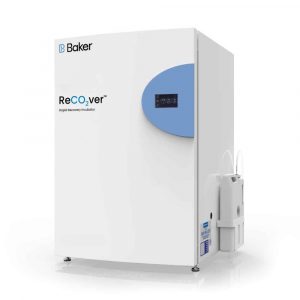
Air-jacketed incubators use heated air circulating in the space between the chamber wall and outer cabinet. Electric heaters warm the air, which is continuously circulated by fans to maintain temperature uniformity. The Baker RECO2ver utilizes advanced air-jacketed technology combined with intelligent temperature control algorithms.
Baker RECO2ver Air-Jacketed Technology
The Baker RECO2ver represents the latest evolution in air-jacketed incubator design. Its proprietary InteliCELL™ PID control algorithm provides pinpoint control over temperature, CO2, and humidity with industry-leading recovery rates. The system achieves better-than-ISO Class 4 (Class 10) air quality in less than 2 minutes, the fastest filtering rate among CO2 incubators.
Key features of the Baker RECO2ver’s air-jacketed design include:
- Vertical Downward Airflow: Delivers clean air from a full-face HEPA filter, sweeping contaminants away from cultures
- Rapid Temperature Recovery: Returns to setpoint quickly after door openings, minimizing stress on sensitive cell cultures
- Active Condensation Control: InteliCELL algorithm factors in surface temperature gradient and sensor accuracy to prevent condensation even at high humidity levels (up to 92% RH)
- Energy Efficiency: Direct heating without the thermal mass of water reduces energy consumption
Advantages of Air-Jacketed Incubators
- Minimal Maintenance: No water to monitor, refill, or treat, significantly reduces routine maintenance
- Fast Heat-Up: Reaches operating temperature quickly, ideal for labs needing rapid turnaround
- Lighter Weight: Easier to install, relocate, and position in laboratory settings
- Reduced Contamination Risk: Eliminates water-related contamination concerns
- Precise Control: Modern systems like the Baker RECO2ver offer exceptional temperature uniformity and stability
- Energy Efficient: Generally consumes less power than water-jacketed models
Disadvantages of Air-Jacketed Incubators
- Faster Heat Loss: Lower thermal mass means temperature drops more rapidly during power outages
- Potential Temperature Variation: Less expensive models may show greater temperature fluctuations during door openings
- Dependency on Power: Limited thermal buffer during electrical interruptions
Gel-Jacketed CO2 Incubators: Caron’s Innovative Hybrid Solution
How Gel-Jacketed Systems Work
Gel-jacketed technology represents an innovative hybrid approach pioneered by Caron Scientific. The Caron GelJacket system surrounds the chamber with a proprietary high-energy absorbing thermal gel that combines the best characteristics of both water-jacketed and air-jacketed designs.
Caron’s Proprietary Thermal Gel Technology
Caron’s thermal gel blankets the entire incubator chamber, absorbing and storing heat energy while maintaining precise temperature control. This advanced material provides superior thermal mass compared to air-jacketed systems while eliminating the maintenance requirements and contamination risks associated with water jackets.
The Caron 7404 Series Stackable GelJacket CO2 Incubators are available in 10 cu.ft. capacity, designed to maximize laboratory space efficiency while accommodating large culture vessels. These units can be stacked to create multiple independent environments within a single footprint. For applications requiring both heating and cooling capabilities, explore our heated and cooled incubators.
Key Features of Caron GelJacket Incubators
- Thermal Gel Technology: Proprietary gel provides exceptional temperature stability, maintaining interior temperature even during power failures
- gVapor™ Humidity Control: Earth-friendly controlled humidity system delivers vapor on an as-needed basis without wasting energy or generating excess heat
- Tool-Free Interior: Components can be removed effortlessly in under 3 minutes for routine cleaning or configuration changes
- Optional H2O2 Sterilization: Patented 2-hour dry hydrogen peroxide cycle eliminates contamination without post-cycle cleanup
- Drift-Resistant IR CO2 Sensor: Provides quick CO2 recovery after door openings and maintains ultra-stable environments
- Stackable Design: Optimizes laboratory space by creating multiple independent chambers in a compact footprint
Advantages of Gel-Jacketed Incubators
- Best of Both Worlds: Combines thermal mass benefits of water jackets with low maintenance of air jackets
- Excellent Temperature Recovery: Thermal gel retains heat during door openings and power interruptions
- Zero Water Maintenance: No filling, monitoring, or treatment required
- No Contamination Risk: Sealed gel system eliminates water-related bacterial growth
- Superior Uniformity: Gel blanket ensures consistent temperatures across entire chamber
- Space Efficiency: Stackable models maximize culture capacity per square foot of lab space
- Energy Retention: Maintains stable temperatures with reduced energy consumption
- Culture Capacity: 10 cu.ft. size provides 1.5x the capacity of standard benchtop cell culture incubators
Disadvantages of Gel-Jacketed Incubators
- Limited Availability: Currently exclusive to Caron Scientific’s product line
- Initial Cost: May have higher upfront investment compared to basic air-jacketed models
- Gel Integrity: Long-term performance depends on maintaining gel jacket integrity (though Caron units are highly durable)
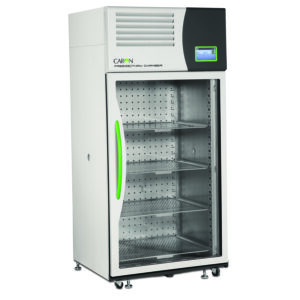
Caron Reach-In CO2 Incubators: Scaling Up with Thermal Technology
For applications requiring larger capacity, the Caron Reach-In Shaker-Ready CO2 Incubators (25 and 33 cu.ft. models) offer production-scale solutions while maintaining advanced thermal management. While these units utilize refrigeration systems rather than gel jackets, they incorporate Caron’s commitment to temperature stability and contamination control:
- Adaptable Refrigeration: Handles internal heat loads from shaker platforms while maintaining optimal temperature control
- 500 lb. Dynamic Load Capacity: Supports high-capacity shake flask loads and high-volume multi-layer flasks
- 2-Hour H2O2 Sterilization: Rapid, validatable chamber sterilization with no post-cycle cleanup—compare with our sterilizers and autoclaves
- Cleanroom-Ready Options: Available with 316 stainless steel construction for cGMP environments
- Tool-Free Interior: Disassembles in under 3 minutes for quick cleaning
Side-by-Side Comparison: Jacket Technologies
| Feature | Water-Jacketed | Air-Jacketed (Baker RECO2ver) | Gel-Jacketed (Caron GelJacket) |
|---|---|---|---|
| Thermal Mass | High | Low to Medium | High |
| Temperature Recovery | Excellent | Rapid (advanced models) | Excellent |
| Power Outage Protection | Excellent (hours) | Limited | Very Good |
| Maintenance Requirements | High (water management) | Low | Low |
| Contamination Risk | Moderate (water-related) | Low | Very Low |
| Heat-Up Time | Slow | Fast | Moderate |
| Weight | Heavy | Light | Moderate |
| Temperature Uniformity | Excellent | Very Good to Excellent | Excellent |
| Energy Efficiency | Moderate | Good to Excellent | Very Good |
| Installation Flexibility | Limited (heavy) | Excellent | Good |
| Advanced Features | Standard | InteliCELL control, ISO Class 4 air | gVapor humidity, H2O2 sterilization |
| Ideal Capacity Range | All sizes | Small to large (Baker models) | 10 cu.ft. stackable (Caron) |
| Best For | Frequent access, power concerns | Low maintenance, rapid recovery | Space efficiency, low maintenance |
| Compatible Equipment | Benchtop instruments | Biosafety cabinets | Orbital shakers |
Which Jacket Technology Is Right for Your Application?
Choose Water-Jacketed Incubators When:
- Your facility experiences frequent power interruptions or lacks backup power
- You need maximum thermal protection for irreplaceable cell lines
- Cultures are accessed extremely frequently throughout the day
- Your laboratory has dedicated staff for routine maintenance procedures
- Temperature uniformity is critical for sensitive primary cells or stem cells
- You’re working with established protocols specifying water-jacketed equipment
Choose Air-Jacketed Incubators (Like Baker RECO2ver) When:
- You need minimal maintenance requirements and maximum uptime
- Rapid temperature recovery after door openings is essential
- You require ISO Class 4 air quality with HEPA filtration
- Fast heat-up time from cold start is important for your workflow
- You want to eliminate water-related contamination risks entirely
- Energy efficiency and operational cost reduction are priorities
- You need precise humidity control with active condensation prevention
- GMP compliance requires pharmaceutical-grade contamination control—see our guide on biosafety cabinets for pharmaceutical compounding
- Installation flexibility and unit relocation are important considerations
- You’re setting up cleanroom environments requiring ISO-certified equipment
Choose Gel-Jacketed Incubators (Like Caron GelJacket) When:
- You want water-jacket thermal performance without maintenance burden
- Laboratory space is at a premium and stackable designs would maximize capacity
- You need excellent temperature stability with minimal energy consumption
- Zero contamination risk is a top priority for sensitive cell cultures
- You want tool-free cleaning and rapid chamber reconfiguration
- Quick H2O2 sterilization cycles (2 hours) would improve productivity
- You’re working with large culture vessels requiring 10 cu.ft. capacity
- Power outage protection is important but not mission-critical
- Your application requires multiple independent environment chambers in one footprint
- You’re designing pharmaceutical manufacturing facilities with space constraints
- Integration with air shower systems is required for personnel protection
Application-Specific Recommendations
Stem Cell Research and Regenerative Medicine
Recommended: Caron GelJacket or Water-Jacketed
Stem cells are extremely sensitive to temperature fluctuations and environmental changes. The high thermal mass of gel-jacketed or water-jacketed systems provides optimal stability. Caron’s GelJacket eliminates water contamination risks while maintaining superior temperature uniformity critical for pluripotent stem cell maintenance. Complement with proper cold storage solutions for cell banking and media storage.
Cell and Gene Therapy Manufacturing
Recommended: Baker RECO2ver or Caron Reach-In Models
GMP manufacturing environments require rapid turnaround, validated sterilization, and maximum contamination control. The Baker RECO2ver’s ISO Class 4 air quality and InteliCELL control ensure pharmaceutical-grade conditions. For larger production volumes, Caron’s 25-33 cu.ft. reach-in models with cleanroom-ready packages and 2-hour H2O2 sterilization offer excellent scalability. Pair with biological safety cabinets for comprehensive contamination control.
High-Throughput Drug Screening
Recommended: Baker RECO2ver
Frequent door access for plate manipulation demands rapid recovery. The RECO2ver’s fast temperature and CO2 recovery (< 2 minutes to ISO Class 4) minimizes experimental variability. Low maintenance requirements reduce downtime in high-volume operations. Consider pairing with Class II biological safety cabinets for optimal contamination control throughout your workflow.
Academic Research Laboratories
Recommended: Caron GelJacket Stackable
Academic labs often need multiple environment chambers for diverse projects while managing limited space and budget. Caron’s stackable GelJacket units maximize capacity per square foot, minimize maintenance labor costs, and provide flexibility to create different culture conditions simultaneously. For general applications, explore our full range of laboratory incubators.
Vaccine and Antibody Production
Recommended: Caron Reach-In Shaker-Ready Models
Large-scale production requires substantial capacity and equipment compatibility. Caron’s 25-33 cu.ft. reach-in models support up to 500 lb. of shake flasks with adaptable refrigeration to handle heat load. The 2-hour H2O2 sterilization cycle maintains contamination-free conditions between production runs.
Primary Cell Culture and Tissue Engineering
Recommended: Caron GelJacket or Baker RECO2ver
Primary cells are notoriously sensitive to environmental stress. Both systems offer excellent temperature stability and advanced contamination control. Choose Caron GelJacket for maximum thermal buffer and stackable configuration flexibility, or Baker RECO2ver for ISO Class 4 air quality and rapid parameter recovery. For researchers working with primary cells from animal research facilities, maintaining consistent culture conditions is critical.
Temperature Uniformity and Stability Considerations
Temperature uniformity across all shelf positions is critical for reproducible results, especially when running multiple experiments simultaneously. All three jacket technologies can achieve excellent uniformity, but through different mechanisms. For related information on jacket technology, see our article on air vs. water-jacketed laboratory incubators. Similar thermal principles apply to laboratory ovens and other temperature-controlled equipment.
Water-Jacketed Uniformity
Water circulation creates natural convection currents that distribute heat evenly throughout the jacket. This results in consistent chamber wall temperatures and minimal shelf-to-shelf variation. Temperature gradients are typically less than ±0.25°C at 37°C.
Air-Jacketed Uniformity (Baker RECO2ver)
The RECO2ver’s vertical downward airflow pattern, combined with full-face HEPA filtration, ensures uniform temperature distribution while simultaneously maintaining air quality. The InteliCELL algorithm actively compensates for any temperature variations, achieving uniformity comparable to water-jacketed systems.
Gel-Jacketed Uniformity (Caron GelJacket)
Thermal gel completely blankets the chamber, creating a continuous heat reservoir with no cold spots. This comprehensive coverage ensures exceptional uniformity across all shelf levels. The gel’s thermal properties provide stability that bridges the gap between water and air systems.
Humidity Control and Condensation Management
Maintaining appropriate humidity levels (typically 90-95% RH for cell culture) without creating condensation is a significant challenge for CO2 incubators. Jacket technology directly impacts humidity management:
Caron gVapor™ Technology
Caron’s GelJacket incubators feature the proprietary gVapor humidity control system. Unlike conventional steam generator humidification systems, gVapor delivers controlled humidity vapor on an as-needed basis without generating heat or wasting energy. The drift-resistant IR sensor maintains precise humidity levels while the thermal gel jacket prevents condensation formation on chamber walls.
Baker RECO2ver InteliCELL™ Humidity Management
The RECO2ver’s InteliCELL PID control algorithm factors in surface temperature gradient and RH sensor accuracy to prevent condensation even at high humidity setpoints (up to 92% RH). The system provides active condensation control, automatically adjusting parameters to maintain optimal conditions without sacrificing humidity levels. This ultrasonic nebulizer-based system generates no excess heat and requires minimal maintenance.
Sterilization and Contamination Control
Effective contamination control extends beyond the jacket system, but jacket technology influences sterilization effectiveness and maintenance requirements:
Caron H2O2 Sterilization
Both Caron GelJacket stackable and reach-in models offer an optional patented 2-hour dry hydrogen peroxide sterilization cycle. This validated system achieves 12-log reduction with no post-cycle cleanup required. The gel jacket maintains chamber integrity during the sterilization process without water contamination concerns.
Baker RECO2ver Plus H2O2 Decontamination
The RECO2ver Plus model includes optional H2O2 total biodecontamination in addition to UV light, killing even resistant contaminating microbes in approximately 4 hours (versus up to 12 hours for other methods). The air-jacketed design facilitates rapid cycling between decontamination and normal operation without thermal mass delays.
Energy Efficiency and Operating Costs
Long-term operating costs significantly impact total cost of ownership. Jacket technology directly affects energy consumption:
- Water-Jacketed: Moderate energy consumption. Large thermal mass requires continuous energy input to maintain temperature but provides excellent retention. Water treatment and monitoring add to operating costs.
- Air-Jacketed (Baker RECO2ver): Good to excellent energy efficiency. Direct heating with lower thermal mass reduces continuous energy draw. No water treatment costs. Rapid heat-up minimizes energy waste during startup. Consider adding environmental monitoring systems for complete oversight.
- Gel-Jacketed (Caron GelJacket): Very good energy efficiency. Thermal gel provides excellent heat retention with reduced energy consumption compared to continuous water circulation. No water treatment or monitoring costs. Learn more about real-time temperature monitoring for critical applications.
Installation and Infrastructure Considerations
Water Requirements
- Water-Jacketed: Requires pH-neutral water (50K-1MΩ resistivity) from distilled, RO, or DI sources. Ongoing water supply essential. Similar requirements to laboratory water baths.
- Air-Jacketed: No water jacket to maintain. Baker RECO2ver requires only humidity water reservoir.
- Gel-Jacketed: Caron units require pH-neutral water for humidity system only. Optional CRSY condensate recirculator available for facilities without house water systems.
Electrical Requirements
All three technologies typically require 115V or 208/230V power, though specifications vary by model and capacity. Water-jacketed units may draw slightly more power for continuous water circulation, while air-jacketed systems use fans for air circulation. Always verify electrical specifications for specific models.
Physical Installation
- Water-Jacketed: Heavy units require reinforced surfaces and may need multiple personnel or equipment for relocation.
- Air-Jacketed: Lighter weight allows easier installation and future relocation. Baker RECO2ver units offer installation flexibility.
- Gel-Jacketed: Moderate weight. Caron’s stackable models designed for space efficiency and can be configured to fit through standard doorways.
Making Your Decision: Questions to Ask
When selecting between jacket technologies, consider these critical questions:
- How frequently will you access the incubator daily? High-frequency access favors high thermal mass systems (water or gel) or rapid recovery systems (Baker RECO2ver).
- What is your laboratory’s power reliability? Frequent outages favor water or gel jackets for thermal protection. Consider backup systems similar to those used with laboratory refrigeration.
- How much laboratory floor space is available? Limited space may benefit from Caron’s stackable GelJacket design.
- What are your maintenance labor constraints? Limited maintenance staff favors air or gel jackets over water-jacketed systems.
- Is contamination control mission-critical? GMP manufacturing or sensitive cell lines may benefit from gel jackets or Baker RECO2ver’s ISO Class 4 air.
- What is your budget for both initial purchase and ongoing operation? Consider total cost of ownership including energy, maintenance, and potential culture loss.
- Do you need rapid sterilization capabilities? Caron’s 2-hour H2O2 cycle or Baker RECO2ver Plus’s 4-hour decontamination may be essential.
- How important is equipment relocation flexibility? Future lab renovations may favor lighter air-jacketed systems. Plan with appropriate lab furniture.
- What culture capacity do you require now and in the future? Small stackable units, medium benchtop, or large reach-in models?
- Are you working under GMP regulations? Cleanroom-ready options available for both Caron reach-in and Baker RECO2ver systems.
- Do you need environmental testing capabilities? Consider complementary environmental test chambers for stability studies.
Conclusion: Matching Technology to Your Needs
There is no universally “best” jacket technology, the optimal choice depends on your specific application requirements, laboratory infrastructure, and operational priorities. However, clear patterns emerge:
For maximum thermal protection with minimal maintenance, Caron’s GelJacket technology delivers water-jacket performance without water-related complications. The stackable design maximizes space efficiency while the 2-hour H2O2 sterilization provides rapid turnaround between experiments.
For pharmaceutical-grade contamination control and rapid recovery, the Baker RECO2ver’s air-jacketed design with InteliCELL control and ISO Class 4 air quality sets the industry standard. The system excels in high-throughput environments requiring frequent access and minimal downtime.
For production-scale applications, Caron’s 25-33 cu.ft. reach-in shaker-ready models provide the capacity and flexibility needed for vaccine production, antibody manufacturing, and cell therapy applications, with optional cleanroom-ready packages for GMP compliance.
Regardless of jacket technology, modern CO2 incubators from manufacturers like Caron Scientific and Baker Company incorporate sophisticated control systems, contamination prevention features, and user-friendly designs that far surpass earlier generations of equipment. Pair your incubator with complementary equipment like laboratory centrifuges, homogenizers, and ultra-low temperature freezers for a complete cell culture workflow.
Ready to Upgrade Your CO2 Incubator?
Selecting the right CO2 incubator with optimal jacket technology is crucial for research success and operational efficiency. Our team of laboratory equipment specialists can help you evaluate your specific requirements and recommend the ideal solution from our complete line of Caron Scientific and Baker Company CO2 incubators.
Contact ARES Scientific today for:
- Detailed technical specifications and performance data
- Custom configuration recommendations based on your applications
- Competitive pricing on Caron GelJacket, Caron Reach-In, and Baker RECO2ver models
- Installation planning and facility assessment
- Demonstration units and customer references
Don’t let jacket technology confusion delay your critical cell culture research. Let our expertise guide you to the perfect incubator solution.