Dissection tables are the central work surface in any anatomy lab, mortuary, or medical examiner facility, and selecting the right configuration directly affects workflow efficiency, infection control, and staff ergonomics. ARES Scientific carries a comprehensive range of dissection tables from Mopec, a manufacturer recognized across the mortuary science and medical education sectors for stainless steel construction and purpose-built designs. Whether the application involves gross anatomy instruction, embalming preparation, forensic examination, or multi-body throughput in a busy coroner's office, the selection available through ARES Scientific's pathology and mortuary equipment catalog covers the full range of facility needs. Models span standard recessed-top tables, creased-top variants with integrated fluid channeling, covered tables for dignified body storage, rotating dual-body configurations, and ventilated dissection tables with integrated exhaust hoods for facilities managing formaldehyde vapor exposure. Every model in this category features all-welded type 304 stainless steel construction with a weight capacity of approximately 350 lbs, heavy-duty locking casters, and integrated PVC drain valves — the core requirements for a sanitary, durable dissection work surface.
Dissection Table Types and Configurations
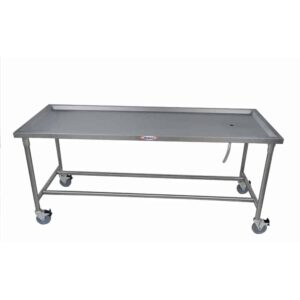
Recessed and Creased-Top Tables — The Mopec HA Series represents the workhorse configuration for most anatomy and mortuary applications. The HA100 features an 86" L × 30" W recessed non-removable top with a built-in tapered slope and PVC drain valve, supported by four heavy-duty 5" casters with three total-lock and one directional caster for controlled positioning. The HA100 recessed-top table works well in medical school gross anatomy labs where a fixed, cleanable surface is preferred. The HA200 offers a creased-top variant at a narrower 78" L × 27" W footprint, suited to smaller rooms or when lateral fluid channeling is preferred over the recessed perimeter design. The HA400 extends the creased-top design to 87" L × 30" W and adds built-in drawers for instrument storage, reducing the need for separate carts during procedure. All HA Series tables carry a sloped top height range of approximately 34.4"–36", accommodating different operator heights without requiring height-adjustable mechanisms. Each table reaches a weight capacity of approximately 350 lbs, consistent with full-body cadaveric loads in adult anatomy programs.
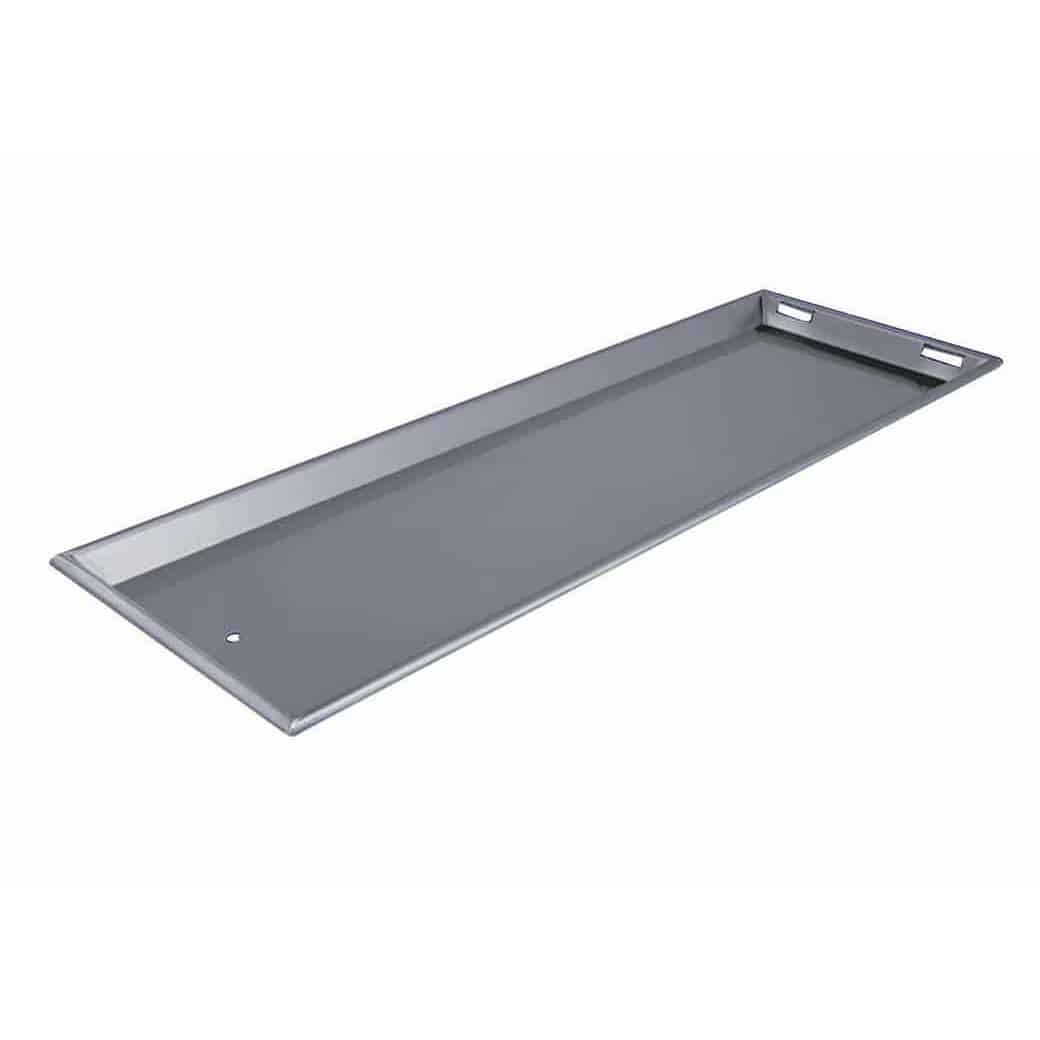
Economy and Cart-Style Configurations — The Mopec HA210 economy dissection table provides the standard 80" L × 30" W × 36" H form factor with a creased non-removable top and drain valve at a reduced feature set, appropriate for facilities managing budget constraints or high-turnover training environments. The HA300 dissection cart takes a different approach: it uses a conveyor roller transfer top and includes a removable 27" body tray (JC101), making it adaptable for facilities that need to move the work surface between rooms or integrate it alongside autopsy carts in a multi-room workflow. The JC Series heavy-duty body trays with hand slots function as standalone accessories or removable components, providing flexibility for facilities that standardize on tray-based cadaver handling systems coordinated with cadaver carriers and transfer equipment.
Covered and Rotating Multi-Body Tables — The Mopec HB Series covered dissection table introduces hinged covers with a lid-assist mechanism designed to safely and easily open and close over cadavers up to approximately 250 lbs. The recessed non-removable top and all-stainless construction allow the HB Series to function as both a working surface and a temporary covered storage unit, which is useful in smaller facilities where dedicated cadaver refrigeration units are not adjacent to the work area. The Mopec HM100 two-body rotating dissection table provides the highest throughput configuration, measuring 95" L × 33" W × 39.7" H and accommodating two fixed body trays of 26" W × 78" L each mounted on a rotating mechanism. The rotating design allows staff to reposition bodies between the two trays without manual lifting, reducing physical strain and improving procedural efficiency in high-volume anatomy programs or busy medical examiner offices.
Dissection Table Features and Construction Standards
Stainless Steel Construction and Sanitation Design — All dissection tables in this category use all-welded type 304 stainless steel construction with heavy-duty tubing, typically 1.5" square 16-gauge. Type 304 stainless steel resists corrosion from the disinfectants, embalming fluids, and biological fluids routinely encountered in mortuary and anatomy environments. The all-welded frame eliminates mechanical fasteners from fluid-contact surfaces, which reduces harborage points for pathogens and simplifies decontamination. Integrated tapered slopes on recessed and creased-top models direct fluid toward the PVC drain valve, which connects to standard facility drainage systems. This self-draining design supports compliance with OSHA's bloodborne pathogen standard (29 CFR 1910.1030) by facilitating rapid surface decontamination between uses. Facilities that also perform embalming preparation benefit from pairing dissection tables with dedicated autopsy and embalming sinks that share the same corrosion-resistant material standard.
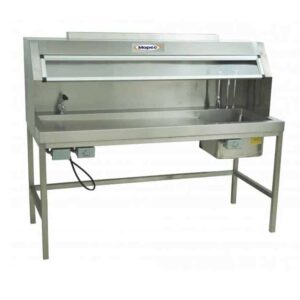
Ventilated Hood Systems — The Mopec HC Series — available in HC100, HC200, and HC300 variants — integrates a vented hood directly above the work surface, creating a downdraft or backdraft airflow pattern that captures formaldehyde vapor and other volatile organic compounds at the point of generation. This is a critical feature in gross anatomy programs where preserved cadavers release formaldehyde vapor continuously during dissection. OSHA's permissible exposure limit (PEL) for formaldehyde is 0.75 ppm as an 8-hour TWA, with a short-term exposure limit (STEL) of 2 ppm; enclosed or poorly ventilated anatomy labs frequently exceed these thresholds without active source capture. The HC Series ventilated dissection tables exhaust captured air to the facility's ductwork, keeping ambient air concentrations within regulatory limits and reducing reliance on room-level general ventilation alone. The vented hood configuration is available across multiple size variants to match different room layouts and cadaver volumes.
Mobility and Ergonomics — Heavy-duty 5" casters with a combination of total-lock and directional-lock wheels appear on most models in this category. The total-lock casters immobilize the table during procedures, while the single directional-lock caster allows controlled steering when repositioning. This caster configuration supports safe integration with cadaver lifts that require a stable, positioned table during transfer. Table heights in the HA Series range from approximately 34.4" to 36" on a sloped surface, reflecting the ergonomic requirements for standing operators performing manual dissection. Facilities with height-variable needs should evaluate the specific model dimensions carefully, as most tables in this category are fixed-height designs rather than hydraulically adjustable.
Applications Across Anatomy and Mortuary Facility Types
Medical School and University Anatomy Programs — Gross anatomy remains a foundational component of medical, dental, nursing, and physical therapy education. University anatomy departments typically operate dedicated dissection labs with multiple tables accommodating simultaneous student groups, each assigned a cadaver from the institution's anatomical gift or willed body program. In this setting, the HA Series recessed or creased-top tables provide the flat, drainable work surface students and faculty need for full-body dissection over a semester-long course. The HA400 with integrated drawers supports organized instrument storage at each station, reducing cross-contamination risk from shared instrument carts. Ventilated HC Series tables are commonly specified in new construction or renovation projects where institutional health and safety policies mandate source-capture ventilation as part of the anatomy, morgue, and pathology facility design. The HM100 rotating two-body table serves programs with high cadaver-to-student ratios, enabling efficient use of limited floor space when multiple dissection positions are needed from a single table footprint.
Funeral Homes and Mortuary Science Programs — Licensed funeral establishments and mortuary science training programs use dissection tables for embalming preparation, body viewing preparation, and cosmetological restoration procedures. In these environments, the covered HB Series table addresses the specific need for maintaining body dignity during the interval between case receipt and preparation, particularly in smaller facilities where a separate body holding room is not available. The HA300 dissection cart with its conveyor roller top and removable body tray provides useful flexibility for funeral homes that transfer bodies between a receiving area and a preparation room, coordinating with autopsy tables or embalming equipment already in use. State mortuary board regulations govern preparation room equipment requirements, and all-stainless-steel, drain-equipped tables typically satisfy surface material and sanitation requirements across most state codes.
Medical Examiner and Coroner Offices — Medical examiner (ME) and coroner offices operate under forensic investigation mandates that require documented chain-of-custody handling and thorough evidentiary examination of decedents. The work surfaces used in these settings must withstand heavy use, support large adult body weights, and facilitate rapid decontamination between cases. The HA100 and HA400 stainless steel tables serve straightforward examination workflows, while the HM100 two-body rotating table provides throughput advantages in busy jurisdictions where multiple simultaneous examinations are common. ME facilities typically integrate dissection tables alongside autopsy carts for instrument organization and X-ray positioning equipment, creating a coordinated procedure environment. Facilities managing infectious or decomposed cases benefit from the complete drainability and non-porous stainless surfaces that support terminal disinfection protocols aligned with CDC infection control guidance.
Selecting the Right Dissection Table for Your Facility
Configuration and Surface Design — The first decision point is the top configuration: recessed versus creased. Recessed tops like the HA100 contain fluid within a perimeter channel, which suits facilities performing embalming or wet gross anatomy where fluid pooling is expected. Creased tops like the HA200 and HA400 channel fluid laterally toward a central or peripheral drain, which works well for anatomy programs that use injection-preserved specimens with lower fluid volume. Facilities that need temporary covered storage should evaluate the HB Series, and programs managing high cadaver throughput should assess whether the HM100 two-body rotating design improves operational efficiency enough to justify its larger 95" L × 33" W footprint. Removable tray systems like the HA300 with its JC101 body tray provide maximum flexibility for facilities that also use dedicated cadaver transport carriers that accept standardized tray dimensions.
Ventilation Requirements — Whether a facility requires a ventilated dissection table depends on the type of specimens used and the baseline ventilation capacity of the room. Fresh-frozen cadavers and plastinated specimens produce minimal volatile chemical exposure, making standard HA Series tables appropriate. Formalin-fixed cadavers release formaldehyde continuously during dissection; in rooms where the HVAC system cannot maintain ambient formaldehyde below OSHA's 0.75 ppm TWA through general dilution ventilation alone, source-capture ventilation via the HC Series vented hood tables is the more reliable control strategy. Facilities planning new gross anatomy suites should work with their facilities engineering team to determine whether general ventilation rates (typically 10–15 air changes per hour in anatomy labs) are sufficient or whether local exhaust ventilation at each table position is required by institutional policy or accreditation standards.
Space, Budget, and Workflow Integration — Table dimensions vary meaningfully across this product line: the HA200 at 78" L × 27" W is the most compact option, suited to smaller preparation rooms or facilities with limited floor space. The HM100 at 95" L × 33" W is the largest and requires adequate aisle clearance for the rotating mechanism to function safely. Economy models like the HA210 reduce per-unit cost for programs equipping multiple stations, while feature-rich models like the HA400 with drawers reduce the need for supplemental instrument storage furniture. Integrating dissection tables with the broader mortuary workflow — including cadaver refrigeration, Mopec lifting equipment, and transfer systems — benefits from selecting compatible equipment from a coordinated product line to ensure consistent tray dimensions, caster clearances, and surface heights across the facility.
ARES Scientific is an authorized Mopec representative and Mopec Group Partner, providing access to the full Mopec dissection table product line, supporting anatomy departments, mortuary facilities, medical examiner offices, and mortuary science programs in specifying and acquiring the work surfaces that match their procedural, regulatory, and facility requirements.