
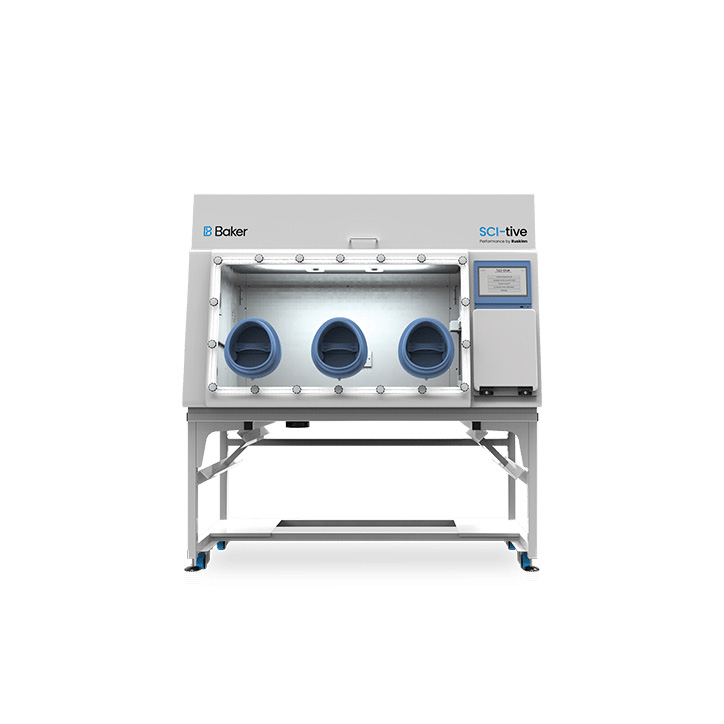
Baker Ruskinn SCI-tive Hypoxia Workstation (Single, Dual, Quad)
Quote
The Baker Ruskinn SCI-tive is an advanced “Lab in a Box” hypoxia workstation built for cell culture under physiological oxygen, part of the Baker Company laboratory equipment line distributed by ARES Scientific. By eliminating cellular stress linked to variations in temperature, pH, and oxidation, the SCI-tive helps yield better stem-cell lines and is widely used in cell-therapy, regenerative-medicine, and drug-discovery research.
Available in Single, Dual (symmetrical or asymmetrical), and Quad configurations, the SCI-tive provides a spacious, continuous controlled-oxygen environment from seeding through expansion, assay, and harvest. Its large interior accommodates analytical equipment such as inverted and atomic force microscopes, plate readers, cell-imaging systems, bioenergetics instruments, centrifuges, and bioprinters, so researchers no longer work on an open bench. It fits naturally alongside standard CO₂ incubators for cell culture and complements the broader laboratory incubator range in a physiological workflow.
The SCI-tive supports stem-cell, cancer, and physiological-oxygen research across life-science laboratory and research and vivarium programs that require in-vivo-like oxygen conditions with room for instrumentation inside the controlled atmosphere.
Description
Baker Ruskinn SCI-tive — Product Highlights
- Delivers physiological-oxygen cell culture in a closed environment that mimics in vivo conditions, helping produce healthier stem-cell lines beyond what conventional cell-culture CO₂ incubators allow.
- Provides a spacious “Lab in a Box” workspace that supports the full workflow from seeding through expansion, assay, and harvest without leaving the controlled atmosphere.
- Accommodates analytical instruments inside the chamber, including inverted and atomic force microscopes, plate readers, cell-imaging systems, bioenergetics platforms, centrifuges, and bioprinters.
- Scales across Single, Dual, and Quad configurations, with symmetrical and asymmetrical dual models and larger center chambers for bigger equipment.
- Offers independently controlled atmospheres in Dual and Quad models, letting researchers run different oxygen and CO₂ conditions side by side for comparative studies.
- Includes ultrasonic humidity control from ambient up to 85% relative humidity to protect cultures from drying and pH shifts.
- Supports cycle programming of up to four O₂ and CO₂ concentrations in a user-defined timed sequence for dynamic experimental protocols.
- Provides an optional Class 4 HEPA filtration system and an enhanced containment package for user protection, aligning with contamination control practices used with Baker biosafety cabinets.
- Features a removable front cover and pass-through interlock with its own temperature and oxygen control, and integrates with Baker ReCO2ver rapid-recovery incubators in physiological culture workflows.
- ARES Scientific is an authorized distributor for the Baker Company, ensuring genuine SCI-tive workstations with full manufacturer warranty.
Frequently Asked Questions — Baker Ruskinn SCI-tive
What is the SCI-tive hypoxia workstation used for?
The SCI-tive is used for cell culture under physiological oxygen, especially stem-cell, cell-therapy, regenerative-medicine, and drug-discovery research. Its closed, in-vivo-like environment reduces cellular stress from temperature, pH, and oxidation, and its large interior lets researchers run analytical instruments inside the controlled atmosphere.
What is the difference between SCI-tive Single, Dual, and Quad?
The SCI-tive Single provides one controlled-oxygen chamber, the Dual offers two independently controlled atmospheres in symmetrical or asymmetrical layouts, and the Quad provides four independently controlled chambers. Dual and Quad models allow different conditions to be run side by side and include larger chambers for bigger instruments such as microscopes.
How does the SCI-tive compare to a standard CO₂ incubator?
Unlike a standard CO₂ incubator, which leaves oxygen at atmospheric levels, the SCI-tive gives precise oxygen control plus a large enclosed workspace where cells can be handled and analyzed without exposure to ambient air. Labs often use it alongside conventional CO₂ incubators when physiological oxygen and in-atmosphere instrumentation are required.
Can the SCI-tive protect the user and the cultures?
The SCI-tive offers an optional HEPA filtration system that provides clean, Class 4 filtered air within the work area to protect cultures from contaminants, and an upgraded enhanced containment package that provides added protection for the user. These options can be selected based on the sensitivity of the work and facility requirements.
What instruments can be installed inside the SCI-tive?
The SCI-tive’s spacious interior accommodates a range of analytical equipment, including inverted and atomic force microscopes, plate readers, cell-imaging systems, bioenergetics instrumentation, centrifuges, and bioprinters. The asymmetrical Dual and the Quad’s center chambers are built to house larger instruments.
Technical Specifications — Baker Ruskinn SCI-tive Hypoxia Workstation
| Product type: | Advanced physiological-oxygen (hypoxia) cell culture workstation, “Lab in a Box” |
| Configurations: | Single; Dual (symmetrical or asymmetrical); Quad |
| Atmosphere control: | Precise, user-defined O₂ and CO₂ control; independently controlled atmospheres in Dual and Quad models |
| Cycle programming: | User-defined timed sequence of up to four O₂ and CO₂ concentrations |
| Humidity control: | Ultrasonic humidity control from ambient up to 85% RH |
| Filtration: | Optional HEPA filtration system providing Class 4 filtered air |
| User protection: | Optional enhanced containment package |
| Interlock: | Pass-through interlock with its own temperature and oxygen control |
| Work area: | Electrical power sockets within the work area; removable front cover for instrument placement and cleaning |
| Instrument compatibility: | Inverted and atomic force microscopes, plate readers, cell-imaging systems, bioenergetics instruments, centrifuges, bioprinters |
Related products

Consolidated Medium Lab Series Steam Sterilizers Single Chamber 24 Cu. Ft.
Quote• An intuitive user interface with modern, easy to view touchscreen display.
• Ability to program up to 50 sterilization cycles.
• Ability to favorite frequently used cycles for quick access.
• A controller platform ...

Baker BioPROtect ® III Class II Style Walk-In Clean Air and Containment Enclosures
Quote
Baker SterilGARD e3 SG304 3-Foot Class II Type A2 Biological Safety Cabinet
Quote
Follett Symphony Plus™ ice and water dispenser 12 CI series 12 lb capacity
Quote• Narrow, 16.12" (40.9 cm) width
• 12 lb (5.4 kg) ice storage capacity
• Integral air-cooled ice machine with up to 425 lb (193.0 kg) daily production of Chewblet ice
• soft, chewable, compressed nugget ice is preferred over cub...